

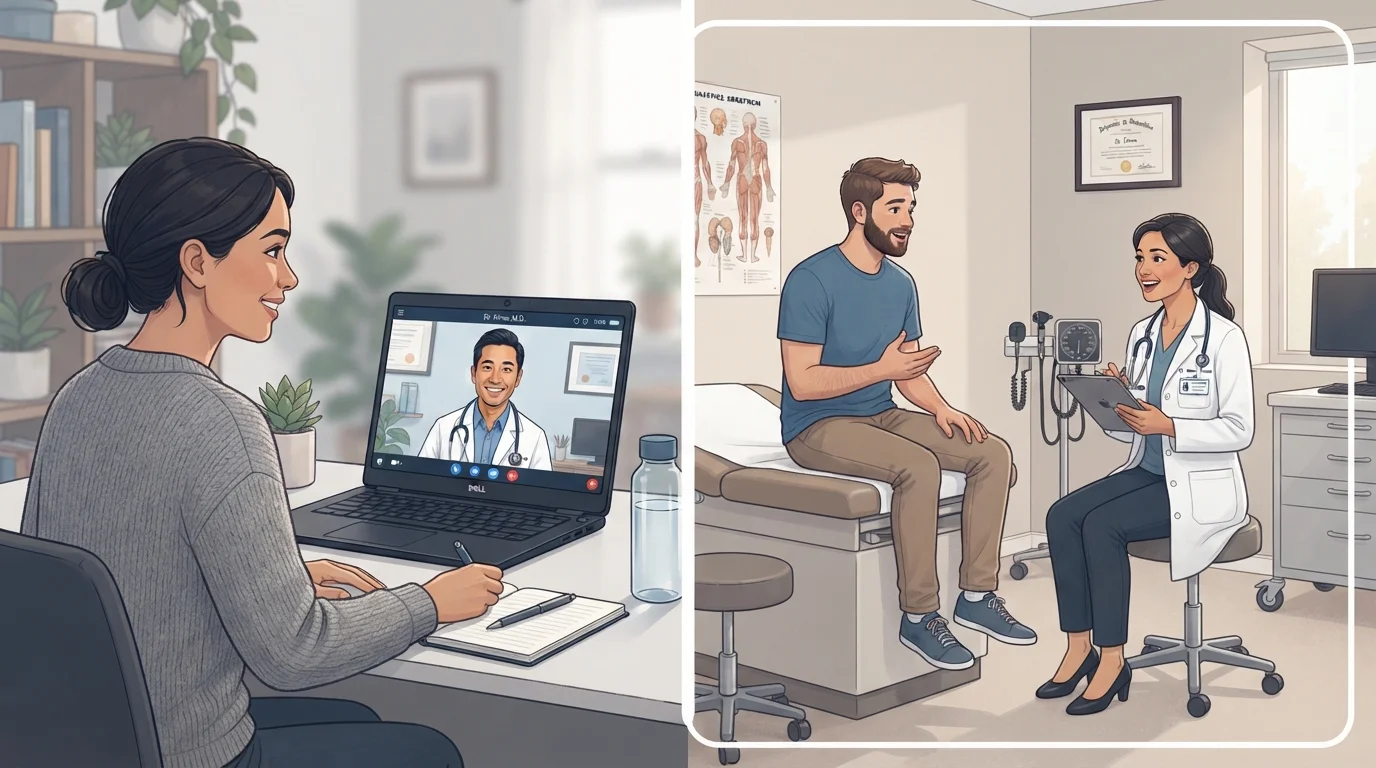
Key Takeaways
- Telemedicine is clinically appropriate for many routine and follow-up care scenarios.
- In-person visits remain essential when a physical examination or diagnostic test is required.
- Neither format is universally superior — the right choice depends on your specific health situation.
- Always consult a qualified healthcare professional to determine the appropriate care setting.
- Emergency symptoms should always prompt a call to 911 or a visit to an emergency room.
Option A
Telemedicine
The convenient, remote-first option for many everyday health needs.
Best for: Best for non-emergency concerns, follow-up appointments, prescription management, and mental health check-ins.
Option B
In-Person Visits
The comprehensive, hands-on standard for complex or physical concerns.
Best for: Best for new or unexplained symptoms, physical examinations, diagnostic testing, and urgent or serious conditions.
If you need a prescription refill or chronic condition check-in
Telemedicine
Routine management of stable chronic conditions and medication reviews are well-suited to virtual visits, reducing travel time without sacrificing care quality.
If you have a new, unexplained, or worsening symptom
In-Person Visits
Undiagnosed or changing symptoms typically require physical examination and may require on-site lab work or imaging that telemedicine cannot provide.
If you are managing mental health with an established provider
Telemedicine
Research supports telehealth as effective for ongoing therapy and psychiatric follow-ups, and it removes common access barriers like transportation.
If you need a physical, vaccine, or hands-on procedure
In-Person Visits
Annual physicals, vaccinations, wound care, and any procedure requiring physical contact cannot be safely or effectively conducted remotely.
If you live in a rural area with limited specialist access
Telemedicine
Telemedicine significantly expands access to specialists for patients in underserved areas, making care possible where it might otherwise be unavailable.
What Sets These Two Approaches Apart
Telemedicine refers to the delivery of clinical care through secure video, phone, or messaging platforms, allowing patients and providers to connect remotely. In-person visits, by contrast, bring the patient and clinician into the same physical space, enabling direct examination, immediate diagnostic testing, and hands-on procedures.
The core distinction is not convenience alone — it is clinical capability. A provider conducting a telemedicine visit cannot listen to your lungs with a stethoscope, palpate your abdomen, or perform a blood draw. That physical limitation matters enormously for certain presentations and is largely irrelevant for others.
For a fuller picture of how the two models compare across different patient scenarios, see how telehealth and face-to-face appointments differ for patients.
| Criterion | Telemedicine | In-Person Visits |
|---|---|---|
| Physical examination | Not possible | Full exam available |
| Diagnostic testing | Limited or unavailable | Labs, imaging, procedures available |
| Convenience | High — no travel required | Lower — travel and wait time |
| Suitable for emergencies | No | Yes (ER/urgent care) |
| Mental health follow-up | Generally effective | Effective, but less accessible |
| Chronic condition management | Often appropriate | Periodically required |
| New or unexplained symptoms | Often insufficient | Recommended |
| Access in rural areas | Significantly expands access | Limited by geography |
When Telemedicine Is Clinically Appropriate
Telemedicine performs well for a defined — and genuinely broad — set of health needs. These include follow-up appointments for stable chronic conditions such as hypertension or type 2 diabetes, mental health therapy sessions, dermatology consultations where photos can convey the clinical picture, and acute minor illnesses like urinary tract infections or seasonal allergies where a provider can assess symptoms verbally and review prior records.
Telehealth also removes meaningful barriers. Patients who face transportation challenges, work inflexible schedules, or live far from specialists can access care that would otherwise be out of reach. According to the Health Resources and Services Administration (HRSA), telehealth has been particularly effective at expanding access in rural and medically underserved communities.
Telemedicine Is Not a Replacement for All Care
Even when telemedicine is appropriate for your current concern, it works best as part of an ongoing relationship with a primary care provider who knows your full medical history. Virtual-only care without any in-person baseline can leave important clinical gaps. Patients with complex or multiple conditions should discuss with their provider how to balance both modalities effectively.
Before booking any virtual consultation, it is worth knowing what to look for. Our guide on evaluating a virtual health consultation covers credentials, privacy protections, and clinical scope to check in advance.
When an In-Person Visit Is the Right Call
In-person care becomes necessary — and sometimes urgent — when clinical decisions depend on direct physical assessment. New or unexplained chest pain, shortness of breath, neurological changes, or severe abdominal symptoms should not be triaged through a video screen. These require examination, and potentially immediate intervention.
Beyond emergencies, routine in-person care remains essential for annual wellness exams, vaccinations, Pap smears, blood pressure cuffs, cholesterol panels, and any diagnostic imaging. A clinician who cannot physically examine you is working with fundamentally incomplete information for these purposes.
Knowing which setting matches your situation is also a matter of choosing the right venue. For a practical breakdown of when urgent care, the emergency room, or a primary care provider is most appropriate, see our guide on matching your situation to the right care setting.
37%
US adults who used telehealth in the past year
According to the CDC's National Center for Health Statistics, telehealth use has remained substantially elevated compared to pre-pandemic baselines.
2x
Likelihood of telehealth use in rural vs. urban areas for certain specialties
HRSA data indicates telemedicine has roughly doubled specialist access rates in rural communities where in-person options are scarce.
Making an Informed Decision for Your Health
Choosing between telemedicine and in-person care is not simply a matter of preference — it is a clinical judgment best made in partnership with your provider. If you are unsure which format is appropriate for your concern, calling your provider's office to describe your symptoms is a reasonable first step. Most practices can help triage which format fits.
Patients managing ongoing conditions can also benefit from understanding the broader landscape of digital health options. Our overview of telehealth platforms and digital healthcare pathways explains how different services differ in scope and purpose.
It is equally worth understanding common misconceptions about online medical advice before relying on any digital health resource. Our piece on myths about online medical advice addresses the most persistent errors in judgment that can lead patients astray.
This article is intended for general informational purposes only and does not constitute medical advice. Always consult a qualified healthcare professional regarding your specific symptoms, diagnosis, or treatment options. In a medical emergency, call 911 or go to your nearest emergency room immediately.