

Key Takeaways
- Telehealth is appropriate for many routine, follow-up, and mental health visits but cannot replace physical examination.
- In-person care remains essential when a clinician needs to observe, touch, or test beyond what a camera can capture.
- Both formats are bound by the same professional and ethical standards — clinician quality matters regardless of the setting.
- Your medical history and ability to describe symptoms clearly are critical in both consultation types.
- Choosing the right format can reduce delays, costs, and unnecessary in-person trips when used appropriately.
Option A
Telehealth Consultation
The flexible, accessible option for many routine care needs.
Best for: Adults managing stable, well-documented conditions or seeking care for straightforward concerns without leaving home.
Option B
In-Person Consultation
The comprehensive, hands-on standard for complex or physical assessment.
Best for: Situations requiring physical examination, diagnostic testing, or evaluation of new, ambiguous, or urgent symptoms.
If you need a prescription refill or routine follow-up for a known condition
Telehealth Consultation
Stable, documented conditions with no new physical symptoms are well-suited for virtual review, saving time without compromising care quality.
If you have new, unexplained, or worsening physical symptoms
In-Person Consultation
New or ambiguous symptoms often require physical examination or diagnostic tests that telehealth simply cannot provide.
If you are managing anxiety, depression, or other mental health concerns
Telehealth Consultation
Research supports video-based therapy and psychiatric consultations as comparably effective to in-person sessions for many mental health conditions.
If you require hands-on procedures, imaging, or lab work
In-Person Consultation
Blood draws, X-rays, wound care, and physical assessments fundamentally require the clinician and patient to be in the same space.
If you have limited mobility or live in a rural area with limited clinic access
Telehealth Consultation
Telehealth significantly reduces access barriers for patients who face transportation, geographic, or physical mobility challenges.
What Telehealth Actually Changes
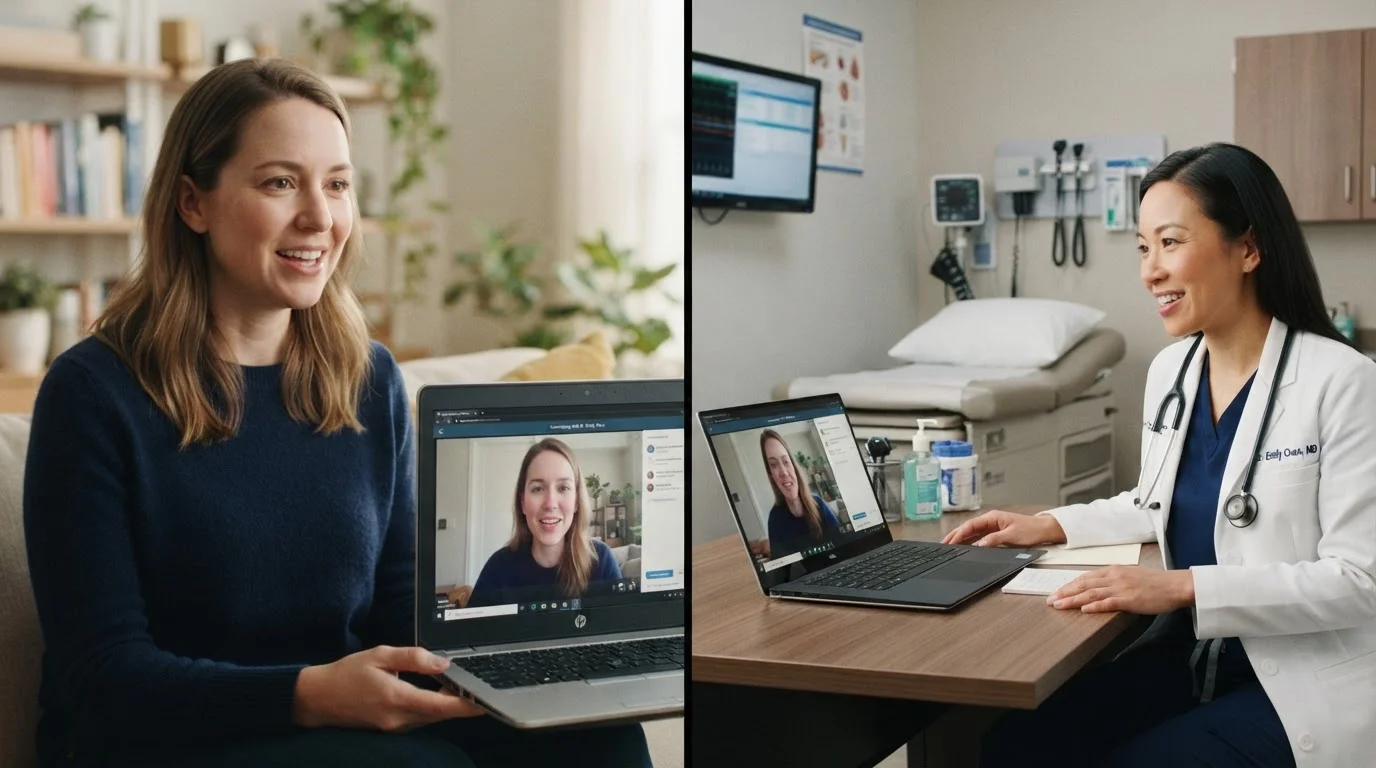
Telehealth — video, phone, or messaging-based consultations with a licensed clinician — has expanded dramatically over the past several years. For many adults, it has removed real barriers: long commutes, waiting rooms, time off work, and geographic distance from specialists.
What genuinely changes with telehealth is the logistics of access. You can connect with a clinician from home, often with shorter scheduling waits. This is particularly valuable for follow-up appointments, medication management, and initial screenings where a detailed conversation is the primary clinical tool. Mental health care has seen especially strong outcomes through telehealth; many patients report comparable satisfaction to in-person therapy when the relationship and continuity of care are maintained.
However, the shift to a screen imposes real clinical limits. A clinician cannot auscultate (listen to) your lungs, palpate your abdomen, examine a rash under proper lighting, or take your blood pressure through a camera. These aren't minor omissions — they are core diagnostic tools. For this reason, telehealth works best when the concern is well-defined, the history is known, or the visit is explicitly conversational in nature.
For a broader overview of navigating digital health safely, see our complete guide to online health advice.
| Criterion | Telehealth | In-Person |
|---|---|---|
| Physical examination | Not possible | Fully available |
| Access & convenience | High — no travel required | Varies by location and mobility |
| Diagnostic testing | Cannot be performed on-site | Labs, imaging available on referral |
| Mental health care | Comparable effectiveness for many conditions | Established standard of care |
| Follow-up & medication management | Well-suited | Effective but may be unnecessary |
| New or complex symptoms | Limited — risk of incomplete assessment | Preferred setting |
| Privacy & data standards | Regulated (HIPAA applies) | Regulated (HIPAA applies) |
| Wait times | Often shorter | Typically longer |
What Stays the Same — and Why It Matters
A common misconception is that telehealth is a lower-stakes or less rigorous form of care. In practice, licensed clinicians conducting telehealth visits are held to the same professional, ethical, and legal standards as in-person providers. Your right to informed consent, privacy protections, and a thorough clinical assessment applies equally in both settings.
Your role as a patient also doesn't change. Arriving — virtually or physically — with a clear account of your symptoms, their timeline, and any relevant history remains the most important thing you can do. Clinicians in both settings depend on what you report. If you tend to leave appointments feeling unheard, read about common communication patterns that leave patients without answers — the strategies apply regardless of format.
Continuity of care also matters equally in both models. A telehealth provider who has access to your full medical record and history can deliver meaningfully better care than a rushed in-person encounter with a clinician who has never seen you before. The format is secondary to the quality of the clinical relationship and information exchange.
37%
U.S. adults who used telehealth in the past year
According to CDC National Center for Health Statistics data, telehealth adoption has remained significantly elevated since 2020.
~80%
Telehealth users reporting satisfactory care experiences
Multiple health system surveys have found high patient satisfaction with telehealth for appropriate visit types, particularly follow-up and behavioral health.
This article provides general health information for educational purposes only and is not a substitute for professional medical advice, diagnosis, or treatment. Always consult a qualified healthcare provider regarding your individual health needs.