

Key Takeaways
- Aerobic metabolism uses oxygen and is the primary energy source for sustained, moderate-intensity activity.
- Anaerobic metabolism kicks in during high-intensity efforts when oxygen delivery can't keep pace with demand.
- Both energy systems are always active — the ratio shifts based on exercise intensity.
- Mitochondria, the cell's energy-producing organelles, are central to aerobic capacity.
- Training improves the efficiency and capacity of both systems over time.
- You don't need to choose one system — most forms of exercise engage both to varying degrees.
Aerobic vs. Anaerobic Exercise
Aerobic exercise uses oxygen to produce energy, allowing you to sustain activity for longer periods. Anaerobic exercise relies on energy stores already inside your muscle cells — no oxygen required — and is used for short, intense bursts of effort. Both systems coexist in your body and activate to different degrees depending on the intensity and duration of your movement.
The crossover point where anaerobic metabolism dominates is often referred to as the lactate threshold — the intensity at which lactate accumulates faster than your body can clear it.
Where Your Energy Actually Comes From
Every time your muscles contract — whether you're strolling to the mailbox or sprinting to catch a bus — your cells need a molecule called ATP (adenosine triphosphate). ATP is essentially the universal energy currency of the body. The question is: how does your body make it, and how fast?
Your cells have two main strategies, and which one dominates depends almost entirely on how hard you're working:
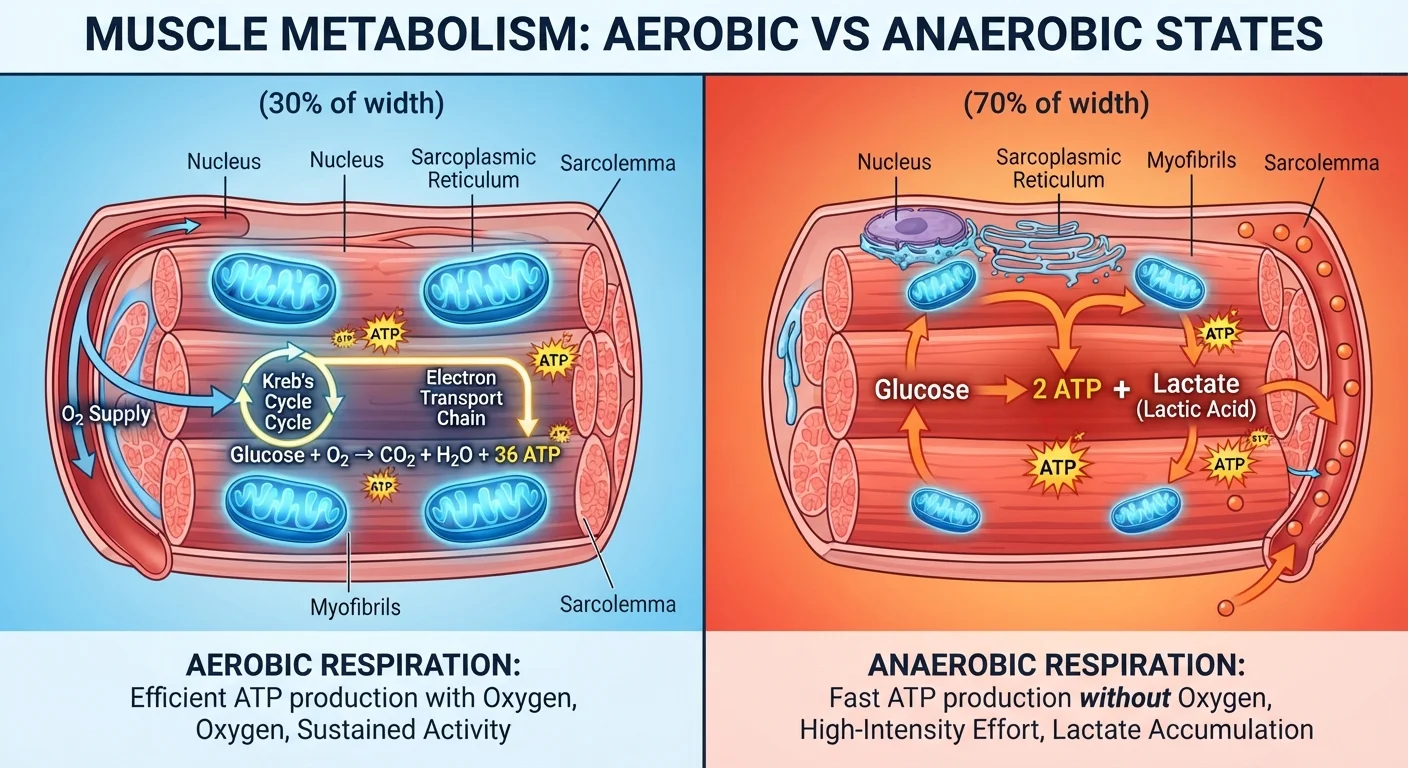
- Aerobic metabolism: Uses oxygen to break down carbohydrates and fats into ATP. This is a relatively slow process but incredibly efficient — it yields roughly 30–32 ATP molecules per glucose molecule.
- Anaerobic metabolism: Produces ATP without oxygen, drawing on glucose stored in muscles (glycogen) through a process called glycolysis. It's fast but inefficient, yielding only about 2 ATP per glucose — and produces lactate as a byproduct.
For a deeper look at how exercise is defined in the first place, see what exercise actually means.
~30–32 ATP
ATP produced per glucose molecule aerobically
Aerobic metabolism is dramatically more efficient than anaerobic glycolysis, which yields roughly 2 ATP per glucose molecule.
2–3x
Increase in mitochondrial density with aerobic training
Research in exercise physiology consistently shows endurance training can significantly increase mitochondrial volume within skeletal muscle cells.
~10 seconds
Duration of maximal anaerobic power output
The phosphocreatine system — the fastest anaerobic pathway — can sustain all-out effort for roughly 10 seconds before glycolysis must take over.
What Happens Inside the Muscle Cell
The aerobic pathway takes place primarily inside the mitochondria — tiny organelles found in every cell, often called the cell's power plants. During sustained, moderate exercise, oxygen arrives via the bloodstream, enters the mitochondria, and drives a chemical sequence (the Krebs cycle and oxidative phosphorylation) that generates ATP in large quantities.
When you ramp up intensity beyond what oxygen delivery can support, your cells shift toward anaerobic glycolysis. Glucose is broken down rapidly in the cell's cytoplasm, producing ATP almost instantly. Lactate is generated as a result. Contrary to popular belief, lactate itself is not the cause of the burning sensation during intense effort — that burning comes largely from hydrogen ion accumulation, which accompanies rapid glycolysis.
It's important to understand that these systems are not on-off switches. Even at rest, your body uses a blend of aerobic pathways. As intensity climbs, the anaerobic contribution grows. Most real-world activities — a game of recreational basketball, a cycling class, a hike with elevation changes — engage both systems throughout.
“The mitochondrion is not merely a power plant. It is a dynamic organelle that remodels itself in response to the metabolic demands placed on the cell — including the demands of physical training.”
— David Hood, Professor of Exercise Physiology, York University — paraphrasing published research on mitochondrial biogenesis
How Training Changes These Systems
One of the most well-established principles in exercise science is that training makes both systems more efficient. Here's what the evidence shows:
Aerobic Training Adaptations
- Increased mitochondrial density — more power plants per muscle cell
- Greater capillary networks in muscle tissue, improving oxygen delivery
- A higher lactate threshold, allowing you to sustain harder efforts aerobically
- Improved fat oxidation, sparing glycogen for when you really need it
Anaerobic Training Adaptations
- Greater glycolytic enzyme activity — faster ATP production from glucose
- Increased muscle fiber size and recruitment capacity
- Improved buffering of hydrogen ions, delaying fatigue during intense efforts
- Enhanced neuromuscular coordination for explosive movements
These adaptations don't compete — they complement each other. A well-rounded fitness routine stimulates both. For definitions of terms like VO2 max, glycolysis, and more, our exercise science glossary is a useful starting point.
Putting It Into Practice
Understanding these systems helps you make sense of why different types of exercise feel different — and what you're actually training when you choose one over another.
Steady-state jogging, cycling, or swimming at a conversational pace primarily develops your aerobic system. Sprint intervals, heavy resistance training, and plyometrics challenge your anaerobic capacity. Neither is inherently superior for overall health — they target different physiological qualities.
If you're also wondering whether the impact level of your exercise matters, that's a separate but related question. Low-impact vs. high-impact exercise is about joint stress, not which energy system you're using.
A practical starting point for most adults is to build an aerobic foundation first — it supports recovery, cardiovascular health, and your capacity to handle more intense work later. Anaerobic efforts can then be layered in progressively as fitness improves.
This article is for general informational and educational purposes only and is not a substitute for professional medical or fitness advice. Consult a qualified healthcare provider before beginning any new exercise program, especially if you have existing health conditions.