
Urgent Care, Emergency Room, or GP: Matching Your Situation to the Right Setting

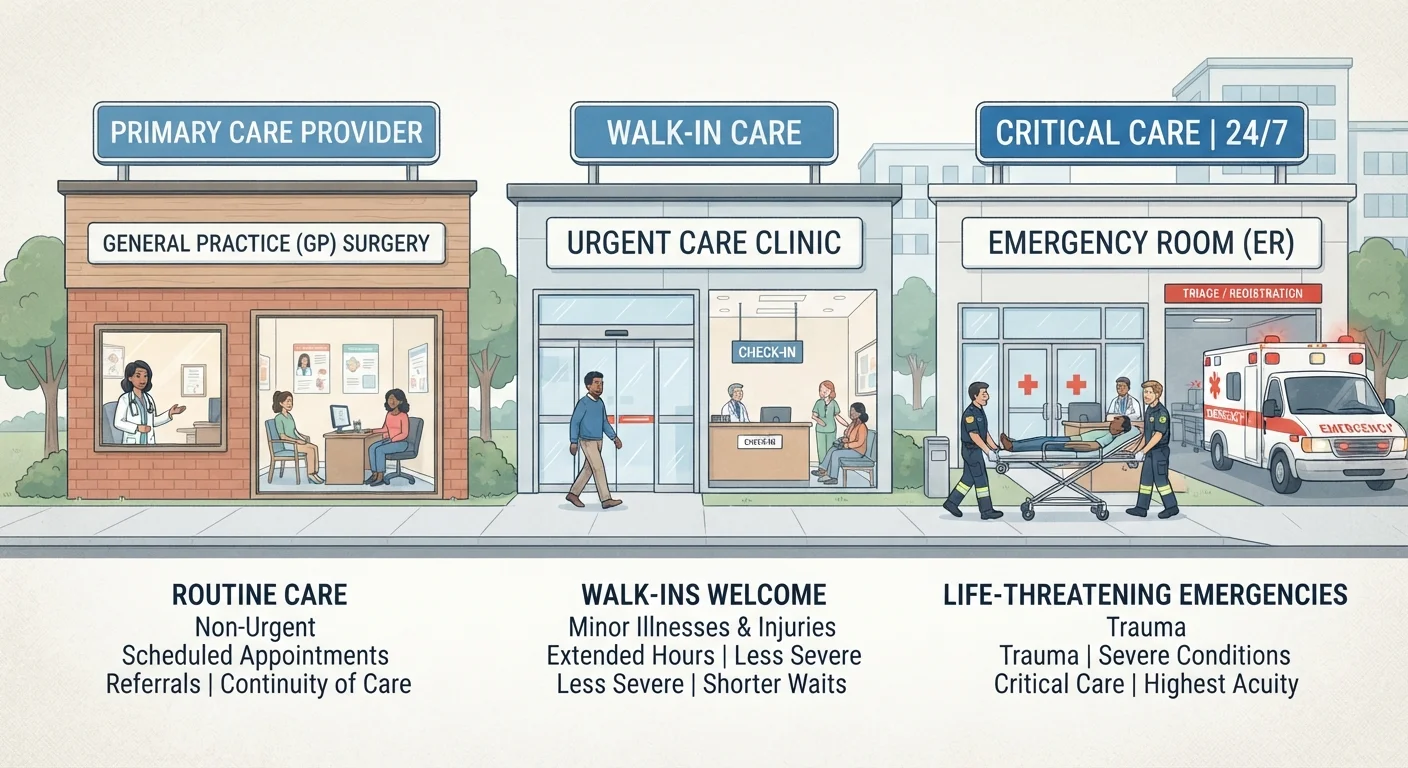
Key Takeaways
- Emergency rooms are for life-threatening or severely deteriorating conditions only — not convenience.
- Urgent care centers fill the gap between GP offices and ERs for same-day, non-life-threatening issues.
- Your primary care physician (GP) remains the best starting point for ongoing, chronic, and preventive health concerns.
- Calling your GP's after-hours line before heading anywhere can often clarify the right next step.
- Choosing the wrong setting can mean longer waits, higher costs, and less continuity of care.
Our Verdict
No single care setting suits every situation. Emergency rooms excel at stabilizing life-threatening conditions; urgent care handles same-day issues that can't wait for a scheduled visit; and your GP remains the cornerstone of ongoing health management. Matching your symptoms to the right setting leads to faster, more appropriate, and more cost-effective care.
| Best for | Recommended |
|---|---|
| Life-threatening symptoms such as chest pain, stroke signs, or severe injury | Emergency Room (ER) |
| Acute but non-life-threatening issues requiring same-day attention | Urgent Care Center |
| Chronic condition management, mental health concerns, and preventive care | Primary Care Physician (GP) |
| Minor issues or initial triage when unsure which setting to use | GP After-Hours Line or Telemedicine |
Why the Right Setting Matters
When you're unwell, the instinct to go somewhere — anywhere — for help is completely natural. But not every health concern belongs in an emergency room, and not every situation can wait three weeks for a GP appointment. Choosing poorly costs more than just time: ERs are significantly more expensive than urgent care or primary care visits, and misuse strains resources for patients who genuinely need emergency services.
Understanding the role of each setting helps you act decisively and appropriately. This article is general health information intended to help you navigate common situations — it is not a substitute for professional medical advice. When in doubt, call a healthcare professional or emergency services.
For a broader overview of navigating medical appointments, see our complete guide to seeing a doctor.
Comparing the Three Settings
Each care setting is designed for a distinct type of need. The table below summarizes how they differ across the criteria most relevant to everyday health decisions.
| Emergency Room (ER) | Urgent Care Center | Primary Care (GP) | |
|---|---|---|---|
| Intended for | Life-threatening conditions | Acute, non-life-threatening issues | Ongoing and preventive care |
| Availability | 24/7, always open | Extended hours, walk-in | Scheduled appointments, limited same-day |
| Wait times | Can be very long (triaged by severity) | Generally shorter | Depends on appointment availability |
| Typical cost (out-of-pocket) | Highest | Moderate | Lowest |
| Continuity of care | None — one-time encounter | Limited — sends notes to GP | Full — knows your history |
| Equipment and specialists | Full diagnostics, surgery, ICU | X-ray, basic labs, wound care | Basic diagnostics, referrals |
One key distinction worth emphasizing: urgency is not the same as severity. A painful kidney stone is urgent and extremely uncomfortable, but it's usually not immediately life-threatening. A mild-seeming stroke, by contrast, can be catastrophic if treatment is delayed even by minutes.
When to Go to the Emergency Room
The ER is staffed and equipped for emergencies that could result in death or permanent disability without immediate intervention. Go directly to the ER — or call 911 — for:
- Chest pain, pressure, or tightness (possible heart attack)
- Sudden facial drooping, arm weakness, or slurred speech (stroke warning signs)
- Difficulty breathing or shortness of breath at rest
- Severe allergic reactions (anaphylaxis), including throat swelling
- Uncontrolled bleeding or major trauma
- Loss of consciousness or sudden severe confusion
- Suspected poisoning or overdose
- Seizures with no prior diagnosis
The CDC notes that recognizing stroke warning signs — using the acronym FAST (Face drooping, Arm weakness, Speech difficulty, Time to call 911) — and acting immediately is critical because every minute without treatment increases brain damage risk.
Don't Drive Yourself in a True Emergency
If you or someone with you is experiencing symptoms of a heart attack, stroke, severe allergic reaction, or loss of consciousness, call 911 rather than driving to the ER. Emergency medical technicians (EMTs) can begin treatment en route and alert the hospital, which can significantly affect outcomes. Every minute counts in these situations.
When Urgent Care Is the Right Call
Urgent care centers bridge a critical gap: they accept walk-ins, are typically open evenings and weekends, and can handle conditions that genuinely cannot wait for a scheduled GP visit but don't require emergency-level resources. Appropriate urgent care situations include:
- Minor cuts requiring stitches or wound care
- Sprains, strains, and suspected minor fractures
- Urinary tract infections (UTIs)
- Moderate flu symptoms, ear pain, or sore throat
- Eye irritation or mild eye infections
- Minor burns or rashes
- High fever in adults without other severe symptoms
Urgent care is generally faster and less expensive than an ER visit for these concerns. It is not a substitute for your regular physician when it comes to managing ongoing conditions or medication adjustments — those conversations belong with your GP.
When to See Your GP (Primary Care Physician)
Your primary care physician is the cornerstone of your long-term health. GPs are best suited for:
- Routine checkups, screenings, and vaccinations
- Management of chronic conditions such as diabetes, hypertension, or asthma — see the chronic conditions hub for related guidance
- Mental health concerns, including anxiety and depression — your GP is often a good first contact, as explored in what to expect when raising mental health with your GP
- Medication reviews, referrals, and follow-up care
- Symptoms that are concerning but not acute — persistent fatigue, unexplained weight changes, or digestive issues that aren't worsening rapidly (see when gut symptoms warrant a doctor's visit)
GP appointments are often brief, so preparation matters. Making the most of a short doctor's appointment offers practical steps to communicate effectively and leave with answers.
Use Your GP's After-Hours Line First
Many primary care practices offer after-hours nurse lines or on-call physicians. Before heading to urgent care or the ER, a quick call can help you triage your situation accurately. You may be advised to wait for a morning appointment, go to urgent care, or proceed straight to the ER — saving both time and money. Telemedicine is another option worth considering; understanding when virtual consultations are appropriate can help you decide.
This article provides general health information only and is not intended as medical advice. Always consult a qualified healthcare professional for guidance specific to your health situation. In an emergency, call 911 immediately.