

Key Takeaways
- Turmeric contains an active compound called curcumin, which has been studied for anti-inflammatory properties.
- Curcumin is poorly absorbed on its own — pairing it with black pepper may improve bioavailability.
- Traditional medicine systems have used turmeric for centuries, but clinical evidence in humans remains limited.
- Turmeric at culinary doses is generally considered safe; high-dose supplements carry real risks.
- Turmeric is not a substitute for prescribed medical treatment or professional medical advice.
Turmeric's Long History as a Healing Spice
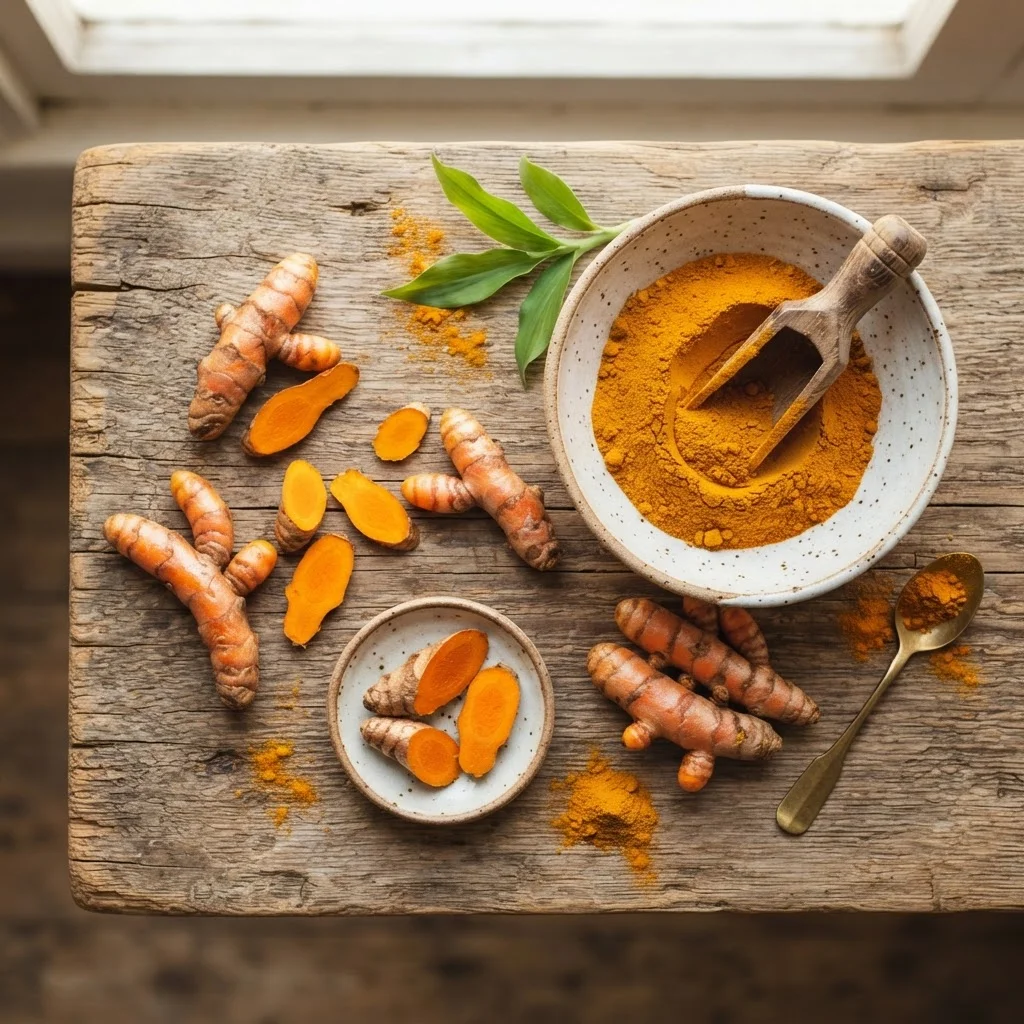
Turmeric (Curcuma longa) is a flowering plant in the ginger family, and its bright orange-yellow rhizome has been ground into powder for both cooking and medicinal use for at least 4,000 years. In Ayurvedic medicine — a traditional healing system originating in the Indian subcontinent — turmeric was prescribed for a wide range of conditions, from digestive complaints and skin problems to joint pain and respiratory issues. Traditional Chinese medicine similarly incorporated turmeric to support circulation and relieve discomfort.
This dual role as a culinary and medicinal ingredient is something turmeric shares with several other pantry staples. Our overview of kitchen remedies across cultures puts turmeric's historical use in a helpful global context. And if you're curious how it compares to a close botanical relative, see our piece on ginger's traditional and culinary uses.
The point isn't that ancient use automatically validates a remedy — it doesn't. But a long documented history of use does give researchers a starting point for asking scientific questions. That's exactly what has happened with turmeric over the past few decades.
What the Science Actually Says About Curcumin
Most of turmeric's studied health properties are attributed to curcumin, a class of compounds called curcuminoids that give the spice its distinctive color. Laboratory and animal studies have shown curcumin can influence inflammatory pathways, act as an antioxidant, and interact with a number of biological processes. These findings have generated significant scientific interest.
However, translating that promise into proven human health benefits has proven difficult. One major obstacle is bioavailability — how well the body actually absorbs and uses a substance. Curcumin on its own is poorly absorbed in the digestive tract. Research suggests that piperine, a compound in black pepper, may significantly enhance curcumin absorption, which is one reason traditional recipes often combine the two spices. For a deeper look at how whole turmeric and isolated curcumin differ in practice, see our explainer on the difference between turmeric and curcumin.
2–5%
Curcumin content in dried turmeric powder
Analytical chemistry studies consistently find curcuminoids make up a small fraction of turmeric by dry weight, limiting what culinary amounts can deliver.
~2,000+
Published studies on curcumin in research databases
A search of the National Institutes of Health's PubMed database returns thousands of curcumin-related studies, reflecting significant scientific interest — though most are preclinical.
Human clinical trials on curcumin have produced mixed results. Some small studies suggest modest benefits for markers of inflammation, and there is limited evidence for symptom relief in conditions like osteoarthritis. But most researchers note that trial sizes are small, methodologies vary, and results haven't been consistently replicated at scale. The evidence base is still developing — and that distinction matters.
Common Myths About Turmeric, Corrected
Because turmeric has such a compelling traditional background and generates regular headlines, it has also accumulated a fair share of popular misconceptions. The myth-fact pairs below address some of the most widely repeated claims.
Myth
Turmeric is a proven cure for inflammation and can replace anti-inflammatory medications.
Fact
Curcumin shows anti-inflammatory activity in lab settings, but clinical evidence in humans is preliminary and does not support replacing prescribed treatments.
Laboratory studies have documented curcumin's ability to inhibit certain inflammatory molecules, which is why this claim gained traction. But showing an effect in a petri dish or animal model is a very early step. Human trials have been smaller, shorter, and less consistent in their findings. No regulatory body has approved curcumin as a treatment for any inflammatory condition, and stopping or substituting prescribed medication without medical supervision carries real risks.
Myth
Eating more turmeric in food gives you the same benefit as a curcumin supplement.
Fact
Turmeric spice contains roughly 2–5% curcumin by weight, a fraction of the amounts used in most research studies, so culinary use and supplement use are not equivalent.
A teaspoon of turmeric powder provides a small amount of curcumin — far less than the doses examined in clinical research. This doesn't mean culinary use is without value; it simply means the two aren't interchangeable. If you've seen claims that a daily golden latte delivers therapeutic doses of curcumin, those claims are generally not supported by the math or the evidence. The distinction between turmeric and curcumin is worth understanding before drawing conclusions about either.
Myth
Turmeric supplements are completely safe because turmeric is a natural food ingredient.
Fact
High-dose turmeric and curcumin supplements have been linked to liver injury in rare cases and can interact with certain medications.
"Natural" does not automatically mean risk-free at any dose. Case reports in medical literature have documented rare but serious liver injury associated with concentrated turmeric or curcumin supplements. Additionally, curcumin can interact with blood-thinning medications, certain chemotherapy drugs, and diabetes medications. These risks are not present at normal culinary amounts but become relevant at the doses found in many commercial supplements. Always disclose supplement use to your healthcare provider.
Myth
Turmeric can prevent or treat cancer.
Fact
Preclinical research has explored curcumin's effects on cancer cells in the lab, but there is no established clinical evidence that turmeric prevents or treats cancer in humans.
Some laboratory and animal studies have examined how curcumin interacts with cancer cell lines, and those findings have attracted scientific curiosity. However, the leap from lab findings to human benefit is large, and no clinical evidence currently supports using turmeric as a cancer prevention or treatment strategy. Making or following such claims could lead people to delay or avoid treatments that do have established efficacy — a serious potential harm. Medical oncologists are the appropriate resource for cancer-related decisions.
Myth
Turmeric has no real medicinal basis — it's just a cooking spice with marketing hype.
Fact
Turmeric has a well-documented traditional medicinal history, and curcumin is a legitimate subject of ongoing scientific research, even if the current evidence is limited.
Dismissing turmeric entirely is as inaccurate as overclaiming its benefits. Ayurvedic and traditional Chinese medicine systems documented turmeric's uses over millennia, and modern science has found plausible biological mechanisms worth investigating. The honest position is that the evidence is promising but incomplete. Spices like turmeric, cinnamon, cloves, and cardamom all carry genuine historical medicinal roles that researchers continue to explore — cautiously and carefully.
Practical Guidance and When to Consult a Professional
Using turmeric as a culinary spice — in curries, soups, warm drinks, or rice dishes — is generally considered safe for most healthy adults and is consistent with both its traditional role and its nutritional profile. That everyday, food-based use is very different from taking high-concentration curcumin supplements.
High-Dose Supplements Are Not the Same as Cooking with Turmeric
Concentrated curcumin supplements can deliver doses far exceeding what any culinary use provides. Rare but documented cases of liver injury have been associated with high-dose turmeric supplements. If you're considering a turmeric supplement rather than using the spice in cooking, discuss it with your doctor or pharmacist first — particularly if you take any regular medications.
People who are pregnant, breastfeeding, managing gallbladder disease, or taking blood thinners or diabetes medications should speak with a healthcare provider before adding turmeric supplements to their routine, as interactions and contraindications are documented. The same applies to anyone managing a chronic health condition. For comparison, ginger's safety profile follows a similar pattern — beneficial at culinary amounts, more complex at supplement doses.
Turmeric is a valuable part of culinary and herbal traditions worldwide, and emerging research continues to explore its properties. But it is general wellness information, not a treatment plan. If you have a specific health concern, a qualified healthcare professional is always the right first call.
This article is for informational purposes only and does not constitute medical advice. Always consult a qualified healthcare provider for personal health decisions.