

Key Takeaways
- Ginger has been used medicinally for over 2,000 years across multiple cultures worldwide.
- The strongest evidence supports ginger's role in reducing certain types of nausea.
- Anti-inflammatory effects are promising in early research but not yet fully established in humans.
- Fresh, dried, and supplemental ginger have different compound profiles and may behave differently.
- Ginger is generally well tolerated but can interact with some medications, including blood thinners.
- Always consult a healthcare provider before using ginger supplements for a specific health condition.
Ginger (Zingiber officinale)
Ginger is a flowering plant whose underground stem, called a rhizome, is used both as a culinary spice and a traditional remedy. It has a sharp, warming flavor that comes from naturally occurring compounds, particularly gingerols in fresh root and shogaols in dried or cooked forms. For thousands of years, cultures across Asia, the Middle East, and Africa have used it to ease nausea, support digestion, and address inflammation.
Gingerols are the primary bioactive compounds in fresh ginger; heat and drying convert them into shogaols, which may have different potency profiles in the body.
A Root With a Long Resume
Long before ginger appeared in grocery stores, it was traveling trade routes. Historical records from India, China, and ancient Greece document ginger's use as both food and medicine stretching back more than two millennia. It features in Ayurvedic texts as a digestive aid, in Traditional Chinese Medicine for warming the body, and in medieval European herbalism as a stomach soother.
Today, ginger sits comfortably in both the spice rack and the supplement aisle — which is part of what makes it worth understanding clearly. Its dual identity as pantry staple and home remedy is not a modern marketing invention. It reflects a genuinely long relationship between this root and human health. For a broader view of how other common spices share this history, see the medicinal history of everyday spices.
“Ginger occupies a unique position in the pharmacopeia of virtually every traditional medicine system on earth. That kind of cross-cultural convergence around a single plant ingredient is worth taking seriously — even as we apply modern scientific standards to evaluate it.”
— Dr. Tieraona Low Dog, Integrative medicine physician and author specializing in botanical medicine
What Makes Ginger Work
Ginger's distinct bite comes from a family of bioactive compounds. In fresh root, gingerols are the dominant players. When ginger is dried or cooked, gingerols convert into shogaols, which some researchers consider even more potent in certain applications. A third compound, paradol, also appears in processed ginger.
These compounds interact with digestive and inflammatory pathways in the body, which is why ginger's traditional uses cluster around stomach complaints and pain. However, understanding that a compound can affect a biological pathway in a lab is different from proving it reliably produces a health outcome in people — an important distinction often lost in popular coverage of ginger research.
2,000+
Years of documented ginger use in medicine
Historical records from Ayurvedic, Chinese, and Greco-Roman traditions document ginger's medicinal use spanning more than two millennia.
~1–1.5g
Daily dose used in most nausea research
Many clinical trials studying ginger for nausea used approximately 1 to 1.5 grams of ginger daily, typically in divided doses — context for comparing food vs. supplement amounts.
12+
Systematic reviews examining ginger for nausea
Multiple systematic reviews and meta-analyses have assessed ginger's effect on nausea, with the most consistent findings in pregnancy-related morning sickness.
Where the Evidence Is Strongest: Nausea
Of all ginger's proposed benefits, its effect on nausea has the most consistent research backing. Multiple clinical trials have examined ginger for pregnancy-related morning sickness, and several systematic reviews conclude it modestly reduces nausea severity compared to placebo. The effect appears most reliable in the first trimester.
Evidence for chemotherapy-induced nausea is more mixed — some trials show benefit, others do not — but ginger is increasingly discussed as a complementary option alongside standard antiemetic medications, not as a replacement for them. Motion sickness evidence remains less conclusive.
If you want a deeper dive into what the studies actually show, ginger for nausea: what the science actually says breaks down the research in plain terms.
Note: Pregnant individuals should consult a healthcare provider before using ginger supplements, even though culinary amounts are generally regarded as safe.
Digestion and Inflammation: Promising but Preliminary
Ginger has long been used for bloating, indigestion, and slow gastric emptying — the feeling that food just sits in the stomach. Some small clinical studies suggest ginger may speed gastric emptying, which could explain its traditional use after heavy meals. The effect sizes observed are modest, and larger trials are needed to draw firm conclusions.
On inflammation, the picture is similarly cautious. Laboratory studies demonstrate that ginger compounds can inhibit certain inflammatory enzymes, similar in mechanism to some nonsteroidal anti-inflammatory drugs. A handful of small human trials have explored ginger for conditions like osteoarthritis with mildly encouraging results. But this research is early-stage, and ginger should not be positioned as a treatment for inflammatory disease. Compare this to what the evidence shows for turmeric, another root with a similar gap between laboratory findings and clinical proof.
Making Ginger Tea at Home
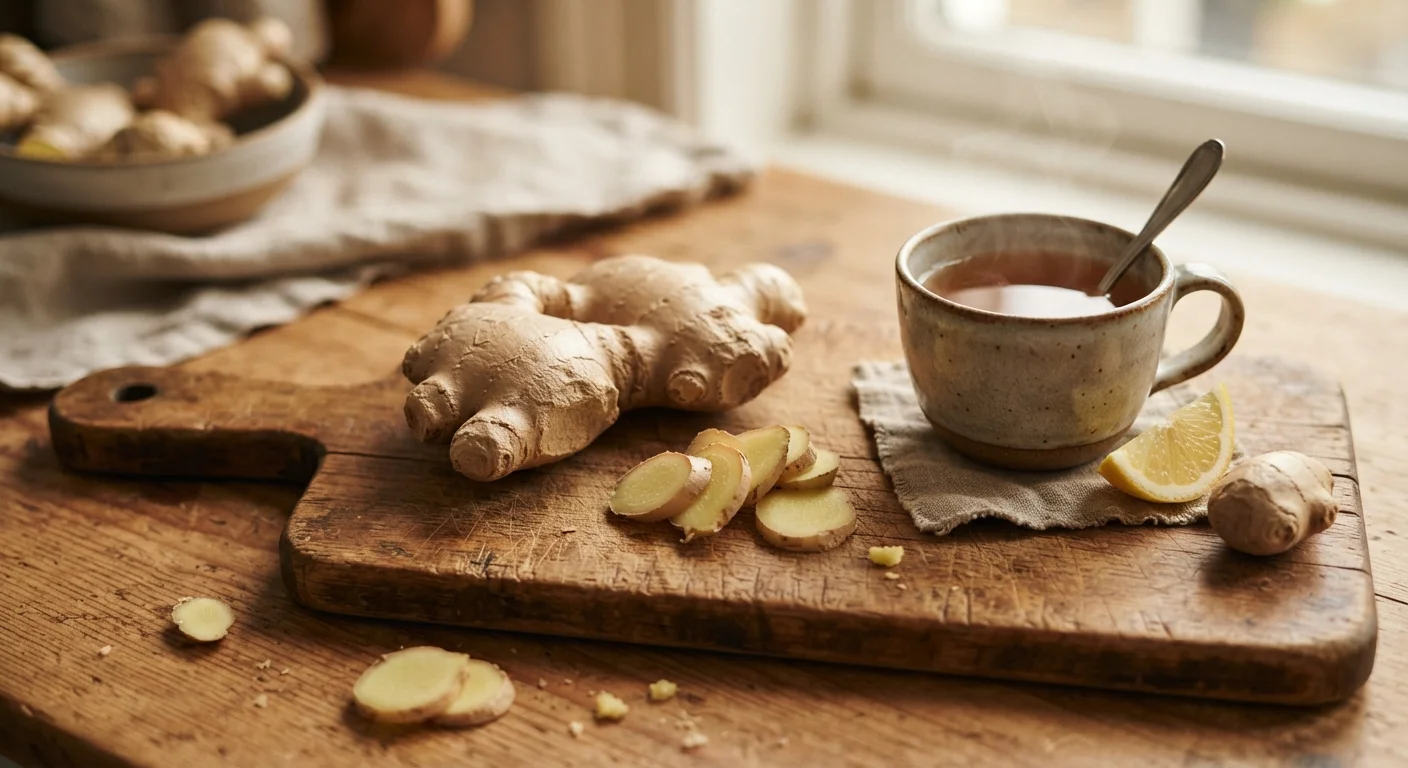
To make a simple ginger infusion, peel and thinly slice about one inch of fresh ginger root and steep it in hot water for 10 minutes. Strain and drink plain or with a small amount of honey and lemon. This method delivers the root's natural compounds without the concentrated doses found in supplements, making it a gentler starting point for most people.
Using Ginger Safely at Home
For most healthy adults, ginger in food amounts — fresh slices, powdered spice, ginger tea made from real root — carries a low risk profile. Cooking with it regularly is generally fine and adds genuine flavor complexity to both savory dishes and warming drinks.
Supplement doses are a different matter. Concentrated extracts deliver far more gingerols and shogaols than food-based use, and at higher doses, ginger may amplify the effects of anticoagulant medications. People taking warfarin or similar drugs, managing blood sugar with medication, or living with gallstone conditions should speak with a healthcare provider before adding ginger supplements to their routine.
Ginger fits naturally alongside other kitchen remedies with traditional roots. See keeping a home remedy pantry for a broader look at what's worth having on hand and why. For digestive-focused remedies specifically, fenugreek, fennel, and cumin offers useful cultural and evidence context alongside ginger.
This article is for general informational purposes only and is not a substitute for professional medical advice, diagnosis, or treatment. Always consult a qualified healthcare provider with questions about your health or before making changes to any treatment plan.