

| Clove origin | Maluku Islands, Indonesia (Historical botanical record) |
| Cinnamon species (true) | Cinnamomum verum (Ceylon) |
| Cardamom traditional nickname | Queen of Spices (South Asian culinary and Ayurvedic tradition) |
| Key clove compound | Eugenol |
| Key cinnamon concern | Coumarin content in cassia variety (European Food Safety Authority guidance) |
| Primary cardamom use (traditional) | Digestive relief and breath freshening (Ayurvedic medicinal tradition) |
From Spice Routes to Medicine Cabinets
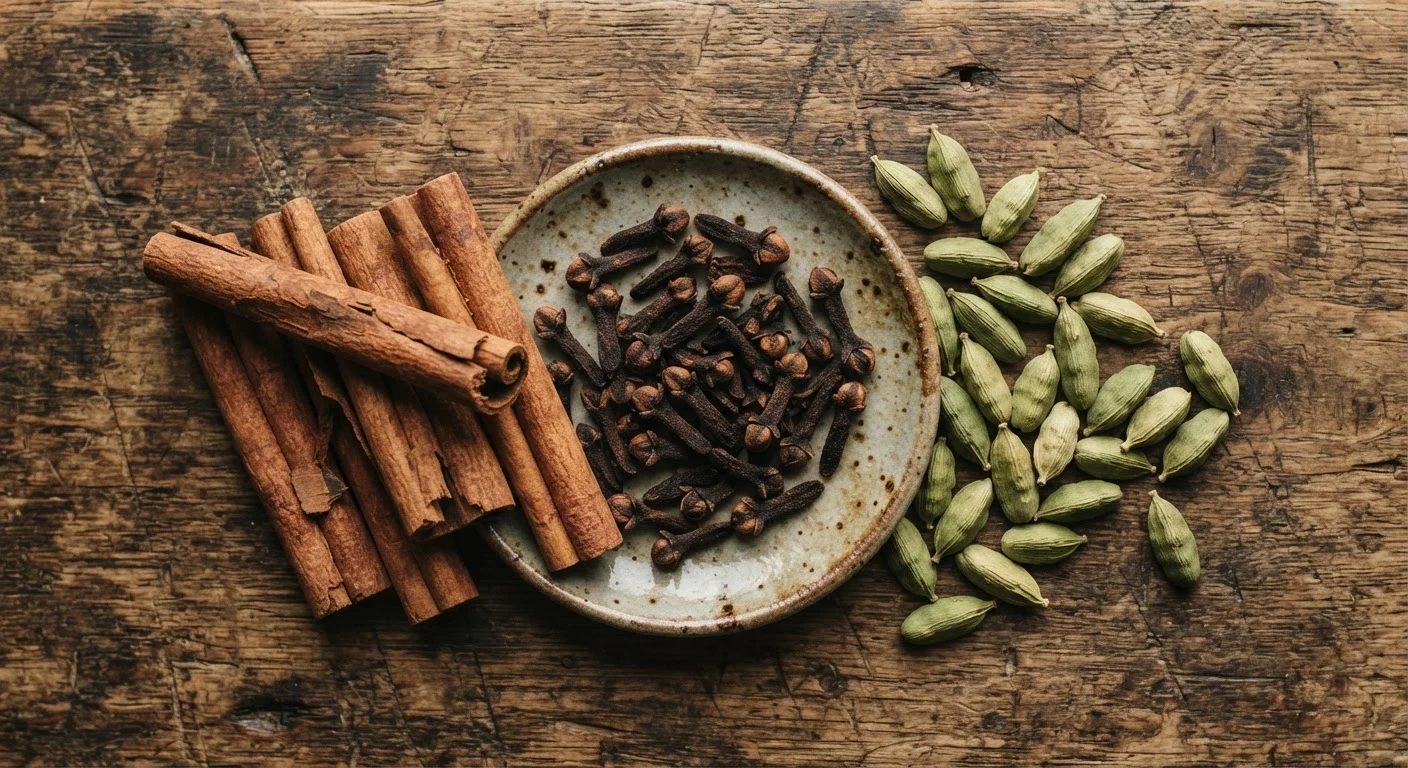
Before pharmacies, before clinical trials, and long before the modern understanding of pharmacology, spice merchants crossing trade routes from South Asia to the Mediterranean carried what many cultures considered medicine. Cloves, cinnamon, and cardamom weren't simply seasoning — they were status goods, ritual items, and healing agents, often valued above gold by weight.
This article takes a reference-style look at each spice: where it comes from, how it was traditionally used, and what — if anything — contemporary research has found to support those ancient claims. Understanding that distinction is important. Traditional use represents centuries of observational practice, while clinical evidence requires a different standard of proof. The two don't always align, and honest readers deserve to know where the gaps are.
For a broader introduction to evaluating home remedies before you try them, see our beginner's guide to home remedies. If you're building a remedy pantry, this overview of pantry staples is a helpful companion.
| Clove origin | Maluku Islands, Indonesia (Historical botanical record) |
| Cinnamon species (true) | Cinnamomum verum (Ceylon) |
| Cardamom traditional nickname | Queen of Spices (South Asian culinary and Ayurvedic tradition) |
| Key clove compound | Eugenol |
| Key cinnamon concern | Coumarin content in cassia variety (European Food Safety Authority guidance) |
| Primary cardamom use (traditional) | Digestive relief and breath freshening (Ayurvedic medicinal tradition) |
Cloves: The Antibacterial Bud
Cloves are the dried flower buds of Syzygium aromaticum, a tree native to the Maluku Islands of Indonesia — historically called the Spice Islands. For over two thousand years, traditional Chinese and Ayurvedic medicine used cloves primarily to address toothache, digestive complaints, and respiratory symptoms. In medieval Europe, cloves were pressed into oranges during illness outbreaks, a practice rooted more in fragrance than confirmed efficacy.
The active compound that makes cloves medicinally interesting is eugenol, a phenylpropanoid that has been studied for antimicrobial and local anesthetic properties. Laboratory research has confirmed that eugenol shows activity against certain bacteria and fungi in controlled settings. Dentists have historically used eugenol-based compounds as a temporary analgesic. However, consuming large amounts of clove oil is associated with toxicity risk, particularly in children, and concentrated clove oil should never be used without professional guidance.
In culinary quantities — a pinch of ground clove in a dish — the safety profile is well established. It's the concentrated extracts and oils where caution is warranted. Our overview of pantry staples with antimicrobial properties explains why lab results and home application aren't always equivalent.
Eugenol
A naturally occurring compound found in high concentrations in clove oil. It has been studied for local anesthetic and antimicrobial properties and is used in some dental preparations, though concentrated forms carry toxicity risk.
Cinnamaldehyde
The primary aromatic compound in cinnamon bark, responsible for its characteristic flavor and scent. It is also the compound most studied for potential antimicrobial and metabolic effects.
Coumarin
A naturally occurring plant chemical found in significant amounts in cassia cinnamon. At high doses, coumarin may be toxic to the liver, making it a concern for those consuming large quantities of cassia-based cinnamon.
Carminative
A substance that helps relieve gas and bloating in the digestive tract. Many culinary spices — including cardamom, fennel, and ginger — are described as carminatives in traditional medicine.
Ayurvedic medicine
A traditional system of medicine originating in India, estimated to be over 3,000 years old. It uses diet, herbal preparations, and lifestyle practices, and is one of the oldest recorded frameworks for using spices medicinally.
Polyphenols
A large class of plant-based compounds with antioxidant properties. Cinnamon, cloves, and cardamom all contain various polyphenols, which are the subject of ongoing nutrition and pharmacology research.
Cinnamon: Warmth, Blood Sugar, and the Limits of Evidence
Cinnamon comes primarily from two species: Cinnamomum verum (Ceylon or "true" cinnamon, from Sri Lanka) and Cinnamomum cassia (cassia, from China and Southeast Asia). Both share historical use in traditional medicine, but they differ meaningfully in chemical composition — a detail that matters when evaluating health claims.
Historically, cinnamon was used across Ayurvedic, Traditional Chinese, and Egyptian medicine for digestive discomfort, warming the body in cold-related illness, and as an antimicrobial preservative for foods. Its active compounds include cinnamaldehyde and various polyphenols.
Modern research has focused heavily on cinnamon's potential effect on blood sugar regulation. Some small clinical studies suggest that cassia cinnamon may modestly influence fasting blood glucose levels in people with type 2 diabetes. However, the evidence is inconsistent — study designs vary, sample sizes are often small, and effects are not large enough to treat cinnamon as a substitute for prescribed diabetes management. Anyone managing blood sugar should discuss any supplement use with their healthcare provider.
One additional note: cassia cinnamon contains significant amounts of coumarin, a compound that can be harmful to the liver in high doses. Ceylon cinnamon contains much lower levels. This distinction is rarely visible on grocery store labels, which is worth keeping in mind for anyone consuming cinnamon in large or supplemental quantities. For a similar evidence-based look at another popular spice, see how turmeric holds up to scrutiny.
Cardamom: The Queen of Spices
Cardamom — Elettaria cardamomum — is native to southern India and Sri Lanka and has been a fixture in Ayurvedic medicine for well over a thousand years. It earned the nickname "Queen of Spices" partly for its complex flavor and partly for the breadth of conditions it was traditionally applied to: digestive discomfort, bad breath, respiratory congestion, and even as a mild diuretic.
Its primary bioactive compounds are 1,8-cineole and various terpenes, which contribute both its distinctive aroma and its studied properties. Some research has examined cardamom's potential antioxidant and anti-inflammatory effects in animal models and small human studies, with preliminary interest in cardiovascular and metabolic markers. As with cinnamon, the findings are early-stage and shouldn't be interpreted as treatment guidance.
What cardamom does reliably: it supports digestive comfort in the everyday sense. Chewing cardamom pods after meals is a traditional South Asian practice that likely works through simple mechanisms — stimulating saliva, freshening breath, and providing mild carminative (gas-reducing) action. These are modest benefits, but they're real and well within the range of what culinary use can offer.
To explore how digestive spices are used across cultures, fenugreek, fennel, and cumin offer useful parallels. You can also explore the broader world of plant-based home wellness at our Herbal & Plant Basics hub.
This article is for general informational purposes only and does not constitute medical advice. If you have a health condition, are pregnant, or take medications, consult a qualified healthcare provider before using any spice in supplemental quantities.