
Starting Out with Home Remedies: What New Users Should Know Before the First Try

Key Takeaways
- Home remedies draw on centuries of traditional use, but that history is not the same as clinical proof.
- Many common pantry ingredients have genuine bioactive properties worth understanding.
- Research quality varies widely — some remedies have solid evidence, others have almost none.
- Natural does not mean risk-free; interactions and sensitivities are real concerns.
- Home remedies work best as a complement to, not a replacement for, professional medical care.
Start here
What Home Remedies Actually Are
Next
Common Pantry Staples and Their Traditional Uses
Then
How Traditional Remedies Are Evaluated
Almost there
Setting Realistic Expectations Before You Start
Before you try anything
Safety Basics Every First-Timer Should Know
What Home Remedies Actually Are
Home remedies are practical health measures people have applied using everyday ingredients — typically food, plants, or simple household materials — long before modern pharmaceuticals existed. They are passed down through families and communities, rooted in observation and necessity rather than controlled experiments.
The term covers a wide range. A warm saltwater gargle for a sore throat is a home remedy. So is applying raw honey to a minor skin irritation or steeping ginger in hot water to ease an upset stomach. What these approaches share is accessibility: the ingredients tend to already be in your kitchen or available at any grocery store.
It's worth being clear upfront: home remedies are general wellness practices, not medical treatments. They are not intended to diagnose, treat, or cure any disease. This distinction matters — not because the remedies have no value, but because understanding their appropriate role helps you use them wisely. For a broader look at what natural relief can and can't do, see our introduction to natural symptom relief.
Home remedy
A health practice using everyday ingredients — typically food, plants, or household materials — to ease mild symptoms or support general wellness. Not the same as medical treatment.
Bioactive compound
A naturally occurring substance in food or plants that has a measurable effect on living tissue. Examples include curcumin in turmeric or gingerols in ginger.
Traditional use
A remedy's history of being used within cultures or communities over generations, often before any scientific investigation. It signals interest but does not confirm effectiveness.
In vitro study
Research conducted in a laboratory setting — on cells or tissues outside a living organism. Results are preliminary and may not apply to how something works in the human body.
Systematic review
A comprehensive analysis of multiple existing studies on a topic, designed to give a more reliable overall picture of what the evidence shows.
Self-limiting symptom
A symptom or illness that typically resolves on its own without medical intervention, like a common cold. Home remedies are most appropriate here.
Common Pantry Staples and Their Traditional Uses
Several kitchen staples show up repeatedly across cultures and centuries as go-to remedies for mild, everyday complaints. Here's a grounded look at a handful of the most widely used:
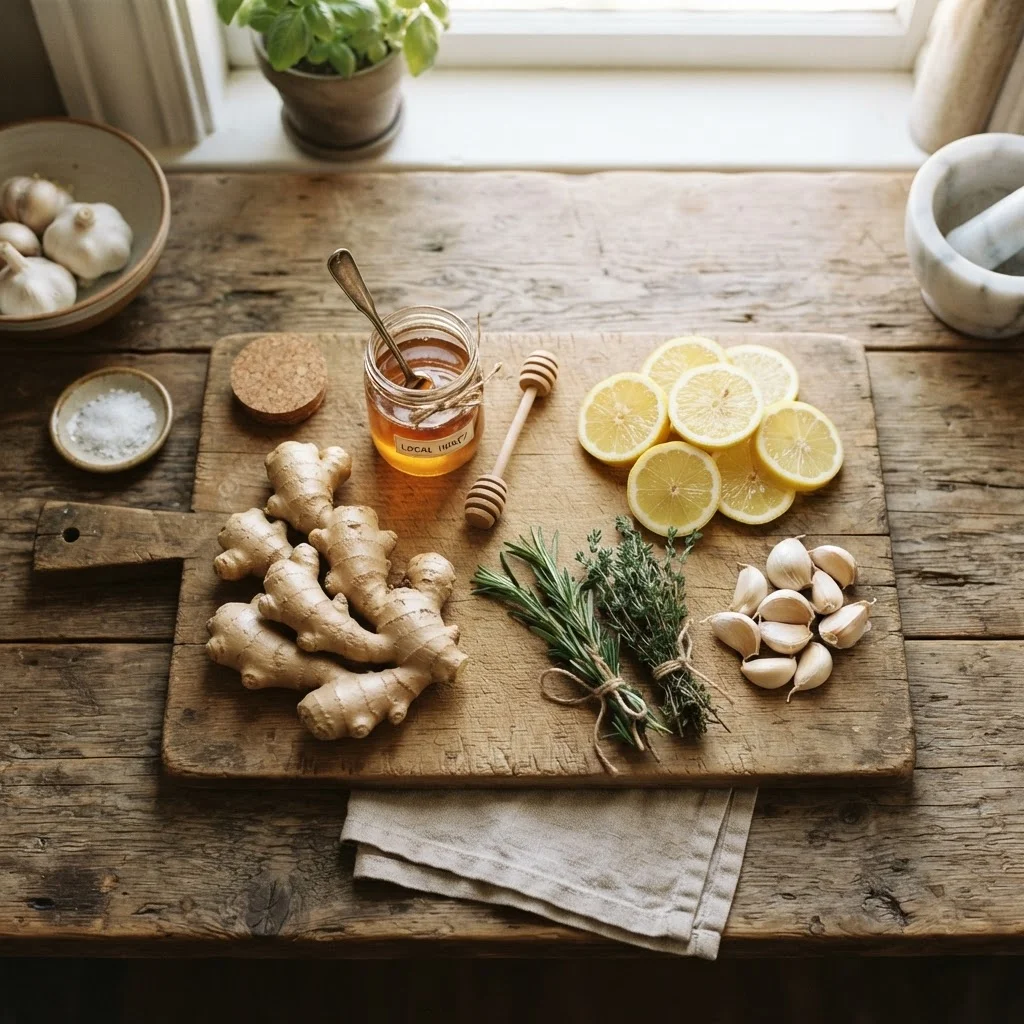
- Ginger: Traditionally used for nausea, digestive discomfort, and general stomach upset. It's one of the better-studied kitchen remedies; several clinical reviews suggest it may help reduce nausea, particularly related to pregnancy or motion sickness.
- Honey: Applied topically to minor cuts and burns in many traditions, and used orally to soothe sore throats and coughs. Raw honey has known antimicrobial properties, and some evidence supports its use for cough relief in adults and older children.
- Garlic: Long associated with immune support and cardiovascular wellness across Ayurvedic, Mediterranean, and East Asian traditions. Research on garlic is ongoing and shows mixed but interesting results.
- Turmeric: The active compound curcumin has attracted significant research interest for its anti-inflammatory properties, though absorption in the body is limited without certain complementary compounds.
- Oats: Used topically in colloidal form to soothe irritated or itchy skin. This is one of the few traditional remedies that has earned formal recognition from dermatological organizations.
- Saline (salt water): Simple saltwater rinses are used for nasal congestion and sore throats. Nasal saline irrigation has solid clinical support for symptom relief in upper respiratory conditions.
For a deeper look at stocking these ingredients at home, our guide on keeping a home remedy pantry is a useful companion reference. You might also find it interesting to see how these same ingredients appear in kitchen remedy traditions across cultures.
How Traditional Remedies Are Evaluated
Understanding how evidence is assessed helps you read claims more critically. Not all supporting evidence carries equal weight:
- Anecdote and tradition: Passed-down use over generations. Valuable as a signal worth investigating, but not proof of effectiveness on its own.
- Lab studies (in vitro): Testing in a petri dish or on isolated cells. Can reveal bioactive properties but doesn't confirm the same effect happens in a living person.
- Animal studies: One step closer to human application, but results don't always translate.
- Small human trials: Useful preliminary data, but limited by size and design.
- Randomized controlled trials (RCTs) and systematic reviews: The most reliable evidence. Still limited for many traditional remedies because large-scale funding for unpatentable ingredients is rare.
Most kitchen remedies sit somewhere in the middle of this spectrum — there's biological plausibility and sometimes early human research, but rarely the large, rigorous trials we'd see for a pharmaceutical drug. Acknowledging that gap isn't a reason to dismiss these remedies entirely; it is a reason to hold expectations in proportion to the evidence. If you're curious about herbal ingredients beyond the kitchen, our Herbal & Plant Basics hub covers foundational concepts.
A Simple Way to Read Remedy Claims
When you see a claim like 'studies show this ingredient reduces inflammation,' ask: what kind of study, and in whom? Lab studies and animal studies are not the same as human trials. Looking for systematic reviews or meta-analyses — summaries of multiple human studies — gives you a much more reliable picture of what's actually known.
Setting Realistic Expectations Before You Start
Most home remedies offer supportive relief — meaning they may ease discomfort, support your body's natural recovery processes, or help you feel more comfortable while an illness runs its course. They are generally not fast-acting, and they are rarely transformative on their own.
A few grounded expectations worth holding onto:
- Relief, when it comes, is typically mild to moderate — not dramatic.
- Results vary by individual. What helps one person may do nothing for another.
- Consistency often matters more than a single use. A cup of ginger tea once is different from a regular practice.
- Home remedies are most useful for mild, self-limiting symptoms — not serious or persistent illness.
It can also help to track what you try and how your symptoms respond over time. This kind of simple record makes it easier to tell what's actually helping versus what's coincidence. For a balanced look at where home remedies excel and where they fall short, see our article on the tradeoffs of relying on home remedies.
Safety Basics Every First-Timer Should Know
Natural ingredients are not automatically harmless. Before trying any home remedy for the first time, keep these principles in mind:
- Start small. Use modest amounts, especially with potent ingredients like raw garlic or concentrated ginger, and observe how your body responds.
- Check for allergies. If you've never consumed an ingredient in significant quantity, consider that you may have an undetected sensitivity.
- Mind your medications. Some common kitchen ingredients interact with prescription drugs. Garlic, for example, may affect blood-thinning medications. Our guide on using kitchen remedies safely covers the most common interactions to be aware of.
- Special populations need extra care. Pregnant individuals, nursing mothers, infants, young children, and people with chronic conditions should consult a healthcare provider before using any remedy beyond ordinary culinary amounts.
- Know when to stop. If symptoms worsen, persist, or if you develop signs of an allergic reaction, discontinue immediately and seek medical attention.
Home remedies are at their best when they complement — not replace — professional medical care. Used thoughtfully, they can be a meaningful part of everyday wellness. Used carelessly, even a kitchen staple can cause harm.
When to Skip the Pantry and See a Doctor
Home remedies are not appropriate for symptoms that are severe, sudden, or worsening. High fever, difficulty breathing, chest pain, persistent vomiting, or signs of infection that spread all require prompt professional evaluation. No kitchen remedy should delay you from seeking care when something feels seriously wrong.
This article is for general informational purposes only and does not constitute medical advice. Always consult a qualified healthcare professional for personal health concerns, diagnosis, or treatment decisions.