

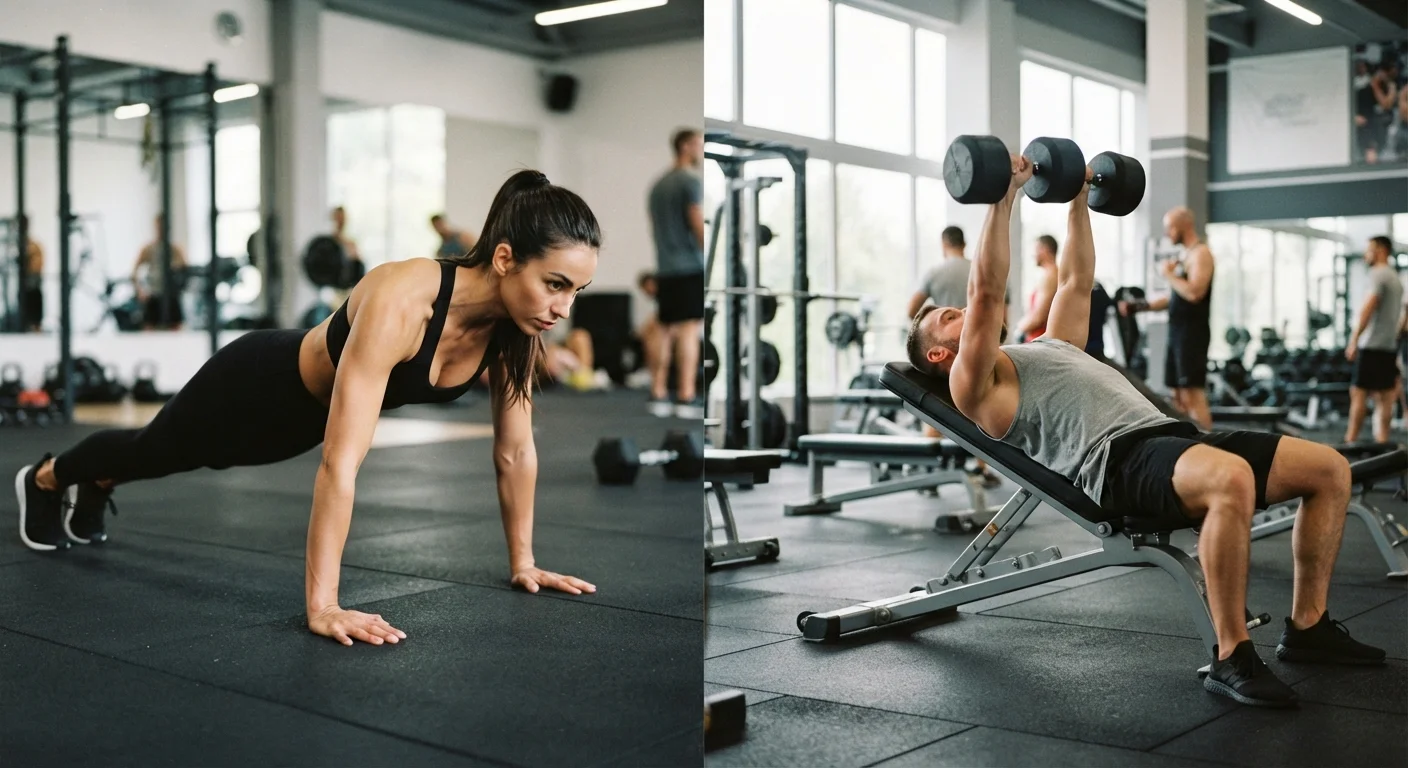
Key Takeaways
- Both bodyweight training and free weights can build meaningful strength when applied with progressive overload.
- Free weights offer more precise load adjustment, making them advantageous for long-term strength progression.
- Bodyweight training is highly accessible, requires no equipment, and develops functional movement patterns effectively.
- Combining both methods often produces better results than relying exclusively on either approach.
- Your training history, goals, and available resources should guide which method you prioritize.
Our Verdict
Neither bodyweight training nor free weights hold a universal advantage — both are evidence-supported methods for building strength and improving physical health. Free weights allow more controlled load progression over time, while bodyweight training offers unmatched accessibility and skill transfer to functional movement. For most adults, a combined or complementary approach will serve them better than an either-or commitment.
| Best for | Recommended |
|---|---|
| Beginners or those training without equipment access | Bodyweight Training |
| Adults focused on long-term progressive strength gains | Free Weights |
| Those seeking balanced strength, mobility, and functional fitness | Combined Approach |
| Adults returning to exercise after a long break | Bodyweight Training |
How Both Methods Build Strength
Strength development follows one core principle regardless of the tool you use: progressive overload. This means gradually increasing the challenge placed on your muscles over time — whether that challenge comes from a barbell, a dumbbell, or the weight of your own body.
Research consistently shows that muscles respond to mechanical tension and metabolic stress, not to any specific piece of equipment. A well-structured bodyweight program and a well-structured free weight program both trigger the muscle protein synthesis process that drives strength adaptation. What differs is how each method applies that overload and how easily it scales.
If you're newer to resistance training, this introduction to bodyweight training offers a practical framework for understanding the foundational movements involved.
| Bodyweight Training | Free Weights | |
|---|---|---|
| Equipment required | None | Dumbbells, barbells, or kettlebells |
| Load progression | Exercise variation (less precise) | Incremental weight increases (precise) |
| Beginner accessibility | High — low barrier to entry | Moderate — technique learning curve |
| Functional movement benefit | High | Moderate to high |
| Long-term hypertrophy potential | Moderate | High |
| Joint stress at high loads | Generally lower | Higher if form breaks down |
| Cost | Free | Moderate to high upfront investment |
The Case for Bodyweight Training
Bodyweight training's primary advantage is accessibility. No gym membership, no equipment, and no dedicated space beyond a few square feet are required. This removes common barriers that prevent people from training consistently — and consistency, not perfection, drives long-term results.
Compound bodyweight movements like push-ups, squats, lunges, and inverted rows recruit multiple muscle groups simultaneously and reinforce the movement patterns used in everyday activities. Research in exercise science also suggests that bodyweight training can meaningfully improve muscular endurance, joint stability, and coordination.
The main limitation is load progression. Once you can perform 20 or more reps of a given movement, increasing difficulty requires switching to harder exercise variations — such as single-leg squats or archer push-ups — rather than simply adding weight. This progression can become less intuitive and may plateau for experienced exercisers seeking maximum hypertrophy or strength output.
Progress Requires Increasing Difficulty Over Time
Whether you train with bodyweight or free weights, the overload principle applies equally. Once a movement becomes comfortable for 15 or more repetitions, it's time to advance — either to a harder variation or a heavier load. Staying at the same difficulty for months limits your results. Track your workouts so you can see when it's time to level up. If you're unsure how to structure that progression, common exercise myths covers several misconceptions that often stall progress.
The Case for Free Weights
Free weights — dumbbells, barbells, and kettlebells — allow for precise, incremental load increases. Adding 2.5 to 5 pounds to a lift is far simpler than moving to an entirely different exercise variation, which makes long-term progression more systematic and measurable.
Studies comparing resistance training modalities generally find that free weights produce comparable or slightly superior gains in maximal strength when volume and effort are equated. They also allow greater muscle isolation when needed and provide a broader range of loading options across exercise types.
The trade-off is learning curve and injury risk if form breaks down under heavy load. Beginners should prioritize technique before adding significant weight. Our beginner's guide to lifting covers safe starting points and realistic expectations for those new to free weight training.
What the Evidence Actually Shows
Head-to-head studies comparing bodyweight and free weight training are limited in number, partly because program design variables — volume, frequency, intensity, and exercise selection — make direct comparisons difficult. What the literature does support is this: both methods produce significant strength and muscle gains when effort, consistency, and progressive challenge are present.
A 2019 review published in the Journal of Human Kinetics found that calisthenics (structured bodyweight training) produced comparable improvements in strength and body composition to traditional resistance training over an eight-week period in untrained adults. However, evidence for advanced trainees tilts toward free weights for maximizing hypertrophy and one-rep max strength due to superior load range.
Adults over 40 may find bodyweight work particularly valuable for joint-friendly conditioning. For more on how strength training adapts with age, see strength training after 40.
~equal
Strength gains: bodyweight vs. weights in beginners
A 2019 review in the Journal of Human Kinetics found comparable strength and body composition improvements in untrained adults across both training modalities over 8 weeks.
2×/week
Minimum training frequency for strength gains
The American College of Sports Medicine recommends training each major muscle group at least twice per week for meaningful strength adaptation, regardless of modality.
Making the Decision for Your Situation
The most practical question isn't which method is objectively better — it's which method you'll actually sustain and progress within. Consider these factors:
- Access and environment: If a gym is inconvenient, bodyweight training removes the friction entirely.
- Current fitness level: Beginners often build a strong foundation with bodyweight movements before adding external load.
- Goals: Functional movement, endurance, and general fitness respond well to bodyweight work; maximal strength and hypertrophy may benefit more from free weights at advanced levels.
- Injury history or joint concerns: Always consult a qualified healthcare professional before beginning any new training program, particularly if you have existing musculoskeletal conditions.
Many adults find that combining both approaches — using bodyweight exercises for warm-ups, accessory work, or travel days, and free weights for primary strength sessions — offers the broadest benefit. This isn't a compromise; it's a well-rounded strategy supported by exercise physiology principles.
For a broader look at how strength training fits alongside cardiovascular exercise, see cardio vs. strength training.
This article is for general informational and educational purposes only and does not constitute medical or professional fitness advice. Consult a qualified healthcare provider or certified fitness professional before starting a new exercise program.