

Key Takeaways
- Bodyweight training builds genuine strength and endurance using only your body as resistance.
- Progressive overload — gradually increasing challenge — is the key driver of improvement.
- Six foundational movement patterns cover the vast majority of functional human movement.
- Two to three sessions per week with rest days is a sound starting structure for beginners.
- Form quality matters more than volume, especially in the first few weeks of training.
Start here
What Is Bodyweight Training?
Build your foundation
Core Principles Every Beginner Should Know
Learn the moves
The Foundational Movement Patterns
Put it into practice
How to Structure Your First Weeks
Train smarter
Common Mistakes and How to Avoid Them
What Is Bodyweight Training?
Bodyweight training is a form of resistance exercise that uses your own body weight as the load — no barbells, machines, or gym membership required. Push-ups, squats, lunges, and planks are familiar examples, but the category spans hundreds of movements ranging from very accessible to highly challenging.
What makes bodyweight training particularly useful for beginners is its scalability. Almost every exercise can be made easier or harder by adjusting your body position, range of motion, or tempo. For a broader look at how strength and flexibility training fits together, see our complete overview of strength and flexibility training.
Progressive overload
Gradually increasing the difficulty of exercise over time so the body continues to adapt and improve rather than plateauing.
Repetition (rep)
One complete cycle of an exercise movement, such as lowering into and rising from a single squat.
Set
A group of consecutive repetitions performed without stopping, followed by a rest period before the next group.
Posterior chain
The muscles running along the back of your body — including the glutes, hamstrings, and lower back — which are critical for posture and movement.
Tempo
The speed at which you perform each phase of a movement; slowing down the lowering phase, for example, increases the difficulty without adding load.
Core Principles Every Beginner Should Know
Understanding a few foundational principles will make your training far more effective than simply following a random list of exercises.
- Progressive overload: Your body adapts to a given level of stress and then stops changing. To keep improving, the challenge must increase incrementally — more reps, slower tempo, a harder variation, or reduced rest periods.
- Specificity: Your body adapts to what you specifically practise. Squatting regularly improves squatting ability; if your goal is better endurance, you need consistent cardio alongside strength work.
- Recovery: Muscles don't grow during exercise — they grow during rest. Sleep, nutrition, and rest days are not optional extras; they are where adaptation happens.
- Consistency over intensity: Showing up regularly at a manageable effort beats sporadic, all-out sessions. Building a sustainable habit is the single most important factor for long-term progress.
Start With Two Exercises Per Pattern
Beginners often feel compelled to do as much as possible in early sessions. A more effective approach is to choose just one or two exercises per movement pattern and perform them well. Mastering a standard push-up and a bodyweight squat delivers more training benefit than rushing through ten unfamiliar exercises with poor form.
The Foundational Movement Patterns
Rather than thinking in terms of individual exercises, it helps to organise training around movement patterns. Most human movement falls into six categories, and a well-rounded programme touches each of them.
- Push
- Moving resistance away from your body. Examples: push-up, pike push-up.
- Pull
- Drawing resistance toward your body. Examples: inverted row, doorframe row.
- Squat
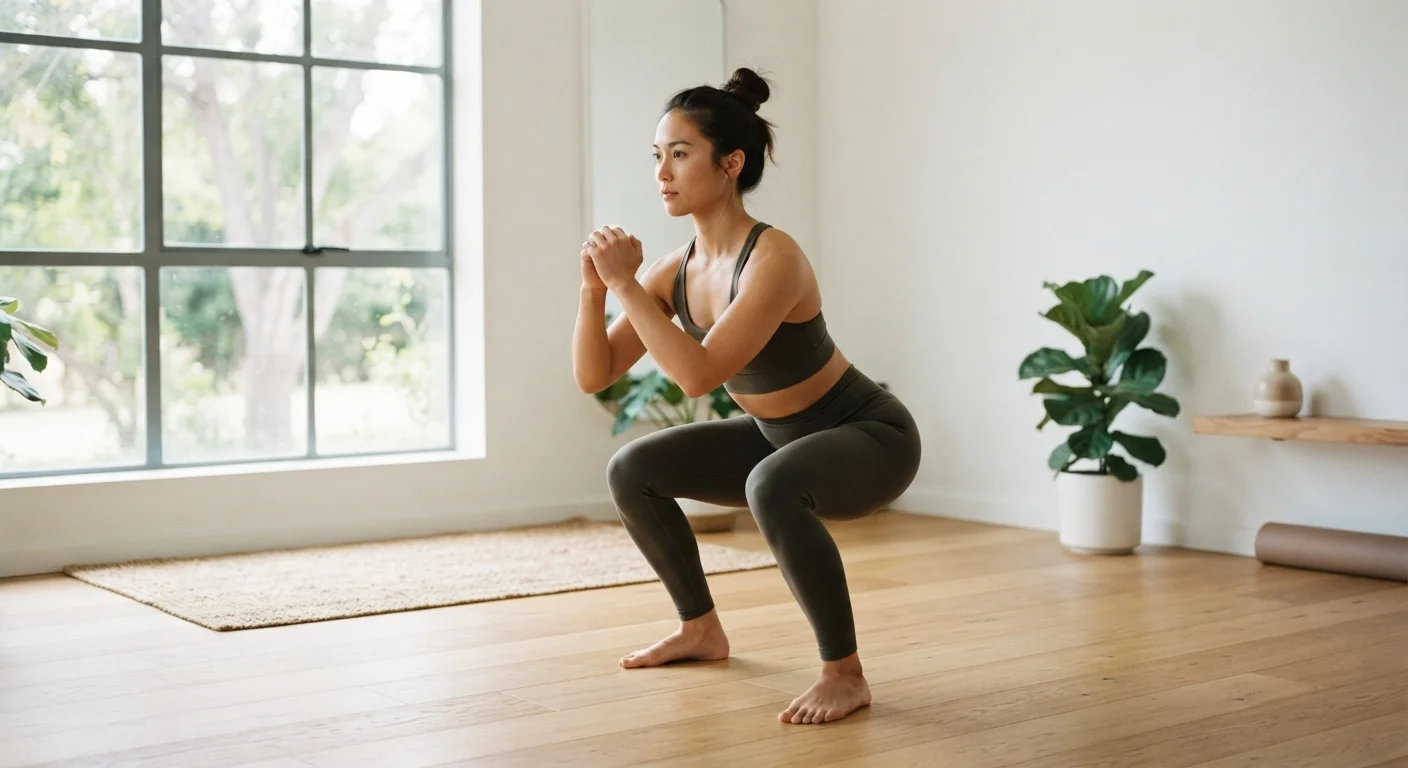
- Bending and extending at the hips and knees under load. Examples: bodyweight squat, split squat.
- Hinge
- Hinging at the hip with a neutral spine. Examples: glute bridge, single-leg Romanian deadlift.
- Core
- Stabilising the trunk against movement. Examples: plank, dead bug, hollow body hold.
- Carry or locomotion
- Moving your whole body through space. Examples: bear crawl, step-up.
Beginners don't need to master all patterns at once. Starting with one or two exercises per category and focusing on clean technique is a more productive approach than rushing through a long exercise list.
How to Structure Your First Weeks
A simple, sustainable structure removes decision fatigue and helps you build consistency. Here is a practical framework for the first four to six weeks:
- Frequency: Aim for two to three sessions per week, with at least one rest day between sessions.
- Session length: Twenty to thirty minutes is enough at the start. Quality of movement matters more than duration.
- Warm-up: Spend five minutes raising your heart rate and mobilising the joints you'll use — leg swings, arm circles, and gentle hip rotations are sufficient.
- Main work: Choose one exercise from each of three or four movement patterns. Perform two to three sets of eight to twelve repetitions, or a time-based set of fifteen to thirty seconds for holds.
- Cool-down: End with two to three minutes of gentle stretching focused on the muscles worked.
Before committing to a programme, it is worth reviewing your readiness. Our readiness checklist walks you through the key considerations.
Common Mistakes and How to Avoid Them
Most beginner setbacks are predictable and preventable. Watch for these patterns:
- Progressing too fast: Adding difficulty before technique is solid increases injury risk and reinforces poor movement habits. Earn each progression.
- Skipping the hinge pattern: Glute bridges and hip hinges are often overlooked, but the posterior chain — glutes, hamstrings, lower back — is central to posture, athletic performance, and injury prevention.
- Treating rest as failure: Rest days are when adaptation occurs. Feeling the urge to train every day is common in the early enthusiasm phase; resist it.
- Ignoring discomfort signals: Muscle fatigue and mild soreness are normal. Sharp, localised, or joint pain is not. Stop the movement and, if symptoms persist, consult a qualified healthcare professional.
If you're curious how bodyweight work compares to training with equipment, our article on strength training for adults who have never lifted before offers a useful parallel perspective.
This article is for general informational purposes only and does not constitute medical advice. Always consult a qualified healthcare professional before beginning a new exercise programme, particularly if you have any health conditions or concerns.