

Key Takeaways
- Every lab report includes reference ranges that show what values are considered normal for a given test.
- A single out-of-range value rarely tells the full story — context and trends matter more than any one number.
- The CBC measures blood cells; the CMP evaluates organ function and chemical balance.
- Lipid panels and thyroid tests are commonly ordered alongside routine blood work for a broader health picture.
- Always discuss your results with your healthcare provider before drawing conclusions or making health changes.
Start here
How Lab Reports Are Structured
Next
The Complete Blood Count (CBC) Explained
Then
The Basic Metabolic Panel (BMP) and Comprehensive Metabolic Panel (CMP)
Continue
Lipid Panels and Thyroid Markers
Final step
What to Do After Reading Your Results
How Lab Reports Are Structured
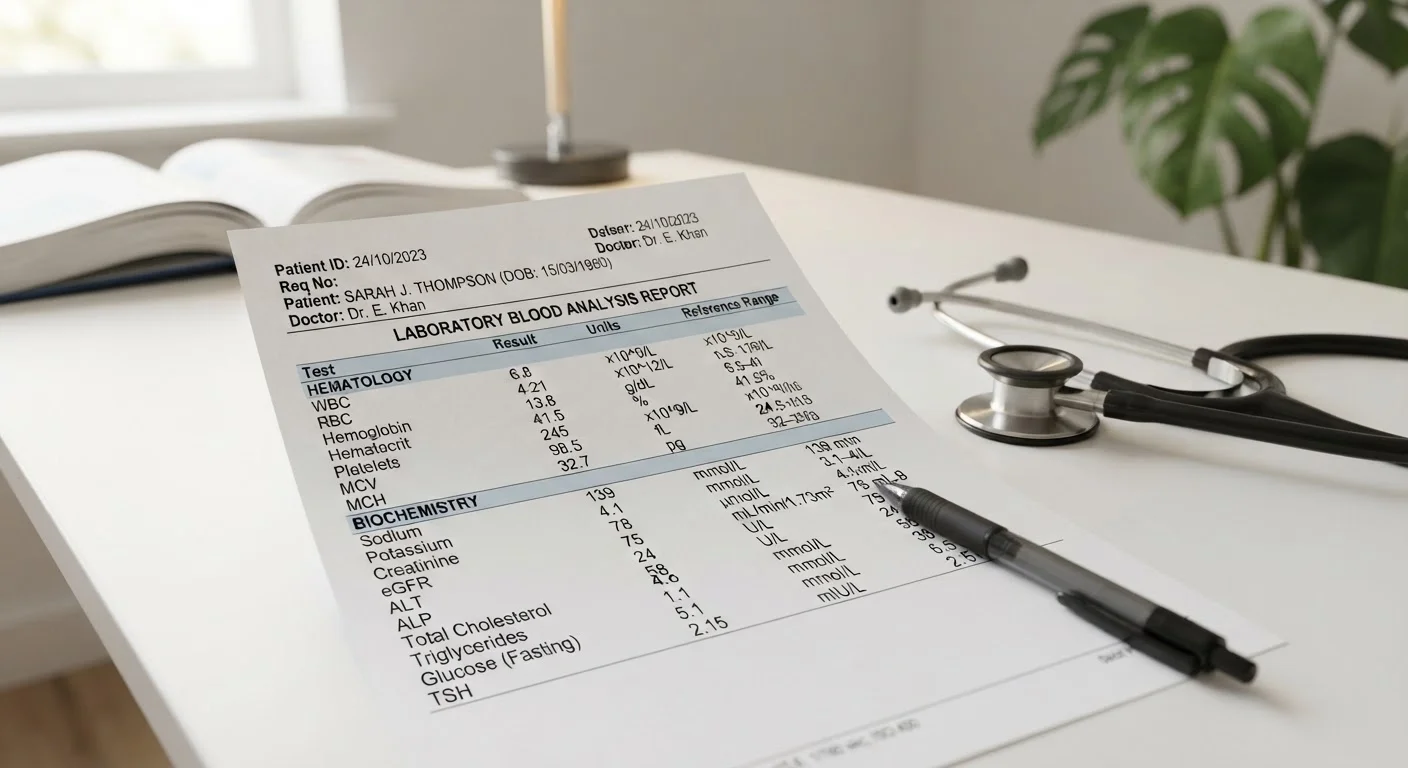
When your blood work results arrive — whether by mail, patient portal, or from your doctor's office — you are looking at a standardized document, even if it doesn't feel that way at first glance. Every lab report shares a common anatomy: a list of tests performed, the value measured for each, the units used (such as mg/dL or g/dL), and a reference range — the span of values the lab considers typical for the general population.
That reference range is the most important column on the page. It tells you the expected boundaries for a result and is usually printed right next to your value so you can compare them side by side. Values outside the range are commonly flagged with an H (high) or L (low), or sometimes an asterisk.
What the report cannot tell you is why a value sits where it does — that requires clinical judgment. Reference ranges are statistical averages derived from large populations, so a result just outside the range doesn't automatically signal illness, and a result technically within range doesn't guarantee perfect health. For a broader orientation to medical language, our plain-language medical glossary can help decode other terminology you may encounter on your report.
Reference Range
The span of values a lab considers typical for a healthy population. Results outside this range are flagged but not automatically a cause for alarm.
CBC (Complete Blood Count)
A blood test that measures red cells, white cells, and platelets — providing a broad snapshot of blood cell health and immune function.
CMP (Comprehensive Metabolic Panel)
A panel of 14 blood tests that checks blood sugar, electrolytes, kidney function, and liver function markers all at once.
eGFR
Estimated Glomerular Filtration Rate — a calculated number that estimates how well your kidneys are filtering waste from the blood.
LDL and HDL
Two types of cholesterol. LDL is associated with arterial plaque buildup, while HDL helps transport cholesterol away from the arteries.
TSH (Thyroid-Stimulating Hormone)
A hormone produced by the brain that signals the thyroid gland. Abnormal TSH levels are the primary indicator of thyroid dysfunction.
The Complete Blood Count (CBC) Explained
The Complete Blood Count, or CBC, is one of the most frequently ordered blood tests. It measures the three major types of cells circulating in your blood and provides several sub-measurements for each.
- RBC (Red Blood Cell count): The number of oxygen-carrying red cells per volume of blood. Low values may prompt investigation for anemia; high values can occur with dehydration or certain conditions.
- Hemoglobin (Hgb or Hb): The protein inside red cells that binds oxygen. This is the primary marker used to diagnose anemia.
- Hematocrit (Hct): The percentage of your blood volume made up of red cells.
- MCV (Mean Corpuscular Volume): The average size of your red blood cells — useful for distinguishing different types of anemia.
- WBC (White Blood Cell count): Measures immune cells. Elevated counts can indicate infection or inflammation; very low counts may suggest immune suppression.
- Platelets (PLT): Cell fragments essential for blood clotting. Both very high and very low platelet counts can have clinical significance.
A CBC is a screening tool, not a diagnosis. Abnormal values prompt further testing, not immediate conclusions.
The Basic Metabolic Panel (BMP) and Comprehensive Metabolic Panel (CMP)
Metabolic panels assess the chemical environment of your blood, giving clinicians a window into how your kidneys, liver, and internal balance systems are functioning.
The Basic Metabolic Panel (BMP) typically includes:
- Glucose: Blood sugar levels. Fasting glucose is used to screen for diabetes and prediabetes.
- BUN (Blood Urea Nitrogen) and Creatinine: Waste products filtered by the kidneys. Elevated levels can indicate reduced kidney function.
- Sodium, Potassium, Chloride, CO2 (Bicarbonate): Electrolytes that regulate fluid balance, nerve function, and acid-base chemistry.
- eGFR (Estimated Glomerular Filtration Rate): Often calculated from creatinine, this estimates how efficiently your kidneys are filtering blood.
The Comprehensive Metabolic Panel (CMP) adds liver function markers:
- ALT and AST: Enzymes that, when elevated, can suggest liver stress or damage.
- ALP (Alkaline Phosphatase): Linked to liver and bone health.
- Total Bilirubin: A byproduct of red blood cell breakdown processed by the liver. High levels can cause jaundice.
- Albumin and Total Protein: Indicators of nutritional status and liver protein synthesis.
Bring a List of Questions to Your Appointment
Before meeting with your provider to review results, write down any values that concerned you and what you'd like to understand better. Asking "What does this number mean for me specifically?" will get you more useful information than asking only whether a result is normal or abnormal. A prepared patient gets more out of every clinical conversation.
Lipid Panels and Thyroid Markers
Two other panels are commonly ordered alongside routine blood work, often as part of a preventive health evaluation.
The lipid panel measures fats in the bloodstream and is a key tool for assessing cardiovascular risk:
- Total Cholesterol: The overall measure of all cholesterol types combined.
- LDL (Low-Density Lipoprotein): Often called "bad" cholesterol because elevated levels are associated with plaque buildup in arteries.
- HDL (High-Density Lipoprotein): Known as "good" cholesterol — higher levels are generally associated with lower cardiovascular risk.
- Triglycerides: A type of fat that, when chronically elevated, is linked to metabolic and cardiac risk.
For a companion guide to understanding another set of numbers that reflects cardiovascular health, see our article on interpreting blood pressure readings.
The thyroid panel commonly includes:
- TSH (Thyroid-Stimulating Hormone): The primary screening marker for thyroid function. A high TSH often suggests an underactive thyroid (hypothyroidism); a low TSH can indicate an overactive thyroid (hyperthyroidism).
- T3 and T4: The hormones the thyroid gland actually produces, sometimes measured when TSH is abnormal.
What to Do After Reading Your Results
Reading your lab report is a starting point, not an endpoint. Even with a solid understanding of what each marker means, interpreting results in the context of your personal health history is work that belongs to your healthcare provider.
Here are practical steps to take after reviewing your blood work:
- Note anything flagged with H, L, or an asterisk, and write down questions before your appointment.
- Avoid self-diagnosing based on a single out-of-range value — trends over time and the full clinical picture matter far more.
- Ask your provider what each abnormal result means for you specifically, whether any repeat testing is needed, and what — if anything — you should do differently.
- Keep copies of your results over time. Tracking how values change from year to year can provide useful insight for you and your care team.
If a result comes back outside the normal range, our guide on what to do when a test result is abnormal explains how to think clearly and prepare for a follow-up conversation.
This article is for general informational and educational purposes only and is not a substitute for professional medical advice, diagnosis, or treatment. Always consult a qualified healthcare provider with questions about your specific test results or health condition.