

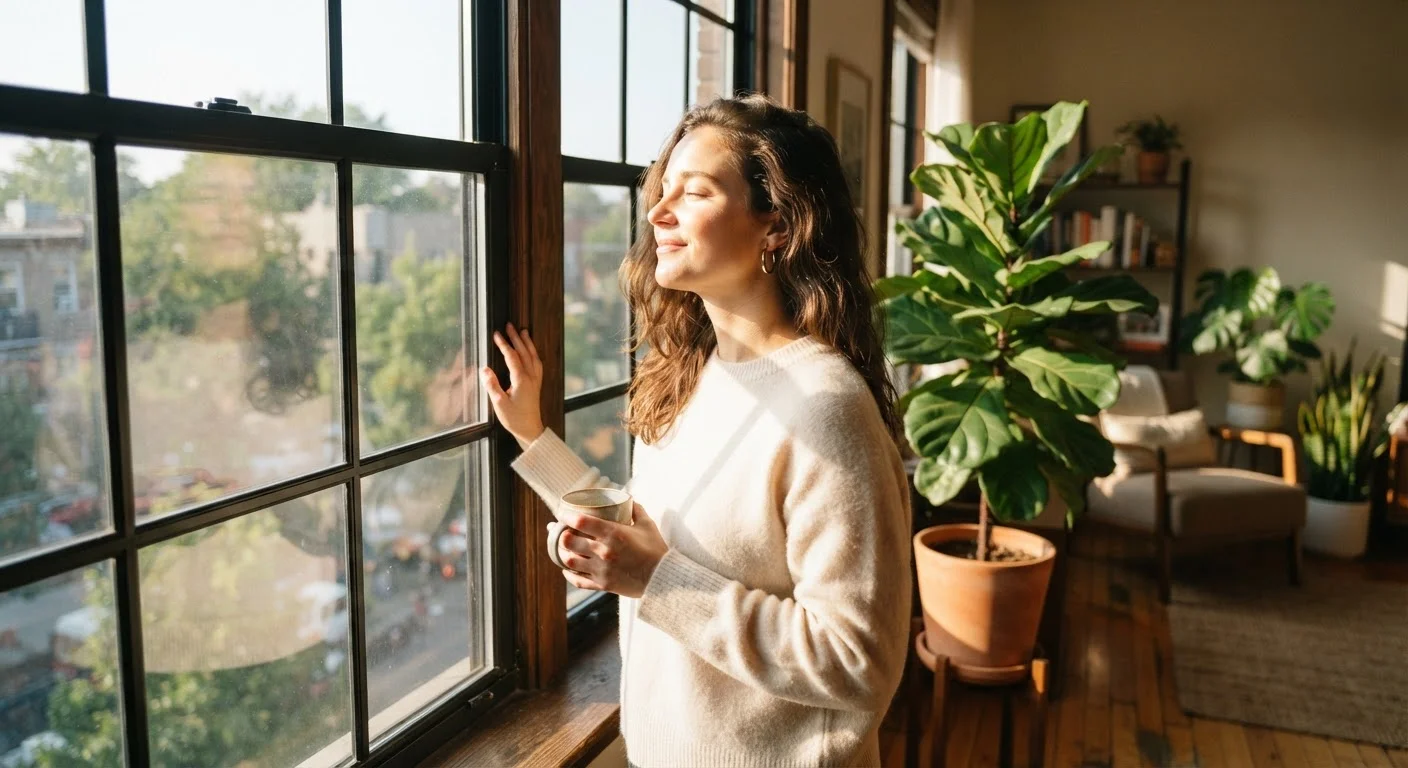
Key Takeaways
- Morning daylight helps set your circadian rhythm, making it easier to fall asleep and wake up on schedule.
- Natural light stimulates serotonin production, which supports mood stability and daytime alertness.
- Adequate daylight exposure in the morning is linked to faster melatonin onset in the evening.
- Even 15–30 minutes of outdoor light in the morning can produce measurable benefits for sleep and mood.
- Indoor lighting — even bright indoor light — is typically far weaker than outdoor daylight and a poor substitute.
Daylight Exposure
Daylight exposure refers to the time you spend in natural sunlight or bright outdoor light each day. Your body uses light signals — especially in the morning — to synchronize an internal 24-hour clock that governs sleep timing, hormone release, mood, and energy levels. Getting enough of the right light at the right times is foundational to how alert you feel during the day and how well you sleep at night.
This internal clock is called the circadian rhythm. It is regulated by specialized photoreceptors in the eyes — particularly intrinsically photosensitive retinal ganglion cells (ipRGCs) — that are most sensitive to short-wavelength blue light present in natural sunlight.
How Light Anchors Your Body Clock
Every cell in your body follows a roughly 24-hour internal schedule. Without an external cue, this clock would drift slightly each day. The most powerful cue it relies on is light — specifically, the pattern of bright light in the morning and darkness in the evening.
When morning light enters your eyes, it triggers a cascade of signals in the brain's suprachiasmatic nucleus (SCN), the master clock that coordinates sleep timing, hunger, body temperature, and hormone release. This signal tells your body it's daytime, setting everything else in motion. When that morning signal is weak — because you stay indoors or use blackout shades long into the morning — your clock loses precision, and sleep, mood, and energy can all suffer.
This is why your first hour after waking shapes so much of how the rest of your day unfolds. Getting outdoor light during that window is one of the highest-leverage habits you can adopt.
10,000 lux
Typical outdoor light intensity on a cloudy day
Standard indoor office lighting averages 300–500 lux — roughly 20–30 times dimmer than overcast daylight outdoors.
~80%
Of adults in developed nations spend most of the day indoors
Research from the National Human Activity Pattern Survey estimates the vast majority of Americans spend around 90% of their time in enclosed buildings or vehicles.
30 min
Morning light exposure linked to better sleep onset
Studies in the journal Sleep and other peer-reviewed publications have associated consistent morning light exposure of 20–30 minutes with earlier, more robust melatonin onset in the evening.
Serotonin, Melatonin, and the Light-Mood Connection
Natural light does more than wake you up — it directly influences two of the most mood-relevant chemicals in your brain.
Serotonin is a neurotransmitter associated with emotional stability, motivation, and wellbeing. Research indicates that light exposure stimulates serotonin synthesis in the brain, with brighter light corresponding to higher daytime serotonin levels. Low serotonin activity is closely linked to depression, and the seasonal dip in daylight hours is one reason why mood disorders peak in winter months.
Melatonin — the hormone that signals nighttime to your body — is suppressed during daylight hours and rises in the evening as light fades. Critically, research published in peer-reviewed sleep journals has found that people who get adequate morning light exposure show earlier, stronger melatonin onset in the evening, making it easier to fall asleep at a consistent time.
This is the direct biological bridge between morning sunlight and better sleep — and it helps explain why sleep and mental health reinforce each other in a cycle that daylight helps regulate.
“Light is the most powerful synchronizer of the human circadian clock. The timing, intensity, and duration of light exposure shapes virtually every biological rhythm the body runs on.”
— Satchin Panda, Circadian biology researcher and professor, Salk Institute for Biological Studies
What Happens When You Don't Get Enough Natural Light
Many American adults spend the majority of their waking hours indoors. Standard office lighting averages around 300–500 lux — a fraction of the 10,000 lux or more available even on an overcast day outdoors. This chronic under-exposure can have compounding effects.
- Circadian drift: Without a strong morning light signal, sleep timing shifts and becomes inconsistent, contributing to difficulty falling asleep or waking too early.
- Mood disruption: Lower serotonin availability is associated with irritability, low motivation, and in vulnerable individuals, depressive episodes.
- Daytime fatigue: Cortisol — the alertness hormone — should rise sharply in the morning. Insufficient morning light can blunt this rise, leaving you feeling sluggish despite adequate sleep.
- Evening alertness: Without daytime light contrast, melatonin may rise too slowly in the evening, making it harder to wind down.
People with irregular schedules — night-shift workers, frequent travelers, or those who work fully remotely — are especially susceptible. For more on supporting rest through daily behavior, see sleep hygiene habits that support restorative rest.
Simple, Evidence-Informed Habits to Increase Daylight Exposure
You don't need to restructure your life to benefit from more natural light. These practical steps can fit into most adults' existing routines:
- Step outside within an hour of waking. A 15–20 minute walk, morning coffee on a porch, or a brief outdoor errand can deliver a meaningful circadian signal. On overcast days, outdoor light still far exceeds indoor levels.
- Position your workspace near a window. While window light isn't a full substitute, it is better than interior office lighting and supports alertness throughout the day.
- Take outdoor breaks at midday. A lunchtime walk serves double duty — physical activity and light exposure both support mood and energy.
- Be intentional about evening light. Dim indoor lights after sunset and limit screen brightness to allow melatonin to rise naturally.
Start Small: One Habit at a Time
You don't need to overhaul your schedule to improve your light exposure. Committing to just one consistent outdoor habit — like a brief morning walk — is enough to start shifting your circadian rhythm in a positive direction. Consistency matters more than duration: a daily 15-minute habit outperforms an occasional 60-minute one.
Connecting daylight habits to other evidence-based mood-supporting routines — like regular sleep timing and movement — compounds the benefit. And understanding your natural sleep preferences through your chronotype can help you optimize when outdoor light exposure is most useful for you personally.
This article is for general informational purposes only and does not constitute medical advice. If you are experiencing persistent sleep problems, mood disturbances, or other health concerns, please consult a qualified healthcare professional.