

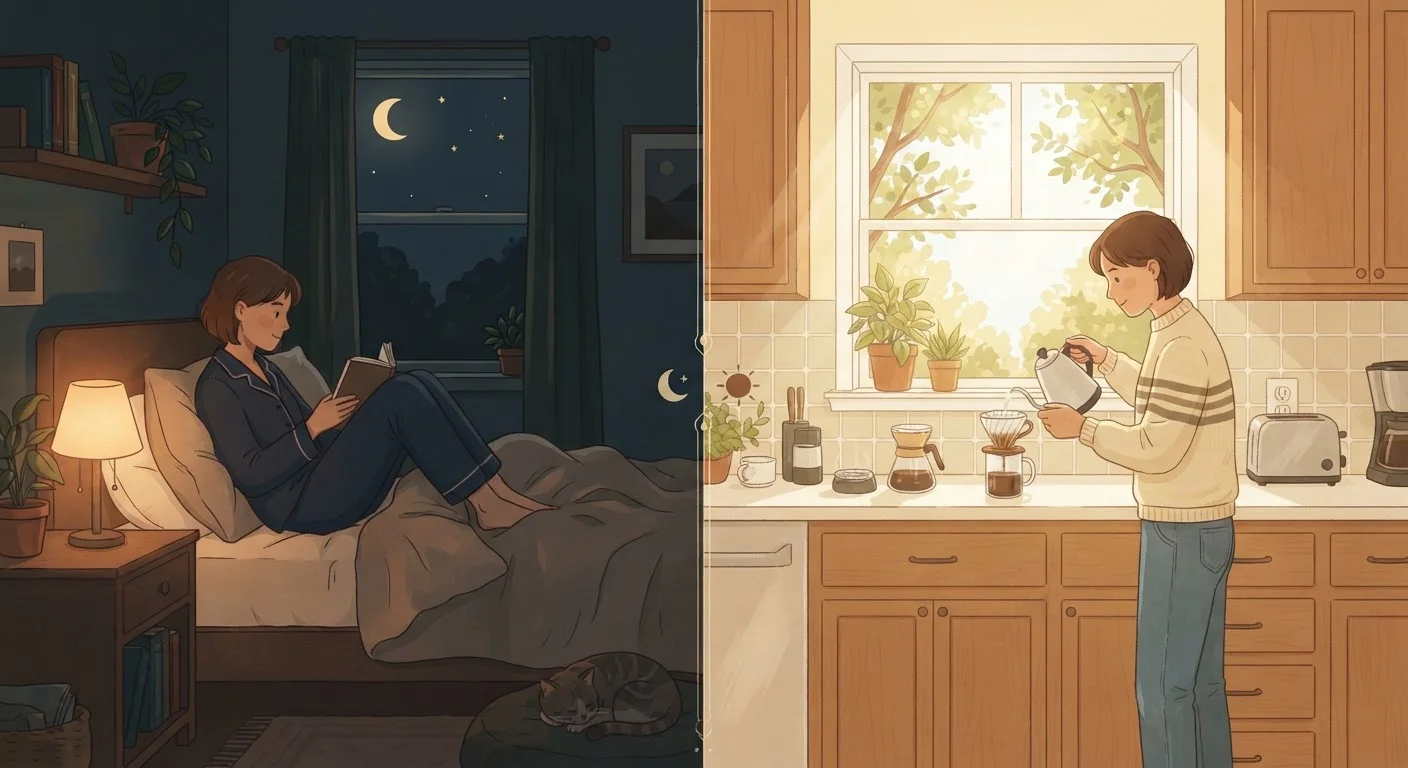
Key Takeaways
- Chronotype is largely determined by genetics and age, not personal discipline or habit.
- Night owls face greater health risks partly because society's schedules favor morning types.
- Both chronotypes can support good health with consistent sleep timing and daylight exposure.
- Extreme evening chronotypes may benefit from gradual, evidence-informed schedule adjustments.
- Total sleep duration and quality matter at least as much as when you sleep.
Option A
Night Owl (Evening Chronotype)
The biologically wired late-to-bed, late-to-rise type.
Best for: Individuals whose natural peak alertness and productivity fall in the late afternoon or evening hours.
Option B
Early Riser (Morning Chronotype)
The naturally early-to-bed, early-to-wake type.
Best for: Individuals whose energy, focus, and mood peak during the morning hours after an early wake time.
If your schedule gives you flexibility over wake times
Night Owl (Evening Chronotype)
When you can align your schedule to your natural rhythm, evening types perform and feel just as well as morning types — the key is consistency.
If you work a standard 9-to-5 or earlier schedule
Early Riser (Morning Chronotype)
Morning chronotypes experience less social jet lag — the mismatch between internal clock and social demands — which research links to better metabolic and mood outcomes.
If you want to reduce health risks associated with late sleep timing
Early Riser (Morning Chronotype)
Gradually shifting sleep timing earlier, combined with morning light exposure, is supported by research as a way to reduce some risks tied to an evening chronotype.
If you're looking to optimize cognitive performance windows
Night Owl (Evening Chronotype)
Evening types often show strong cognitive performance in the late afternoon and evening — scheduling demanding tasks during these hours can be highly effective.
What Is a Chronotype, Exactly?
A chronotype is your body's natural preference for the timing of sleep and wakefulness. It reflects the internal biological clock — known as the circadian rhythm — that regulates when you feel alert, when you're hungry, and when you're ready for sleep. Chronotypes exist on a spectrum from extreme early types ("larks") to extreme late types ("owls"), with most people falling somewhere in the middle.
Research consistently shows that chronotype is primarily driven by genetics. Studies of twins estimate that roughly 50% of chronotype variation is heritable. Age also plays a major role: adolescents naturally shift toward evening preferences, while adults tend to shift earlier again after their mid-20s, with older adults often becoming distinctly morning-oriented.
Importantly, chronotype is not a lifestyle choice. Telling a night owl to simply "go to bed earlier" is a bit like telling someone to change their height — the underlying biology is largely fixed, though modest adjustments are possible.
Head-to-Head: How the Two Chronotypes Compare
When researchers examine health, performance, and wellbeing outcomes across chronotypes, some consistent patterns emerge — though the picture is more nuanced than headlines often suggest.
| Criterion | Night Owl | Early Riser |
|---|---|---|
| Biological driver | Delayed circadian phase | Advanced circadian phase |
| Peak cognitive performance | Late afternoon to evening | Morning to early afternoon |
| Social jet lag risk | Higher on standard schedules | Lower on standard schedules |
| Cardiometabolic risk (observed) | Modestly elevated in studies | Generally lower in studies |
| Mood and mental health | Higher depression risk when sleep-deprived | More stable; some evening vulnerability |
| Flexibility of timing | Harder to shift significantly earlier | Harder to shift significantly later |
| Response to morning light | Can gradually advance sleep phase | Reinforces existing early timing |
One critical factor shaping these differences is social jet lag — the chronic mismatch between a person's biological clock and the clock-based demands of work, school, and social life. Because most institutions operate on schedules that favor morning types, evening chronotypes routinely lose sleep on workdays and try to "catch up" on weekends. This irregular pattern, rather than late sleep timing alone, appears to drive many of the health risks associated with being a night owl.
What the Research Says About Health Risks
Several large observational studies have found associations between evening chronotype and elevated risks for conditions including type 2 diabetes, cardiovascular disease, depression, and obesity. A widely cited 2018 study published in Chronobiology International found that self-reported night owls had higher odds of various cardiometabolic risk factors compared to morning types, even after controlling for sleep duration.
~40%
People identifying as evening chronotype
Research estimates roughly 30–40% of adults lean toward an evening chronotype, with prevalence highest in adolescents and young adults.
~1–2 hrs
Average social jet lag in evening types
Studies using wrist-worn actigraphy have found evening chronotypes commonly experience one to two hours of circadian misalignment on workdays compared to free days.
50%
Chronotype variation explained by genetics
Twin studies estimate that approximately half of individual differences in chronotype are attributable to genetic factors, according to research in sleep medicine literature.
However, it's important to distinguish association from causation. Many of these risks are linked to sleep deprivation and social jet lag — outcomes that arise when evening types are forced into morning schedules — rather than to late sleep timing itself. When evening types are allowed to sleep on their own schedule and get sufficient rest, some of those risk differences narrow considerably.
Morning chronotypes aren't without their own vulnerabilities. Some research suggests early risers may be more prone to certain mood disturbances in the evenings, and their performance can drop sharply if social commitments push their bedtimes later. For both types, consistent sleep hygiene practices remain among the most evidence-supported tools for protecting health.
Practical Strategies for Both Types
Regardless of chronotype, several evidence-based habits can help align your biology with your daily demands — without requiring a complete lifestyle overhaul.
- Anchor your wake time. Keeping a consistent wake time, even on weekends, is one of the most effective ways to stabilize circadian rhythm and reduce social jet lag for both chronotypes.
- Prioritize morning light. Natural light exposure within an hour of waking helps calibrate your internal clock. Daylight exposure influences melatonin suppression and serotonin production, which affects both alertness and mood.
- Schedule tasks strategically. Night owls often perform best cognitively in the late afternoon; morning types tend to peak earlier. Aligning demanding work to your natural peak can meaningfully improve output and reduce effort.
- Build a consistent wind-down routine. A structured pre-sleep routine signals your nervous system to transition toward rest — particularly helpful for evening types who struggle to "switch off."
- Shift gradually if needed. For evening types who need to move earlier, sleep researchers suggest advancing bedtime and wake time by 15–30 minutes every few days rather than making sudden large shifts.
This article is for general informational purposes only and does not constitute medical advice. If you have concerns about sleep, circadian health, or related conditions, please consult a qualified healthcare professional.