

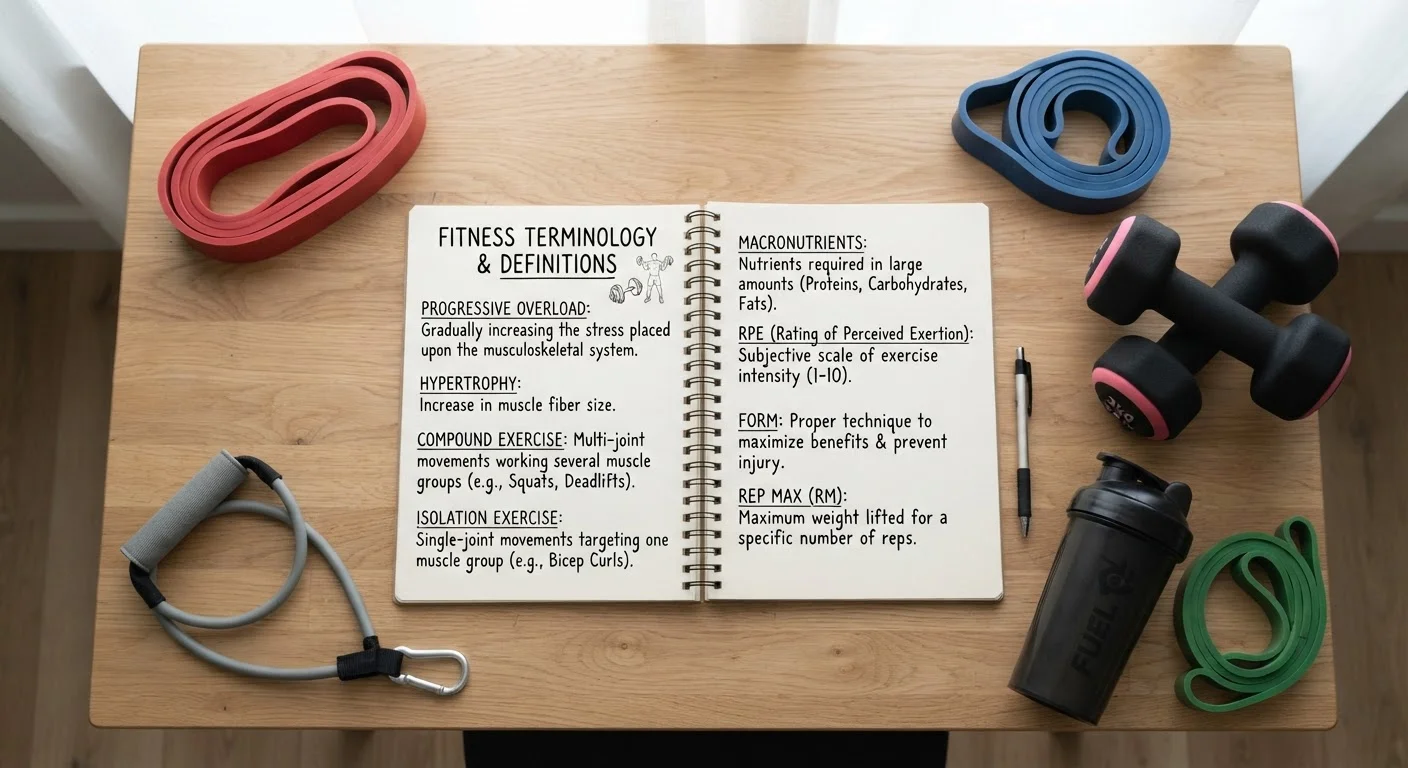
| Concentric vs. Eccentric | Shortening = concentric; lengthening under load = eccentric |
| Typical Static Stretch Hold | 20–60 seconds per position (American College of Sports Medicine guidelines) |
| Progressive Overload Principle | Gradually increase demand to continue adaptation |
| PNF Stretching | Contract-relax technique for advanced flexibility gains |
| Isometric Example | Plank hold — force without joint movement |
| 1RM Use Case | Sets training loads as a percentage of maximum lift |
Why Terminology Matters in Training
Whether you're following a workout plan, working with a trainer, or reading about stretching techniques, you'll quickly encounter a set of recurring terms: eccentric, ROM, PNF, progressive overload. Understanding what these words actually mean — not just guessing from context — helps you train more intentionally and get more out of every session.
This glossary covers the core vocabulary of strength and flexibility training. Each definition is written for practical use, not academic memorization. Think of it as a reference you return to rather than read front to back. For a broader look at how these concepts fit together, see the complete overview of strength and flexibility training.
| Concentric vs. Eccentric | Shortening = concentric; lengthening under load = eccentric |
| Typical Static Stretch Hold | 20–60 seconds per position (American College of Sports Medicine guidelines) |
| Progressive Overload Principle | Gradually increase demand to continue adaptation |
| PNF Stretching | Contract-relax technique for advanced flexibility gains |
| Isometric Example | Plank hold — force without joint movement |
| 1RM Use Case | Sets training loads as a percentage of maximum lift |
Strength Training Terms Defined
Strength training has its own precise language. The terms below describe how exercises are structured and how muscles behave during movement.
Understanding muscle contraction types matters more than it might seem. Many people lift through the concentric phase with effort, then let gravity handle the return — unknowingly skipping the eccentric phase, which research suggests is particularly effective for building both strength and muscle length. For a deeper look at reps, sets, and how to structure your training sessions, see the plain-language breakdown of reps, sets, and rest periods.
Flexibility Terms and How They Apply
Flexibility terminology often confuses people because the same word — stretching — covers several distinct techniques with different mechanisms and timing rules.
Static stretching is what most people picture: hold a position, breathe, and wait. It's effective for increasing long-term flexibility but is generally better suited to post-exercise cool-downs than warm-ups, since it can temporarily reduce explosive muscle output when performed before intense activity.
Dynamic stretching, by contrast, involves controlled movement through a joint's range of motion. Leg swings, hip circles, and shoulder rolls are all dynamic stretches. Because they elevate temperature and rehearse movement patterns, they're well-suited to warm-up routines.
PNF stretching is more advanced: a target muscle is stretched, then contracted isometrically against resistance, then relaxed and stretched further. This cycle can produce meaningful flexibility gains, but it requires careful technique — ideally guided by a trained professional at first.
This Is General Information, Not Medical Advice
The definitions in this glossary are intended for educational purposes. If you have an injury, chronic condition, or are new to exercise, consult a qualified healthcare or fitness professional before beginning any training program. Terminology and protocols may vary between coaches, clinicians, and training systems.
If you're stretching consistently but not making progress, the issue is often technique or timing rather than effort. Explore common reasons flexibility isn't improving for practical corrections.
Putting the Vocabulary to Work
Knowing these terms transforms how you read and follow a training plan. When a program calls for three sets of eight reps at 70% of your 1RM with controlled eccentric tempo, you now have a clear picture of what that means — and why each element is there.
The same applies to flexibility programming. Seeing two rounds of PNF stretching targeting hip flexors is no longer intimidating once you understand the contract-relax mechanism behind it.
For a broader foundation in fitness language — including terms from cardiovascular and endurance training — the exercise science terms every beginner encounters is a useful companion reference. And if you want to understand how strength and flexibility fit into your overall physical health, the four pillars of physical fitness lays out the full picture.
This article is for general informational and educational purposes only and is not a substitute for professional medical or fitness advice. Consult a qualified healthcare provider before beginning any new exercise program, especially if you have existing health conditions or injuries.