

| Number of core fitness pillars | 4 |
| Weekly cardio recommendation (adults) | 150–300 min moderate intensity (U.S. Department of Health and Human Services Physical Activity Guidelines) |
| Muscle-strengthening days per week | 2 or more (U.S. Department of Health and Human Services Physical Activity Guidelines) |
| Balance training benefit | Reduced fall risk in older adults (CDC, Older Adult Falls Data) |
| Flexibility training frequency | 2–3 sessions per week recommended (American College of Sports Medicine) |
Why Four Pillars?
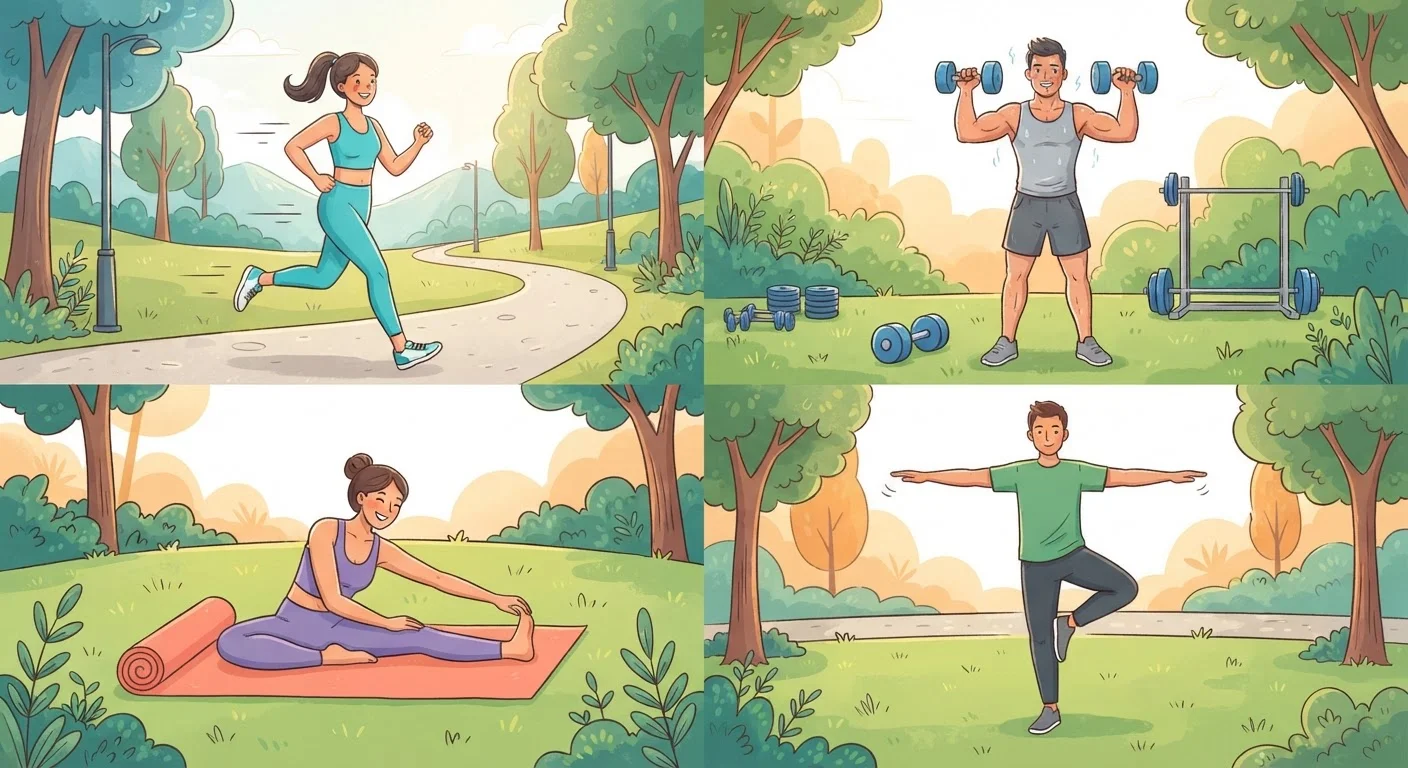
Most people think of fitness as one thing — being "in shape." But physical fitness is actually a collection of distinct capacities, each trained differently and each contributing something the others cannot replace. Exercise scientists and public health bodies consistently organize these capacities into four foundational pillars: cardiovascular endurance, muscular strength, flexibility, and balance.
Understanding what each pillar means — and how they interact — helps you build a routine that is genuinely well-rounded rather than accidentally lopsided. Many beginners over-invest in one area (often cardio or strength) and neglect the others, which can limit progress and increase injury risk over time.
The sections below explain each pillar in plain language. For a deeper dive into the terminology you'll encounter as you start training, see our beginner's exercise science glossary.
This Is General Information, Not Medical Advice
The guidance in this article is educational and intended for generally healthy adults. If you have a health condition, injury, or have been inactive for an extended period, consult a qualified healthcare professional or certified exercise specialist before starting or changing a fitness routine.
Pillar 1: Cardiovascular Endurance
Cardiovascular endurance — sometimes called cardiorespiratory fitness — is your body's ability to keep moving at a sustained pace over time. It reflects how well your heart, lungs, and blood vessels deliver oxygen to working muscles during activities like walking, jogging, cycling, or swimming.
Strong cardiovascular fitness is linked to a lower risk of heart disease, type 2 diabetes, and several other chronic conditions. It also supports energy levels in daily life; tasks like climbing stairs or carrying groceries become noticeably easier as this pillar strengthens.
To build it, adults are generally encouraged to aim for moderate-intensity aerobic activity most days of the week. "Moderate intensity" typically means you can speak in short sentences but couldn't comfortably sing. If you are deciding how to divide your training time between cardio and strength work, our article on cardio vs. strength training breaks down how to prioritise based on your personal goals.
150 min
Minimum weekly moderate cardio for adults
Per the U.S. Department of Health and Human Services Physical Activity Guidelines for Americans.
36 million
Fall-related injuries in U.S. older adults annually
According to the CDC, balance training is a key evidence-based strategy for fall prevention.
2x
Strength training sessions per week
The U.S. Physical Activity Guidelines recommend at least two muscle-strengthening sessions each week for all adults.
Pillar 2: Muscular Strength
Muscular strength is the force your muscles can generate — how much you can lift, push, or pull. It is built through resistance training: bodyweight exercises, free weights, resistance bands, or weight machines all qualify.
Strength is not just for athletes. Everyday tasks — carrying groceries, opening a jar, getting up from a chair — rely on baseline muscular strength. Maintaining it also supports bone density, metabolic health, and joint stability as you age.
Strength training works through a principle called progressive overload: gradually increasing the challenge so muscles continue to adapt. This does not mean lifting heavy right away; it means consistently nudging the difficulty upward at a pace your body can handle. For clear definitions of terms like reps, sets, and range of motion, our strength and flexibility glossary is a useful reference.
| Number of core fitness pillars | 4 |
| Weekly cardio recommendation (adults) | 150–300 min moderate intensity (U.S. Department of Health and Human Services Physical Activity Guidelines) |
| Muscle-strengthening days per week | 2 or more (U.S. Department of Health and Human Services Physical Activity Guidelines) |
| Balance training benefit | Reduced fall risk in older adults (CDC, Older Adult Falls Data) |
| Flexibility training frequency | 2–3 sessions per week recommended (American College of Sports Medicine) |
Pillars 3 & 4: Flexibility and Balance
These two pillars are frequently overlooked — and that's a mistake.
Flexibility refers to the range of motion your joints can move through comfortably. When flexibility is limited, compensatory movement patterns often develop, placing extra stress on surrounding structures. Regular stretching — held for at least 15–30 seconds per muscle group, without bouncing — is the most established way to improve it. Yoga and mobility-focused exercise classes also address flexibility systematically.
Balance is the ability to control your body's position, whether you are standing still or moving. It depends on coordinated signals from your muscles, vision, and inner ear. Balance tends to decline with age, which contributes to fall risk — a significant concern for older adults. Simple exercises like single-leg stands, heel-to-toe walking, and tai chi are well-supported strategies for improving it.
Together, these pillars underpin everything from athletic performance to injury prevention and healthy aging. For a comprehensive look at how strength and flexibility training fit together as a long-term practice, see our complete overview of strength and flexibility training.
Cardiovascular Endurance
The ability of your heart and lungs to sustain aerobic activity over time. It reflects how efficiently your body delivers oxygen to working muscles during prolonged movement.
Muscular Strength
The maximum force a muscle or muscle group can produce in a single effort. It is developed through progressive resistance training.
Flexibility
The range of motion available at a joint or series of joints. Good flexibility reduces movement restriction and supports injury resilience.
Balance
The ability to maintain a controlled body position whether stationary or moving. It relies on coordinated input from muscles, the inner ear, and the nervous system.
Aerobic Exercise
Physical activity sustained for extended periods using oxygen as the primary energy source. Walking, cycling, and swimming are common examples.
Progressive Overload
Gradually increasing the demands placed on the body — through weight, repetitions, or intensity — so muscles continue to adapt and grow stronger over time.
This article is for general informational purposes only and is not a substitute for professional medical advice, diagnosis, or treatment. Always consult a qualified healthcare professional before beginning a new exercise program.