

Key Takeaways
- Prolonged sitting is linked to increased cardiovascular, metabolic, and musculoskeletal health risks.
- Prolonged standing is not a straightforward fix — it introduces its own circulatory and musculoskeletal strain.
- Breaking up sedentary time with frequent movement is more important than which posture you default to.
- Alternating between sitting and standing throughout the day is better than committing to either exclusively.
- Brief, regular movement breaks — even just a short walk — produce measurable physiological benefits.
- No desk setup replaces the value of consistent daily physical activity outside of work hours.
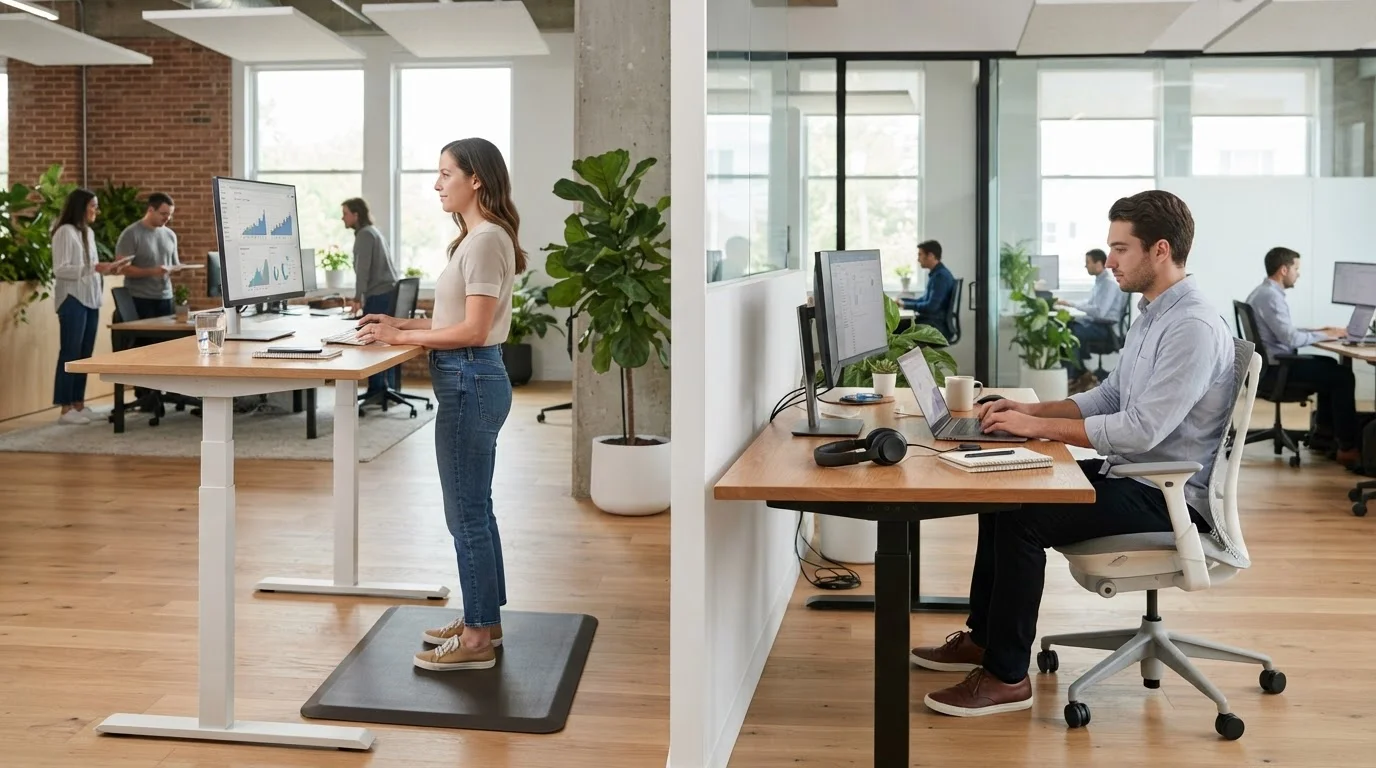
Option A
Prolonged Sitting
The default posture of modern desk work.
Best for: Tasks requiring sustained focus, but problematic when held continuously for hours without breaks.
Option B
Prolonged Standing
The popular alternative — with its own set of trade-offs.
Best for: Short-to-medium bouts of work that benefit from energy and posture variety, not as a static replacement for sitting.
If you sit at a desk for most of your workday
Alternating Sitting and Standing
Research consistently favors posture variety over any single static position. Aim to alternate every 30–60 minutes and add short walks throughout the day.
If you are considering a standing desk to improve health
Alternating Sitting and Standing
Standing desks offer real benefits when used for posture variation, but standing continuously can cause fatigue, varicose vein risk, and lower-limb discomfort — use it as one tool, not the only one.
If you experience back or neck pain from sitting
Prolonged Standing
Brief standing periods can relieve spinal compression associated with sitting, but consult a physical therapist or healthcare provider for persistent musculoskeletal concerns before making major changes.
If you want maximum productivity with minimal health compromise
Alternating Sitting and Standing
Cognitive performance and energy are better sustained with posture changes and movement breaks than with either static posture held throughout the day.
The Case Against Prolonged Sitting
Extended sitting has accumulated a significant body of evidence against it. Research published in journals including the Annals of Internal Medicine has associated prolonged sedentary time — independent of overall physical activity levels — with increased risk of cardiovascular disease, type 2 diabetes, and all-cause mortality. Understanding why this happens matters: why sitting for long periods affects the body the way it does comes down to measurable physiological changes, including reduced muscle electrical activity, slowed circulation in the lower limbs, and suppressed lipoprotein lipase activity — an enzyme involved in fat metabolism.
The concern is not any single bout of sitting. It is the pattern of near-continuous sedentary time that characterizes most desk-based workdays. The average U.S. adult spends roughly 6–8 hours per day sitting, a figure that has risen with remote work becoming more common.
| Criterion | Prolonged Sitting | Prolonged Standing |
|---|---|---|
| Cardiovascular risk | Elevated with continuous, unbroken sitting | Not clearly reduced vs. sitting alone |
| Metabolic effects | Reduced lipase activity, blood glucose spikes | Modest short-term glucose improvement |
| Musculoskeletal strain | Spinal compression, hip flexor tightness | Lower-limb fatigue, varicose vein risk |
| Energy expenditure | Lower calorie burn | Slightly higher calorie burn |
| Cognitive performance | Declines over long unbroken periods | Can decline with fatigue from sustained standing |
| Practicality at work | High — standard office default | Moderate — requires desk equipment |
| Research verdict | Clear risks with prolonged unbroken use | Benefits limited when used as static replacement |
Standing Desks: Promise vs. Reality
Standing desks gained popularity as a logical counterpoint to sitting's risks, and the appeal is understandable. Standing does increase muscle activation and calorie expenditure slightly compared to sitting. Some research has also found modest improvements in blood glucose levels and reductions in lower back discomfort when workers alternate between sitting and standing.
However, the evidence does not support replacing sitting with prolonged standing. Sustained standing over multiple hours raises its own concerns: increased pressure on the lower limbs, greater risk of varicose veins, lower-back and leg fatigue, and reduced comfort that can negatively affect concentration. A systematic review of workplace interventions found that sit-stand desks reduced sitting time meaningfully but that the health benefits were most pronounced when standing was combined with movement — not when standing simply replaced sitting as the new static posture.
6–8 hrs
Average daily sitting time for U.S. adults
Estimates from national health surveillance data suggest most working-age adults in the U.S. sit for the majority of their waking hours.
~54 cal/hr
Calories burned standing vs. ~47 seated
Research published in the Journal of Physical Activity and Health found standing burns modestly more energy than sitting, though the difference is relatively small over a workday.
66%
Reduction in sitting time with sit-stand desks
A Cochrane review of workplace interventions found sit-stand desks can reduce workplace sitting time by up to 66 minutes per day in the short term.
It is also worth noting that common movement myths can distort how people use standing desks — treating them as a complete solution rather than one component of a broader movement strategy.
What the Evidence Actually Recommends
The clearest take from the research is this: variety of posture combined with frequent movement breaks outperforms either static option. Leading exercise science bodies, including the American College of Sports Medicine, emphasize reducing uninterrupted sedentary time rather than prescribing a specific sitting-to-standing ratio.
Practical guidance from current research generally supports:
- Breaking up sitting every 30–60 minutes with a brief stand or short walk
- Using a sit-stand desk to alternate postures, not to stand continuously
- Incorporating light activity — walking to a colleague, taking stairs, standing during phone calls — throughout the day
- Pairing desk-based movement habits with regular moderate-intensity physical activity outside work hours
The habits that offset the risks of sitting all day do not require expensive equipment — they require consistency. Small, repeated movement cues woven into your workday are more effective than any single intervention. For those navigating the difference between sedentary behaviour and physical inactivity, understanding that these are two separate health dimensions can help clarify what desk-time adjustments can — and cannot — accomplish on their own.
This article provides general health information for educational purposes only and is not a substitute for advice from a qualified healthcare or medical professional. If you have specific health concerns related to posture, musculoskeletal pain, or sedentary behavior, consult your doctor or a licensed physical therapist.