

Key Takeaways
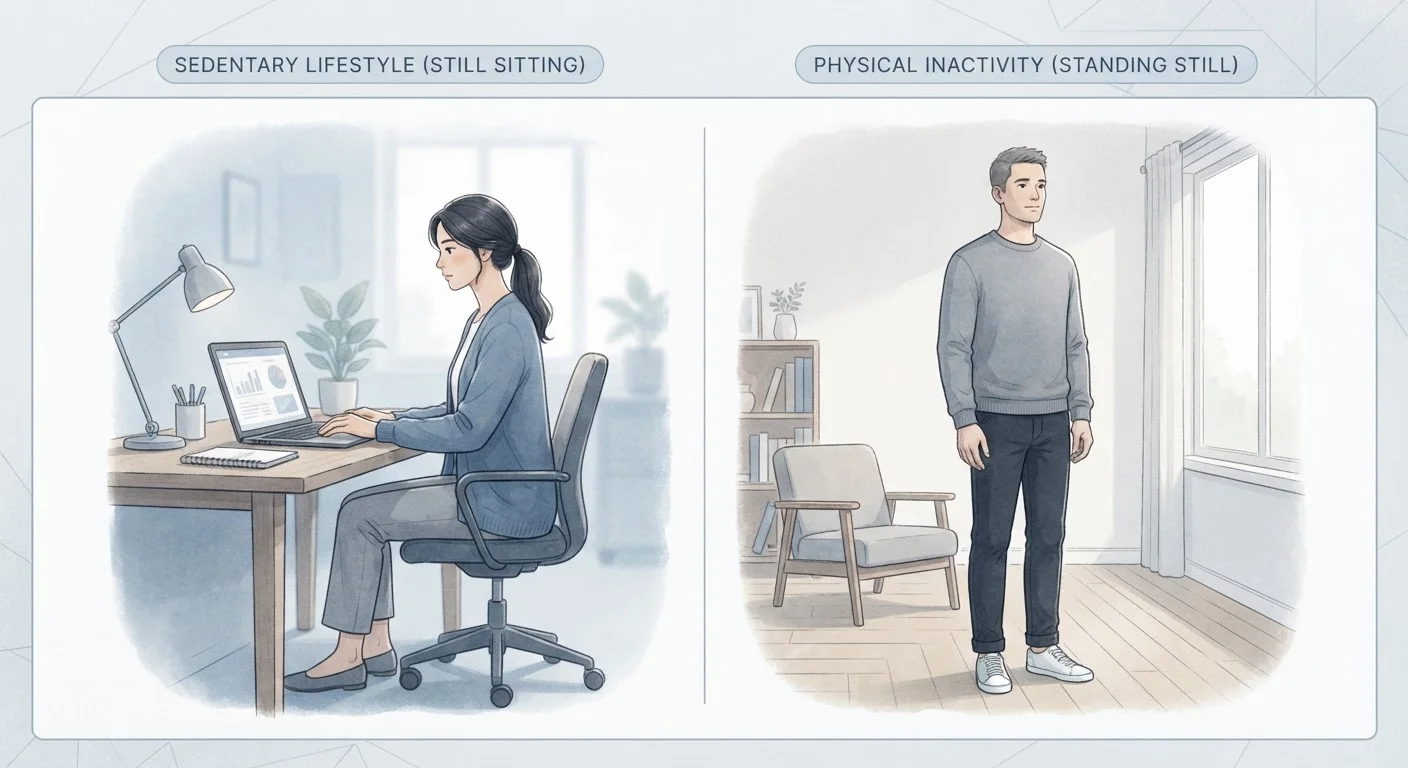
- Sedentary behaviour means sustained low-energy sitting or reclining while awake; physical inactivity means not meeting recommended exercise thresholds.
- A person can be physically active by exercise standards and still be highly sedentary during the rest of their day.
- Both conditions carry independent health risks and require separate behavioural strategies to address.
- Breaking up sitting time with brief movement throughout the day is the primary tool for reducing sedentary risk.
- Meeting structured exercise guidelines is the primary tool for addressing physical inactivity.
- Current evidence suggests that managing both risks together produces greater health benefits than targeting either one alone.
Option A
Sedentary Behaviour
The low-energy sitting problem hiding in plain sight.
Best for: Understanding why prolonged sitting carries health risks independent of how much you exercise.
Option B
Physical Inactivity
Failing to meet the body's minimum movement requirements.
Best for: Understanding why not getting enough moderate-to-vigorous exercise is its own distinct public health concern.
If you sit for most of your workday despite going to the gym
Sedentary Behaviour
Your exercise habit addresses physical inactivity but not the independent health risk of sustained daily sitting. Reducing unbroken sitting time requires a separate strategy.
If you rarely sit for long stretches but avoid structured exercise
Physical Inactivity
Light movement throughout the day is valuable but unlikely to deliver the cardiovascular and metabolic benefits tied to moderate-to-vigorous physical activity.
If you want to understand why health messaging targets both sitting and exercise separately
Sedentary Behaviour
Grasping that sedentary behaviour and inactivity are distinct concepts explains why public health guidance addresses them with different, complementary tools.
If you are building a more active lifestyle from scratch
Physical Inactivity
Prioritising structured moderate activity first tends to produce the most measurable improvements in cardiovascular fitness and metabolic health for beginners.
Why These Two Terms Are Not Interchangeable
Health researchers, clinicians, and public health agencies use sedentary behaviour and physical inactivity as distinct technical terms — yet in everyday conversation, they are treated as synonyms. That confusion matters because the two conditions arise from different behaviours, produce different physiological effects, and call for different solutions.
Sedentary behaviour is defined by researchers as any waking activity performed at a very low energy expenditure — typically sitting, reclining, or lying down — while remaining awake. The threshold used in exercise science is generally 1.5 metabolic equivalents (METs) or below. Watching television, working at a desk, and riding in a vehicle all qualify.
Physical inactivity, by contrast, refers to a failure to meet recommended volumes of moderate-to-vigorous physical activity (MVPA). Major health bodies such as the World Health Organization and the U.S. Department of Health and Human Services set general adult guidelines around 150 minutes of moderate-intensity aerobic activity per week as a reference point, though individual circumstances vary. Not reaching that threshold — regardless of how much time you spend sitting — is what defines physical inactivity.
This is closely tied to what "exercise" actually means in a clinical sense, a distinction worth understanding before drawing conclusions about your own routine.
The Overlap — and the Critical Gap
Imagine two adults. The first runs 30 minutes every morning but spends the remaining 10 waking hours at a desk with almost no movement breaks. The second never does structured exercise but works a job that keeps them on their feet and moving throughout the day.
Under the research definitions: the first person is physically active but highly sedentary. The second is sedentary-behaviour-low but potentially physically inactive — depending on the intensity of their occupational movement.
This gap explains a body of epidemiological research showing that high volumes of daily sitting are associated with elevated health risks even among people who exercise regularly. The mechanisms appear to involve metabolic changes — including shifts in blood glucose regulation and lipoprotein lipase activity — that occur during extended stillness and are not fully reversed by a single bout of exercise later in the day. For a deeper look at these physiological changes, see why sitting for long periods affects the body the way it does.
| Criterion | Sedentary Behaviour | Physical Inactivity |
|---|---|---|
| Core definition | Sustained waking time at ≤1.5 METs (sitting, reclining) | Failing to meet recommended MVPA volumes |
| Can you have one without the other? | Yes — active exercisers can still be highly sedentary | Yes — low sitters may still not reach MVPA thresholds |
| Primary health mechanism | Metabolic disruption from prolonged stillness | Insufficient cardiovascular and muscular stimulus |
| Key intervention | Break up sitting with frequent brief movement | Accumulate structured moderate-to-vigorous activity |
| Intensity of movement required | Even light activity (standing, slow walking) helps | Moderate-to-vigorous intensity is necessary |
| Addressed by gym workouts alone? | Not fully — sitting between sessions still poses risk | Yes, if sessions meet recommended guidelines |
It is also worth acknowledging what the evidence does not firmly establish: the precise dose of sitting that becomes harmful, and whether all sedentary activities carry equal risk. Some research suggests that mentally engaged sedentary time (reading, cognitively demanding work) may differ from passive screen time, though this area remains under investigation.
Separate Risks, Separate Strategies
Because these are distinct constructs, they require distinct responses.
Reducing Sedentary Behaviour
The primary lever for sedentary risk is breaking up sitting time — not necessarily replacing it with vigorous exercise. Brief standing, walking, or light movement interruptions distributed throughout the day appear to attenuate some of the metabolic effects of prolonged stillness. Movement snacks — short activity bursts woven into the day — are a practical, evidence-informed tool here. A room-by-room audit of where sitting time accumulates can make the problem concrete and actionable.
Addressing Physical Inactivity
Meeting recommended activity volumes requires intentional, structured moderate-to-vigorous movement — walking at a brisk pace, cycling, swimming, strength training, or equivalent activities. Light activity alone rarely achieves the cardiovascular and metabolic adaptations linked to MVPA. This distinction is one of the active living myths worth untangling: pottering around the house all day does not substitute for sustained moderate effort.
~25%
Adults globally who are physically inactive
The World Health Organization estimates roughly one in four adults worldwide does not meet recommended physical activity levels.
6–8 hrs
Average daily sitting time for US adults
Research published in health and epidemiology journals consistently places average waking sedentary time for American adults at six to eight hours per day.
Both risks also intersect meaningfully with long-term health outcomes. Sustained physical inactivity is a recognised contributor to the development and progression of several chronic conditions, from cardiovascular disease to metabolic disorders. Understanding the difference between these two behavioural risks can meaningfully improve how you read and apply health information found online.
This article is for general informational purposes only and does not constitute medical advice. Consult a qualified healthcare professional before making changes to your activity levels, especially if you have an existing health condition.