

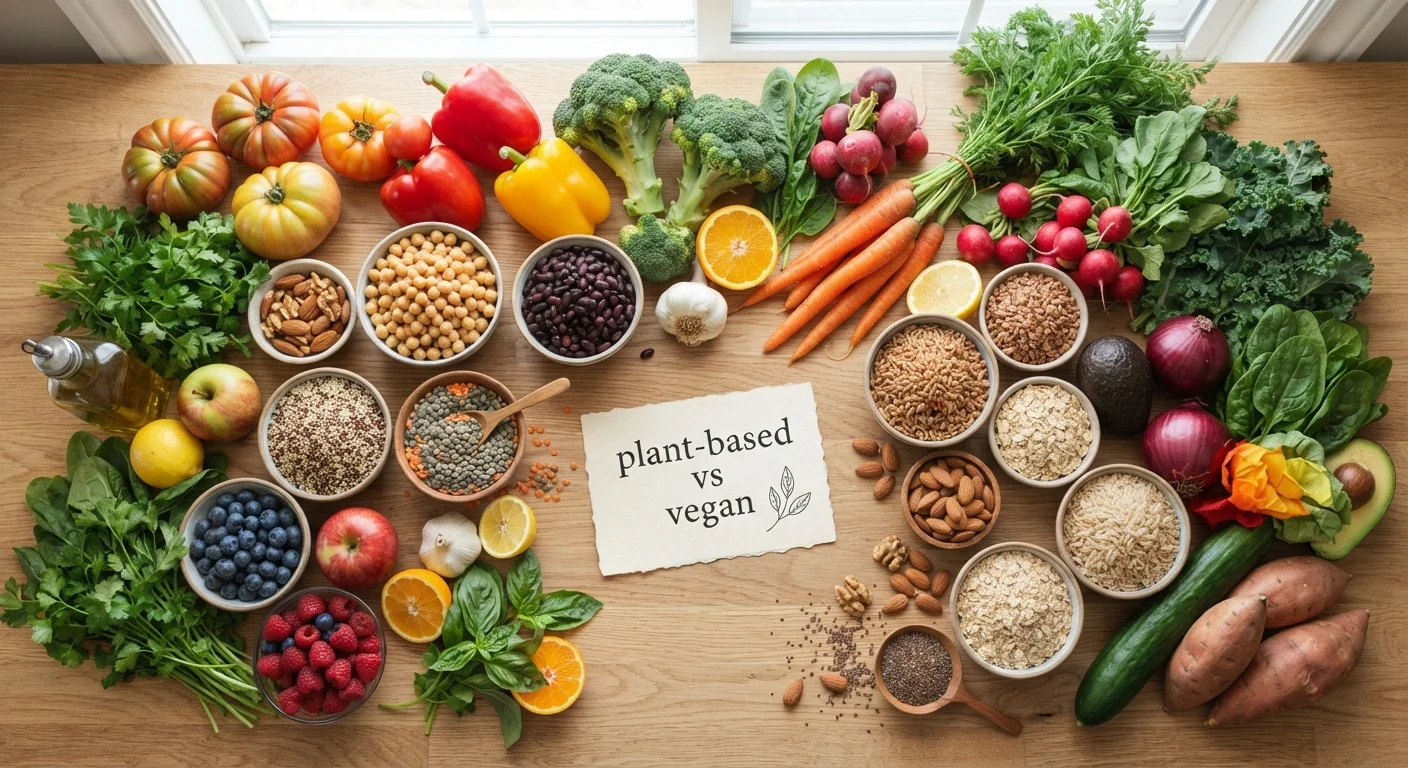
Key Takeaways
- Plant-based is primarily a health-oriented dietary framework; vegan is an ethical and lifestyle commitment.
- Plant-based diets emphasize food quality and minimizing animal products, but do not require eliminating them entirely.
- Vegan diets exclude all animal-derived foods — including dairy, eggs, and honey — regardless of processing level.
- A vegan diet can include heavily processed foods; a plant-based approach specifically discourages them.
- Both patterns require attention to certain nutrients, especially vitamin B12, iron, and omega-3 fatty acids.
- Understanding the distinction helps you choose the approach that aligns with your health goals and values.
Option A
Plant-Based Diet
A flexible, food-quality-focused eating pattern centered on whole plants.
Best for: People prioritizing health outcomes who want to reduce animal products without eliminating them entirely.
Option B
Vegan Diet
A strict, ethics-driven commitment to eliminating all animal-derived foods.
Best for: Individuals motivated by animal welfare or environmental values who want a clear, rule-based framework.
If your primary goal is improving long-term health and reducing chronic disease risk
Plant-Based Diet
The whole-food, plant-based framework specifically targets food quality and nutrient density, which are the drivers most linked to health outcomes in the research literature.
If reducing your contribution to animal agriculture and environmental impact is your priority
Vegan Diet
Veganism provides a clear, consistent ethical boundary that extends beyond food to all animal-derived products, making it the more principled framework for those motivated by these values.
If you want flexibility and are not ready to eliminate all animal products
Plant-Based Diet
A plant-based approach accommodates occasional animal products, reducing the social and practical friction of a strict dietary commitment while still delivering meaningful health benefits.
If you follow structured dietary rules and want minimal ambiguity about what to eat
Vegan Diet
Veganism's clear boundaries — no animal-derived ingredients — make food decisions straightforward once the commitment is in place.
Why the Confusion Exists
Walk through any grocery store or scroll through any wellness feed and you will encounter both terms used almost interchangeably. Food manufacturers label products "plant-based" to signal health or sustainability credentials. Restaurants describe vegan menus as plant-based to broaden their appeal. The result is a blurring of two concepts that, while overlapping, carry distinct meanings rooted in different motivations.
Understanding the distinction matters because the label on a diet shapes what it includes, what it excludes, and why — and those factors directly affect nutritional outcomes, practical sustainability, and whether a given pattern aligns with your personal goals.
| Criterion | Plant-Based Diet | Vegan Diet |
|---|---|---|
| Primary motivation | Health and disease prevention | Animal welfare and ethics |
| Animal product rules | Minimized but not strictly forbidden | Completely eliminated |
| Processed food stance | Explicitly discouraged | No inherent restriction |
| Dietary flexibility | High — adaptable to individual needs | Low — clear, fixed boundaries |
| Extends beyond food | No — food-focused only | Often yes — clothing, cosmetics, etc. |
| Nutrient planning needed | Moderate — especially B12 and iron | Higher — B12, calcium, iodine, omega-3s |
| Research base | Strong for cardiovascular and metabolic health | Positive, but quality-dependent |
Defining Plant-Based: Health First
The term plant-based entered mainstream nutrition discourse largely through research on whole-food dietary patterns associated with reduced rates of cardiovascular disease, type 2 diabetes, and certain cancers. Its core emphasis is on food quality: centering vegetables, fruits, whole grains, legumes, nuts, and seeds while limiting — but not necessarily eliminating — animal products and processed foods.
Crucially, a plant-based diet is descriptive, not prescriptive. Someone eating mostly plants with occasional fish or dairy can legitimately describe their pattern as plant-based. The framework is flexible and health-driven rather than rule-bound. For those curious about structuring this approach more formally, our practical first-timer's overview covers the fundamentals in detail.
"Plant-Based" on Food Labels
Food manufacturers frequently use "plant-based" as a marketing descriptor rather than a nutritional standard. A product labeled plant-based may still be heavily processed, high in sodium, or low in fiber. When evaluating any packaged food, the nutrition facts panel and ingredient list are more informative than front-of-pack labeling. Regulatory definitions for "plant-based" on food labels remain inconsistent across jurisdictions.
Defining Vegan: Ethics as the Foundation
Veganism is defined primarily by ethics, not health. Coined by Donald Watson and the Vegan Society in 1944, it describes the practice of excluding all animal-derived foods and — in its full expression — animal products from clothing, cosmetics, and other areas of life. At the dietary level, veganism eliminates meat, poultry, seafood, dairy, eggs, and honey.
Importantly, veganism places no inherent constraint on food processing or quality. A diet of heavily processed vegan convenience foods, refined grains, and added sugars is technically vegan. This distinction explains why nutritional researchers increasingly distinguish between "healthy" and "unhealthy" plant-based dietary indices — recognizing that vegan and nutritionally optimal are not synonyms.
If you follow a vegan pattern, certain nutrients warrant deliberate planning. Our article on nutrients that deserve attention on a vegan diet covers vitamin B12, calcium, iron, iodine, and omega-3 fatty acids — all of which require strategic sourcing when animal foods are fully excluded.
Where They Overlap — and Where They Diverge
Both approaches share significant common ground: they reduce reliance on animal products and, when well-constructed, can support healthy dietary patterns. Research consistently associates higher plant food intake with favorable health markers, regardless of whether the person identifies as vegan or plant-based.
The divergence becomes clearest on three axes:
- Motivation: Plant-based is health-centric; vegan is ethics-centric.
- Strictness: Plant-based allows flexibility with animal products; vegan permits none.
- Food quality: Plant-based explicitly discourages processed foods; vegan imposes no such constraint.
These differences have real consequences. A person adopting a whole-food, plant-based diet for cardiovascular health may consume small amounts of wild-caught fish. A committed vegan may regularly eat processed meat substitutes that are technically animal-free but nutritionally comparable to conventional ultraprocessed foods. Neither is a flaw — they are simply different tools for different goals. For a broader nutritional comparison, see our article on plant-based eating vs. omnivorous diets.
~3%
U.S. adults identifying as vegan
Gallup polling has consistently estimated veganism at roughly 1–3% of the U.S. adult population, while plant-based eating is adopted more broadly under various interpretations.
16–18%
Reduction in cardiovascular risk
A 2019 analysis published in the Journal of the American Heart Association found that high adherence to a healthy plant-based dietary index was associated with roughly a 16–18% lower risk of cardiovascular disease.
92%
Vegans deficient in vitamin B12 without supplementation
Research reviewed by the European Journal of Clinical Nutrition indicates that the vast majority of individuals following a strict vegan diet without supplementation develop vitamin B12 deficiency over time.
Choosing the Right Framework for You
Neither label is inherently superior. The right choice depends on your motivations, your lifestyle context, and which framework you can sustain over time. A few practical considerations:
- If reducing chronic disease risk is your goal, emphasizing whole-plant food quality matters more than strict animal product elimination.
- If animal welfare or environmental sustainability drives your choices, veganism offers a consistent ethical framework with clear boundaries.
- Either approach benefits from nutritional planning — vitamin B12 supplementation is generally recommended for anyone eliminating or severely restricting animal products.
- Both patterns can be appropriate for most healthy adults, but special populations — including pregnant individuals, children, and those managing chronic conditions — should consult a registered dietitian before making significant dietary changes.
For those interested in how these patterns interact with physical performance, our piece on special diets and athletic performance explores what sports science research currently suggests.
This article is for general informational and educational purposes only and does not constitute medical or nutritional advice. Consult a qualified healthcare professional or registered dietitian before making significant changes to your diet.