

Key Takeaways
- The % Daily Value on a supplement label is based on a 2,000-calorie reference diet and may not match your individual needs.
- RDA, AI, and UL are all different reference values set by nutrition scientists — they serve distinct purposes.
- IU (International Units) is a potency-based measurement used for fat-soluble vitamins like A, D, and E.
- Structure/function claims on supplement labels are not FDA-approved health claims and require a disclaimer.
- Serving size significantly affects how dose numbers compare across products — always check it first.
Start here
Why Supplement Labels Can Be Confusing
Core knowledge
Key Terms on Every Supplement Facts Panel
Go deeper
Understanding Units of Measurement
Apply it
Daily Values, RDAs, and Upper Limits Explained
Final step
Reading Claims and What They Actually Mean
Why Supplement Labels Can Be Confusing
Walk down any supplement aisle — physical or digital — and you'll encounter a dense patchwork of acronyms, measurement units, and health claims. Terms like RDA, DV, IU, and UL appear without explanation, and serving sizes vary wildly between products covering the same nutrient. The result is that shoppers often can't compare one product to another, let alone understand whether a dose is meaningful or excessive.
Unlike the Nutrition Facts panel on food packaging — which is standardized and widely understood — the Supplement Facts panel operates under a different regulatory framework. The FDA regulates dietary supplements under the Dietary Supplement Health and Education Act (DSHEA) of 1994, which means supplements are not subject to pre-market approval. Labels must follow specific formatting rules, but the science behind the numbers can still be opaque. This guide unpacks each major label element so you can read it with confidence. For a comparison with food labels, see our guide to reading food packaging.
Key Terms on Every Supplement Facts Panel
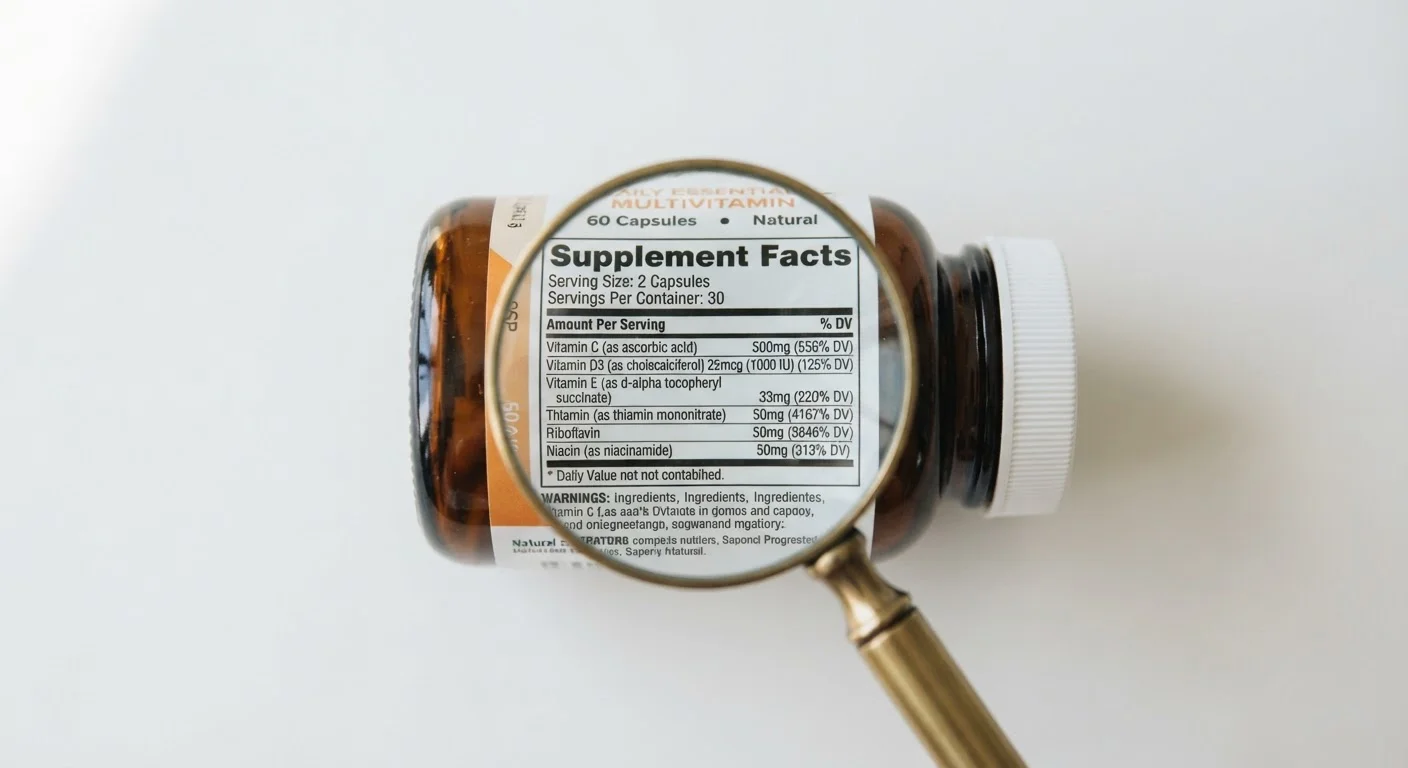
Every Supplement Facts panel contains a core set of required elements. Understanding what each represents is the first step.
Serving Size
The manufacturer-defined amount that constitutes one dose of a supplement. All other label figures — dose amounts and % Daily Values — are calculated based on this quantity.
% Daily Value (% DV)
A percentage showing how much of a nutrient one serving provides relative to an FDA reference intake. It is based on a standard 2,000-calorie diet and is designed for general comparison, not personalized dosing.
RDA
Recommended Dietary Allowance — the average daily intake level estimated to meet the needs of nearly all healthy people in a specific age and sex group, set by the National Academies of Sciences.
IU (International Unit)
A unit measuring the biological potency of a substance rather than its physical weight. Commonly used for vitamins A, D, and E, where different chemical forms have different levels of activity.
UL (Tolerable Upper Intake Level)
The highest daily intake of a nutrient considered safe for almost all healthy adults. Going above this level regularly may increase the risk of harmful effects.
Structure/Function Claim
A statement on a supplement label describing a nutrient's potential effect on the body's structure or normal function. These claims do not require FDA pre-approval and must carry a specific legal disclaimer.
Proprietary Blend
A mixture of ingredients listed on a supplement label under a single combined weight, without disclosing how much of each individual ingredient is present.
AI (Adequate Intake)
A reference intake value used when there is not enough scientific data to establish a full RDA. It represents an estimated level observed in healthy populations.
- Serving Size: The amount the manufacturer designates as one dose — this could be one capsule, two tablets, or a scoop of powder. All other label numbers (dose, % DV) are based on this amount.
- Amount Per Serving: The actual quantity of each nutrient or ingredient in one serving, expressed in the appropriate unit (mg, mcg, IU, etc.).
- % Daily Value (% DV): How much of the FDA's reference daily intake one serving provides. Nutrients without an established DV (often newer or emerging ones) are listed with a dash or an asterisk indicating no DV is set.
- Other Ingredients: Fillers, binders, coatings, or allergens not counted as active ingredients. Relevant for people with sensitivities or dietary restrictions.
Understanding Units of Measurement
Supplements use several measurement units, and mixing them up can lead to significant misreading of a dose.
- mg (milligrams): One thousandth of a gram. Used for minerals like calcium, magnesium, and iron, and for many B vitamins.
- mcg or µg (micrograms): One millionth of a gram — one thousandth of a milligram. Used for nutrients needed in very small amounts, including folate, B12, vitamin K, and selenium. A label showing 1,000 mcg contains the same amount as 1 mg.
- IU (International Units): A unit of biological activity or potency, not weight. Because different chemical forms of the same vitamin have different potencies, IU allows standardized comparison. It is most commonly used for vitamins A, D, and E. The FDA has been encouraging manufacturers to shift away from IU to weight-based units (mcg or mg) for clarity, so many newer labels show both.
- CFU (Colony-Forming Units): Used exclusively for probiotics to measure the number of viable microorganisms in a dose.
Quick Unit Conversion to Keep Handy
When comparing products, note that 1 mg equals 1,000 mcg — a difference that matters for nutrients like folate or B12 where labels sometimes switch units between products. For vitamin D, 400 IU is approximately 10 mcg. Keeping these conversions in mind prevents accidental over- or under-dosing when switching between supplement brands.
Because IU-to-weight conversions differ by nutrient and form, be cautious when comparing products that list the same nutrient in different units. For example, 400 IU of vitamin D equals approximately 10 mcg — a useful conversion to keep in mind.
Daily Values, RDAs, and Upper Limits Explained
These three reference values are related but serve different purposes, and confusing them leads to misinterpretation of what a label is telling you.
- Recommended Dietary Allowance (RDA)
- Set by the National Academies of Sciences, Engineering, and Medicine, the RDA is the average daily intake level sufficient to meet the nutrient needs of nearly all (97–98%) healthy individuals in a specific life stage and sex group. RDAs differ by age and sex, which the simplified DV on labels cannot reflect.
- Adequate Intake (AI)
- Used when there is insufficient data to establish an RDA. It is based on observed or experimentally determined estimates of average intake in healthy populations. Vitamin K and biotin, for example, have AIs rather than RDAs.
- Daily Value (DV)
- The FDA's simplified, population-wide reference number used on labels. It is derived from the highest RDA or AI across major life stage groups. It provides a common baseline for label comparison, not a personalized recommendation.
- Tolerable Upper Intake Level (UL)
- The highest daily intake of a nutrient considered unlikely to pose a risk of harm for almost all individuals. It is not a target — it is a safety ceiling. Regularly consuming nutrients above their UL increases the risk of adverse effects, particularly for fat-soluble vitamins.
Before adding high-dose supplements to your routine, it is worth reviewing what can go wrong when supplementing without guidance and consulting a healthcare provider.
DVs Are Not Personalized Targets
The Daily Value on a supplement label is a population-wide reference, not a recommendation tailored to your age, sex, health status, or diet. Pregnant individuals, older adults, and people with certain conditions often have different nutrient needs than what the standard DV reflects. A registered dietitian or physician can help determine whether a specific nutrient intake is appropriate for your individual situation.
Reading Claims and What They Actually Mean
Beyond the Supplement Facts panel itself, labels often carry marketing claims. Understanding their regulatory weight helps you evaluate them accurately.
- Structure/Function Claims: Statements like "supports bone health" or "promotes immune function" describe how a nutrient may affect a body structure or function. These claims do not require FDA pre-approval and must be accompanied by a disclaimer: "This statement has not been evaluated by the Food and Drug Administration. This product is not intended to diagnose, treat, cure, or prevent any disease."
- Health Claims: Statements linking a nutrient or food component to a reduced risk of a disease. These require FDA authorization and must meet a higher evidence standard.
- Qualified Health Claims: Permitted when evidence is emerging but not conclusive. They must include qualifying language that conveys uncertainty (e.g., "Some evidence suggests...").
Proprietary blends — listed as a single total weight without individual ingredient amounts — are another area requiring careful attention. They make it impossible to know if any single ingredient is present in a meaningful dose. For a deeper look at how this applies to herbal products, see our guide to reading herbal supplement labels.
Once you can read a label confidently, the next step is understanding how nutrients interact with each other — a factor that affects how much you actually absorb. Our article on nutrient interactions worth knowing before supplementing covers this in detail.
This article is for general informational and educational purposes only and does not constitute medical advice. Supplement needs vary by individual. Always consult a qualified healthcare professional before beginning, changing, or stopping any supplement regimen.