

Key Takeaways
- Herbal supplements are not FDA-approved for treating conditions; label claims are regulated separately from drugs.
- Standardized extracts specify a guaranteed percentage of active compounds, giving you more consistent potency information.
- Proprietary blends list ingredients without individual amounts, making it impossible to assess actual doses.
- Structure/function claims on labels do not equal proof of medical effectiveness.
- Third-party certification seals indicate independent quality testing, not government approval.
- Always consult a healthcare provider before starting any herbal supplement, especially with existing medications.
What you will need
Why Herbal Labels Are Uniquely Confusing
Unlike prescription drugs, herbal supplements in the U.S. are regulated as dietary supplements under the Dietary Supplement Health and Education Act (DSHEA) of 1994. This means manufacturers do not need to prove a product is effective — or even that it contains exactly what the label says — before it reaches store shelves. The FDA can act after a problem is reported, not before sale.
That regulatory gap is why two bottles labeled "echinacea" may differ significantly in what they actually contain. Understanding this context is the foundation for reading any herbal label critically. For a broader look at evaluating health claims online, see our hub on online health advice.
Take Label Claims in Context
Even a well-labeled herbal supplement with a clear botanical name and third-party seal tells you nothing about whether that herb will help your specific situation. Evidence quality varies enormously across herbs and conditions. Reviewing common assumptions that lead people astray in herbal wellness can help you set realistic expectations before you start.
What You'll Need Before You Start
You don't need special expertise — just the supplement bottle in hand, a few minutes, and a basic framework for what to look for.
What you will need
Step-by-Step: Decoding the Label
Work through each section of the label systematically using the steps below. Rushing past any one of them is where most people get tripped up.
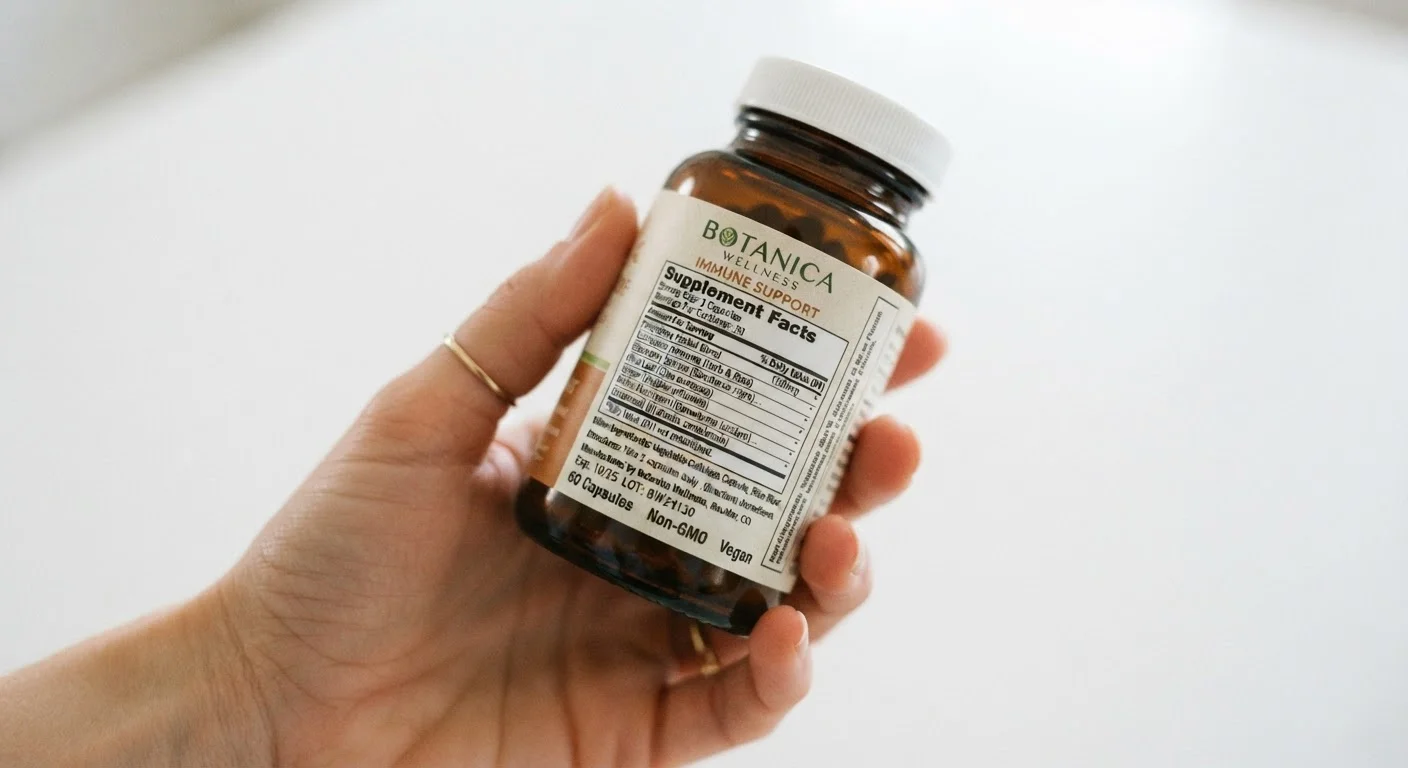
Find the Supplement Facts Panel
Every dietary supplement sold in the U.S. must include a Supplement Facts panel — the equivalent of the Nutrition Facts box on food. Locate it on the back or side of the label. This panel lists the serving size, servings per container, and each ingredient with its amount per serving.
Check the serving size first. Some products list impressive-sounding ingredient amounts that only apply if you take three or four capsules at once.
Identify the Botanical Name and Plant Part
Look for the Latin binomial (genus and species) beside each herb — for example, Valeriana officinalis for valerian. Common names vary by region and can refer to multiple unrelated plants. The Latin name removes that ambiguity.
Also note which plant part is used: root, leaf, flower, bark, or seed. Efficacy and safety data for an herb often apply only to a specific part. A product made from echinacea leaves may behave differently than one made from echinacea root.
Understand Standardized Extracts vs. Whole Herb
Labels may say standardized extract followed by a percentage — for example, "standardized to 0.3% hypericin" for St. John's Wort. This means the manufacturer has guaranteed that a specific marker compound is present at that level in every batch.
Standardization can make dosing more consistent, but it's worth knowing that the standardized compound isn't always the one responsible for the herb's effects — it may simply be the easiest compound to measure. Whole herb or crude extract products contain the full spectrum of plant compounds at naturally occurring ratios, without a guaranteed potency level.
Spot Proprietary Blends
A proprietary blend (sometimes called a "matrix" or "complex") lists several ingredients together under one total weight — without revealing how much of each ingredient is present. Manufacturers use this format to protect formulas from copying, but it also prevents you from knowing whether any single ingredient is present at a meaningful amount.
For example, a blend might list ashwagandha, rhodiola, and ginseng with a combined weight of 500 mg. Any one of those herbs could represent 490 mg or just 5 mg — the label won't say. See our guide on decoding supplement doses and daily values for related guidance on amounts and units.
Check for Third-Party Certification
Look for seals from independent testing organizations such as USP (U.S. Pharmacopeia), NSF International, or ConsumerLab. These indicate that a third party has verified the product contains what the label claims, is free from specified contaminants, and was manufactured under consistent conditions.
These seals do not mean the herb is effective or that the FDA has approved it — only that the product passed quality and purity testing. Their absence doesn't automatically mean a product is poor quality, but their presence adds a layer of accountability.
Read the "Other Ingredients" List
Below the Supplement Facts panel, you'll find Other Ingredients — fillers, binders, capsule materials, preservatives, and coloring agents. These are not the active components but matter if you have allergies, dietary restrictions, or sensitivities. Common examples include gelatin capsules (not suitable for vegetarians), soy-derived fillers, or artificial dyes.
This section also reveals whether the product contains allergens like tree nuts, gluten, or dairy — though supplement labeling requirements for allergens differ from food labeling rules, so don't assume all relevant allergens will be flagged.
Consult a Healthcare Provider First
Some herbal supplements interact with prescription medications or are not appropriate for people with certain health conditions. This is especially important for those who are pregnant, breastfeeding, elderly, or managing a chronic illness. A pharmacist or physician can help you assess whether a specific supplement is safe for your situation — do not rely on label language alone to make that judgment.
Common Label Claims and What They Actually Mean
Labels often carry phrases designed to suggest health benefits without crossing legal lines. "Supports immune health," "promotes relaxation," and "helps maintain energy" are all structure/function claims — a legal category that does not require clinical proof. By law, these statements must be followed by a disclaimer noting the FDA has not evaluated the claim. That disclaimer is often printed in small type.
Compare this to drug claims, which require FDA approval based on evidence. The difference matters enormously. An herb described as "supporting healthy blood sugar" has cleared a much lower bar than a medication prescribed for diabetes management.
For context on how herbal products are actually studied, learn how herbal remedies are evaluated in clinical research — understanding study quality helps you weigh those claims more realistically. Similarly, the phrase "antioxidant support" carries its own marketing baggage; see what antioxidants actually do in supplements for an honest breakdown.
One more label element worth checking: the botanical Latin name. Common herb names are notoriously inconsistent, and buying the wrong species is a real risk. Our herb identification reference covers the most frequently mixed-up plants.
This article is for general informational purposes only and does not constitute medical advice. Always consult a qualified healthcare professional before starting any herbal supplement, particularly if you take prescription medications, are pregnant, or have a chronic health condition.