

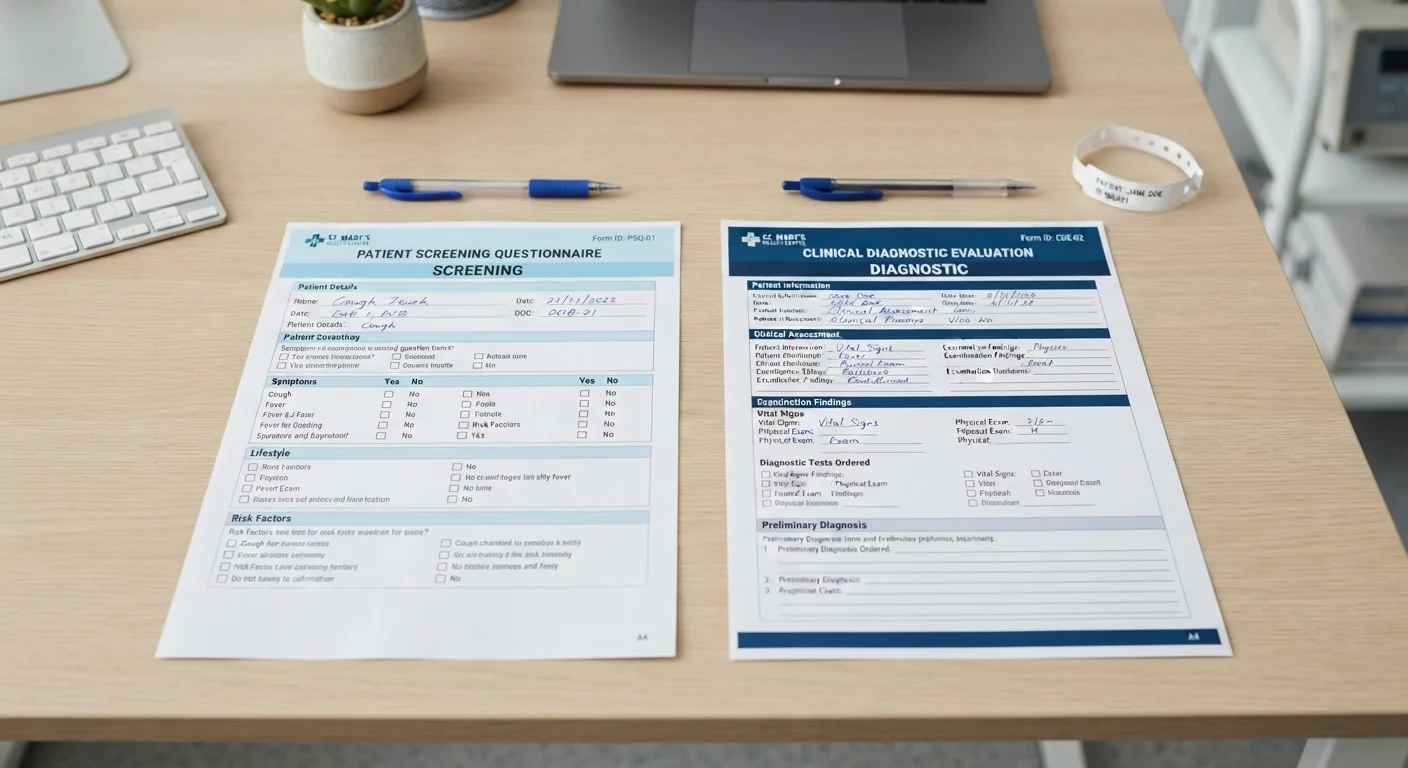
Key Takeaways
- Screening tests identify people who may have a condition; they do not confirm one.
- Diagnostic tests are ordered to confirm, rule out, or characterize a specific condition.
- An abnormal screening result almost always requires follow-up diagnostic testing before any diagnosis is made.
- Screening is typically applied to broader populations; diagnostic testing is tailored to an individual's clinical picture.
- Neither test type is infallible — false positives and false negatives occur in both.
- Always discuss what type of test you are having and what the results mean with your healthcare provider.
Option A
Screening Test
The population-level early warning system.
Best for: Healthy or asymptomatic individuals being checked for risk or early signs of a condition before symptoms appear.
Option B
Diagnostic Test
The targeted, definitive investigation.
Best for: Patients with existing symptoms, abnormal screening results, or a clinical reason requiring a confirmed answer about a specific condition.
If you are healthy with no symptoms but your doctor wants to check for early disease
Screening Test
Screening is designed for asymptomatic populations to catch potential problems early, before a condition has caused noticeable harm.
If you have symptoms, a family history concern flagged by a clinician, or an abnormal screening result
Diagnostic Test
Diagnostic testing is the appropriate next step when there is a specific clinical question to answer or a finding that requires confirmation.
If you want to understand what your next steps are after a positive mammogram or elevated PSA
Diagnostic Test
A positive or abnormal screening result is not a diagnosis — it is a signal that targeted diagnostic follow-up is needed.
Why the Distinction Matters
When a doctor orders a test, patients often assume any result is a verdict. In reality, a test result is only as meaningful as the purpose behind the test itself. Screening tests and diagnostic tests are two fundamentally different tools used at different points in the care journey — and confusing them can cause unnecessary anxiety or, conversely, false reassurance.
Understanding which type of test you are having, and why, puts you in a far better position to interpret results and have an informed conversation with your clinician. For a broader look at what test results ultimately mean, see what a diagnosis actually means.
| Criterion | Screening Test | Diagnostic Test |
|---|---|---|
| Primary purpose | Detect potential risk in asymptomatic people | Confirm or rule out a specific condition |
| Who it's for | Broader population, no symptoms required | Individuals with symptoms or abnormal findings |
| Result interpretation | Abnormal = further investigation needed | Result informs a clinical decision or diagnosis |
| Examples | Mammogram, PSA, fasting glucose | Biopsy, HbA1c, MRI, culture |
| False positive risk | Higher — intentionally sensitive | Lower — designed for specificity |
| Next step if abnormal | Diagnostic testing | Treatment planning or specialist referral |
What Screening Tests Are — and Are Not
A screening test is applied to people who have no current symptoms of the condition being tested for. Its purpose is to identify individuals within a larger population who may be at elevated risk or who may have early-stage disease that has not yet caused noticeable problems. Common examples include mammograms for breast cancer, colonoscopies for colorectal cancer, blood pressure checks, and fasting glucose tests for prediabetes risk.
Critically, a positive or abnormal screening result does not mean you have a disease. It means the result is outside the expected range and warrants a closer look. Screening tests are intentionally designed to be sensitive — they cast a wide net — which means they produce a meaningful number of false positives. For more on this, see false positives and false negatives in medical testing.
~10%
Mammograms recalled for additional imaging
According to the American Cancer Society, approximately 10% of women screened will be called back after a mammogram, but the vast majority do not have cancer.
~50%
Men receiving a false-positive PSA over 10 years
Research published in peer-reviewed literature suggests roughly half of men screened annually with PSA over a decade will receive at least one false-positive result.
What Diagnostic Tests Are — and When They're Used
A diagnostic test is ordered when there is already a clinical reason to investigate — a symptom, an abnormal screening finding, a family history that raises concern, or a doctor's physical examination that turns up something unusual. The goal is to confirm or rule out a specific condition, or to characterize it more precisely.
Diagnostic tests tend to be more specific and more targeted than screening tests. Examples include a biopsy after an abnormal mammogram, an HbA1c test to confirm a diabetes diagnosis following an elevated fasting glucose screen, or an MRI ordered after a neurological symptom. They are designed to answer a focused question rather than cast a broad net.
If you have been referred for diagnostic follow-up, preparing for a diagnostic appointment can help you organize your information and questions in advance.
When One Test Leads to Another
The pathway from screening to diagnosis is often sequential rather than simultaneous. Think of screening as a filter and diagnostic testing as the detailed examination that follows. This is why receiving an abnormal screening result should not be interpreted as a diagnosis — it is an instruction to investigate further.
For example, an elevated prostate-specific antigen (PSA) on a routine screen does not confirm prostate cancer. It signals the need for additional evaluation, which might include imaging, repeat testing, or a biopsy. Similarly, a high blood glucose reading on a wellness panel may prompt a more specific diagnostic workup before any clinical label is applied.
Diagnostic disagreement can sometimes enter this process too — different clinicians may interpret borderline results differently. why two doctors can reach different diagnoses explores why that happens and what to do about it.
This article is for general informational purposes only and does not constitute medical advice. Always consult a qualified healthcare professional about any tests, symptoms, or medical decisions specific to your situation.