

Key Takeaways
- Biopsy, culture, and pathology are distinct processes, each answering a different clinical question.
- Samples follow a strict chain of custody from collection to labeled container to lab analysis.
- Turnaround times vary widely — cultures may take days, while some pathology results take one to two weeks.
- A pathologist or microbiologist, not the collecting clinician, typically renders the formal diagnostic interpretation.
- Understanding the process helps patients ask better questions and set realistic expectations for results.
What you will need
Why Understanding the Lab Process Matters
Hearing your doctor say "we'll send that off to the lab" often marks the most anxious part of any diagnostic workup. Yet the steps between sample collection and your result phone call are rarely explained. Understanding what happens in that interval can reduce uncertainty and help you interpret timelines and terminology when results arrive.
Three terms come up most often: biopsy, culture, and pathology. A biopsy is the physical act of removing tissue or cells for examination. Pathology is the scientific discipline — and the laboratory department — that studies those cells under a microscope to identify disease. A culture is a separate process used to grow and identify microorganisms such as bacteria, fungi, or viruses from a sample. Depending on your clinical situation, your sample may undergo one or all three types of analysis.
What you will need
The Step-by-Step Journey From Collection to Result
Every sample follows a defined, quality-controlled path. The steps below trace that journey so you know what is happening at each stage and what each term means for your care.
Sample Collection and Immediate Preservation
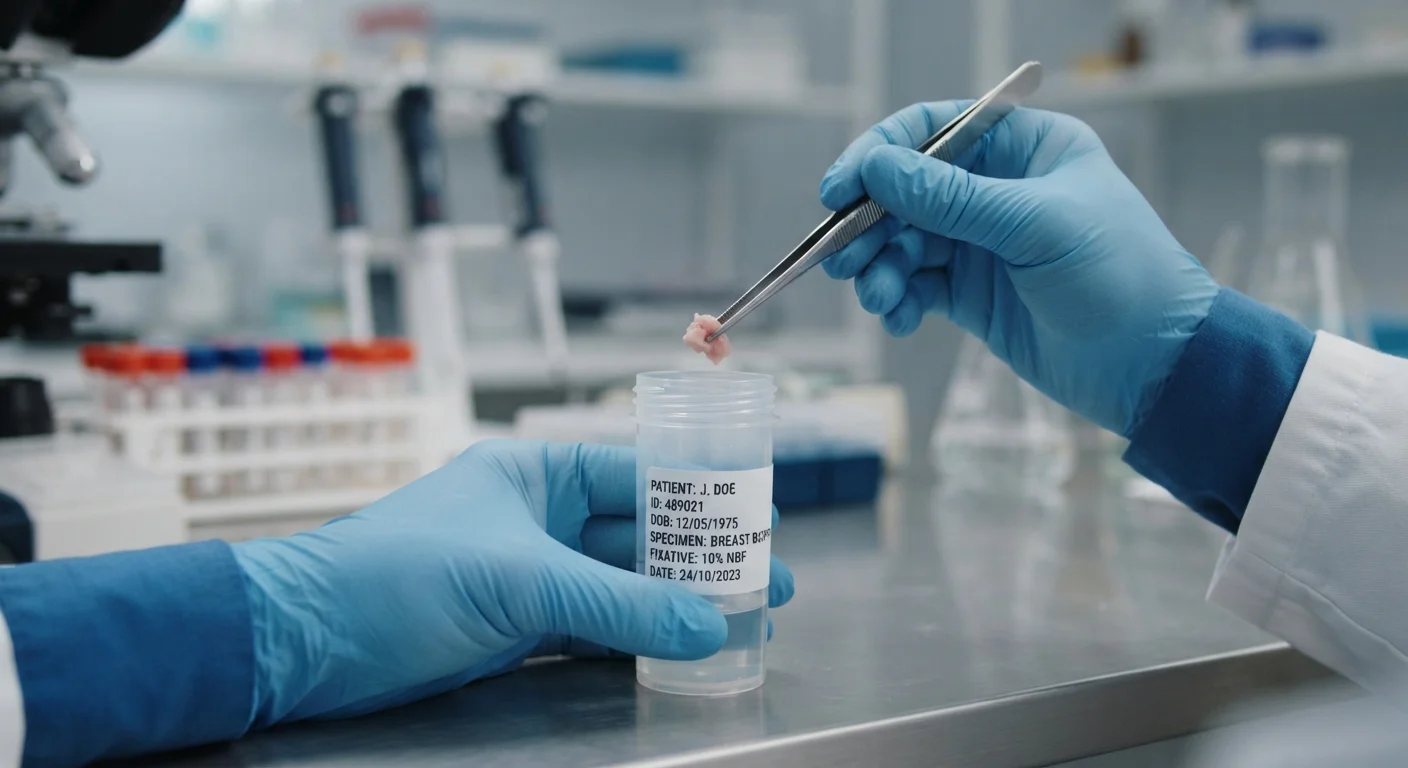
The moment a sample is taken — whether it's a core needle biopsy, punch biopsy, swab, or fluid aspiration — it must be preserved immediately to prevent cellular breakdown. Tissue samples for pathology are typically placed in a solution called formalin (a formaldehyde-based fixative) that halts decay and locks cell structures in place. Samples destined for microbial culture, however, must not be placed in formalin, because that would kill any organisms present. Culture swabs go into specialized transport media that keep microbes viable during transit.
Labeling and Chain of Custody
Every sample container is labeled with at minimum your full name, date of birth, the date and time of collection, and a unique accession number. This chain of custody is a legal and clinical safeguard ensuring the sample analyzed is unambiguously yours. The ordering clinician also completes a requisition form — paper or electronic — that tells the laboratory exactly which tests to run and provides relevant clinical context (for example, "rule out tuberculosis" or "evaluate for malignancy").
Transport to the Laboratory
Samples travel to the laboratory — sometimes in the same building, sometimes via courier to a reference lab — under controlled conditions. Temperature, speed, and packaging standards are regulated to maintain sample integrity. Reference laboratories (large commercial or academic labs) are used when specialized testing is needed that a hospital's in-house lab cannot perform.
Processing — Pathology Workflow
For tissue samples undergoing pathology, laboratory technicians called histotechnologists process the formalin-fixed tissue through a series of chemical baths, embed it in paraffin wax, and slice it into extremely thin sections (typically 4–5 micrometers thick) using a precision instrument called a microtome. These sections are mounted on glass slides and stained — most commonly with hematoxylin and eosin (H&E) — to make cell structures visible under the microscope. Special stains or immunohistochemistry (techniques that use antibodies to detect specific proteins) may be added if the initial review raises questions about cell type or origin.
Processing — Microbiology and Culture Workflow
Culture samples are plated onto nutrient media — specialized growth surfaces — and incubated at body temperature. Bacteria typically become detectable within 24–72 hours; fungi and mycobacteria (like Mycobacterium tuberculosis) can take days to weeks. Once growth is confirmed, laboratory scientists identify the organism using biochemical tests, mass spectrometry, or molecular methods. A sensitivity (or susceptibility) panel is then often run to determine which antimicrobial agents can effectively treat the identified organism — this directly guides your clinician's prescribing decisions.
Pathologist or Microbiologist Review and Report
A pathologist (a physician specialized in diagnosing disease through laboratory analysis) reviews stained slides and renders a written diagnosis. For cultures, a clinical microbiologist or the laboratory director interprets organism identification and sensitivity data. The formal written report is then transmitted electronically to your ordering clinician. Standard turnaround for most surgical pathology is three to seven business days; frozen sections performed during surgery yield a rapid preliminary read within minutes but are confirmed later by permanent section review.
Keep a Record of Your Sample Details
After any procedure, note the date of collection, the type of sample taken, and the name of the ordering provider. This information helps you follow up accurately if results are delayed and ensures your primary care team has a complete picture of pending diagnostics.
Reading and Discussing Your Results
When results are ready, your ordering clinician — not the pathologist or microbiologist — is typically the person who communicates findings and recommends next steps. Pathology reports use standardized language that can feel dense: terms like benign (non-cancerous), malignant (cancerous), dysplasia (abnormal cell growth that may be pre-cancerous), and sensitivity (which antibiotics a cultured bacterium responds to) are common.
Don't hesitate to ask your provider to translate any term you don't understand. You are also entitled to request a copy of the written report for your own records. In some cases, a second opinion from another pathologist — particularly for cancer diagnoses — is not only appropriate but encouraged by major medical organizations.
Never Delay Care While Awaiting Results
If you develop new or worsening symptoms — such as fever, significant pain, or bleeding — while waiting for laboratory results, contact your healthcare provider or seek emergency care promptly. Do not wait for test results to address urgent symptoms. Laboratory turnaround times are not a reason to defer necessary clinical evaluation.
This article is for general informational and educational purposes only and does not constitute medical advice. Always consult a qualified healthcare professional regarding any symptoms, test results, or medical decisions specific to your situation.