

Key Takeaways
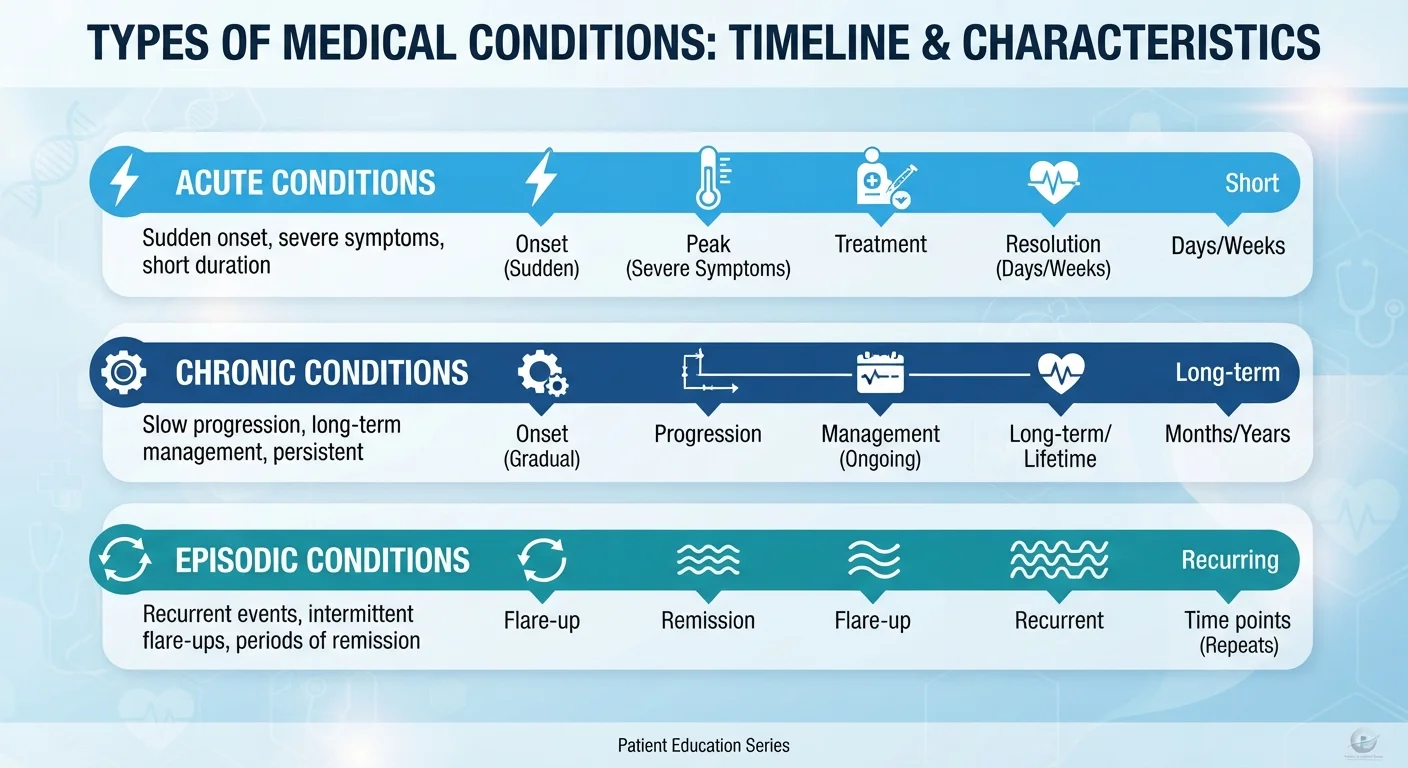
- Acute conditions start quickly and resolve within a short timeframe, usually days to a few weeks.
- Chronic conditions are long-lasting and often require ongoing monitoring and management rather than a single cure.
- Episodic conditions alternate between active flare-ups and symptom-free periods, which can complicate diagnosis.
- The time pattern of a condition directly shapes treatment goals, follow-up schedules, and patient education.
- Knowing these distinctions helps patients ask better questions and understand their care plans more clearly.
Acute, Chronic, and Episodic
These three words describe the time pattern of a medical condition — how quickly it starts, how long it lasts, and whether it comes and goes. Acute conditions arise suddenly and resolve within a short period. Chronic conditions persist for months or years. Episodic conditions recur in distinct, separated episodes with periods of remission in between.
In clinical documentation, 'acute' typically refers to a duration under four weeks, 'subacute' covers four to twelve weeks, and 'chronic' applies to conditions lasting beyond twelve weeks — though thresholds vary by specialty and condition.
Why Time Is One of Medicine's Most Important Diagnostic Tools
When you describe a symptom to a clinician, one of the first questions they ask is: When did this start, and how long has it been going on? This isn't small talk. The time course of a symptom or condition is a core piece of diagnostic information — it narrows the list of possible causes, determines the urgency of evaluation, and shapes the entire management plan.
Medical language reflects this precisely. The terms acute, chronic, and episodic aren't vague descriptors; they are clinical classifications that communicate how a condition unfolds over time. Understanding what each term means — and why it matters — helps patients engage more meaningfully with their care. It also makes sense of phrases that can otherwise feel confusing or alarming on a diagnosis sheet.
The Term 'Subacute' Also Exists
Some clinicians use 'subacute' to describe conditions that fall between acute and chronic — typically lasting between four and twelve weeks. You may encounter this term in radiology reports, physical therapy notes, or specialist letters. It signals a condition that has persisted beyond the acute window but hasn't yet reached the chronic threshold.
Acute: Fast Onset, Defined Endpoint
Acute conditions come on rapidly — often within hours or days — and typically resolve within a few weeks, either on their own or with treatment. The word derives from the Latin acutus, meaning sharp or pointed, which captures the sudden, focused nature of these conditions.
Clinicians treating acute illness focus primarily on immediate relief and resolution. The goal is to address the underlying cause and return the patient to their baseline health. Follow-up care, if needed, is usually time-limited.
It is worth noting that some acute conditions, if left untreated or inadequately managed, can evolve into chronic problems. A good example is an acute infection that, if poorly treated, leads to persistent inflammation. This progression underscores why prompt evaluation of acute symptoms matters.
Chronic: Long-Duration, Long-Term Management
Chronic conditions are those that persist for an extended period — in most clinical definitions, beyond twelve weeks, though the threshold varies by specialty. Many chronic conditions last for years or for a patient's lifetime. Common examples include hypertension, type 2 diabetes, asthma, and arthritis.
The management of chronic illness looks fundamentally different from acute care. Rather than aiming for a single cure, clinicians focus on controlling symptoms, preventing complications, slowing progression, and supporting quality of life. This typically involves ongoing monitoring, lifestyle adjustments, and sometimes long-term medication.
For patients newly navigating this landscape, living with a chronic condition outlines what this kind of ongoing management generally involves. The hub on chronic conditions also provides broader context across many specific diagnoses.
6 in 10
U.S. adults living with a chronic condition
According to the Centers for Disease Control and Prevention (CDC), approximately 60% of American adults have at least one chronic disease.
4 in 10
U.S. adults with two or more chronic conditions
The CDC reports that multiple chronic conditions are common, increasing complexity of care and the importance of coordinated management.
~39 million
Americans affected by migraine
The Migraine Research Foundation estimates that migraine — a well-known episodic condition — affects roughly 12% of the U.S. population.
Episodic: Recurrent Patterns With Periods of Remission
Episodic conditions occupy a distinct category. They are neither continuously present nor a single, self-limiting event — instead, they recur in separate episodes, each with a recognizable onset and resolution, punctuated by periods of remission or relative normalcy.
Migraine is a widely recognized episodic condition: sufferers experience distinct attacks that may last hours to days, then return to baseline until the next episode. Certain mood disorders, some forms of vertigo, and various inflammatory conditions also follow episodic patterns.
The episodic pattern can complicate both diagnosis and day-to-day life. Because symptoms are absent between episodes, patients may struggle to feel taken seriously, or may question the need for ongoing care during remission. In fact, remission periods are often the best time to implement preventive strategies. Flare-ups, remission, and the language of chronic illness explores this vocabulary in more depth.
“Patients with episodic conditions often feel invalidated during remission because they look and feel well. But remission is precisely when preventive management is most effective and most overlooked.”
— American Academy of Neurology, Clinical guidance on episodic neurological conditions
How These Classifications Shape Your Care
Understanding which category your condition falls into helps set realistic expectations. Acute care emphasizes speed and resolution. Chronic care emphasizes continuity and self-management. Episodic care emphasizes recognition of patterns and readiness to act — both during episodes and between them.
These distinctions also affect how stress interacts with health. Stress itself can be classified along similar lines — see how chronic and acute stress affect the body differently for a closer look at that parallel. And for anyone seeking guidance on when and how to bring these concerns to a provider, the Seeing a Doctor hub offers practical direction.
If you leave a clinical appointment unsure whether your condition is being treated as acute or chronic, it is entirely appropriate to ask. Knowing the classification is not just a semantic detail — it tells you what to expect, how often you may need follow-up, and what role you will play in your own care.
This article is for informational purposes only and does not constitute medical advice. Always consult a qualified healthcare professional for guidance specific to your health situation.
Ask Your Clinician to Clarify the Classification
If your diagnosis involves any of these terms, ask your provider directly: 'Is this being treated as an acute, chronic, or episodic condition?' The answer tells you how long to expect symptoms, what monitoring is typical, and what self-management will look like. This one question can make a follow-up appointment far more productive.