

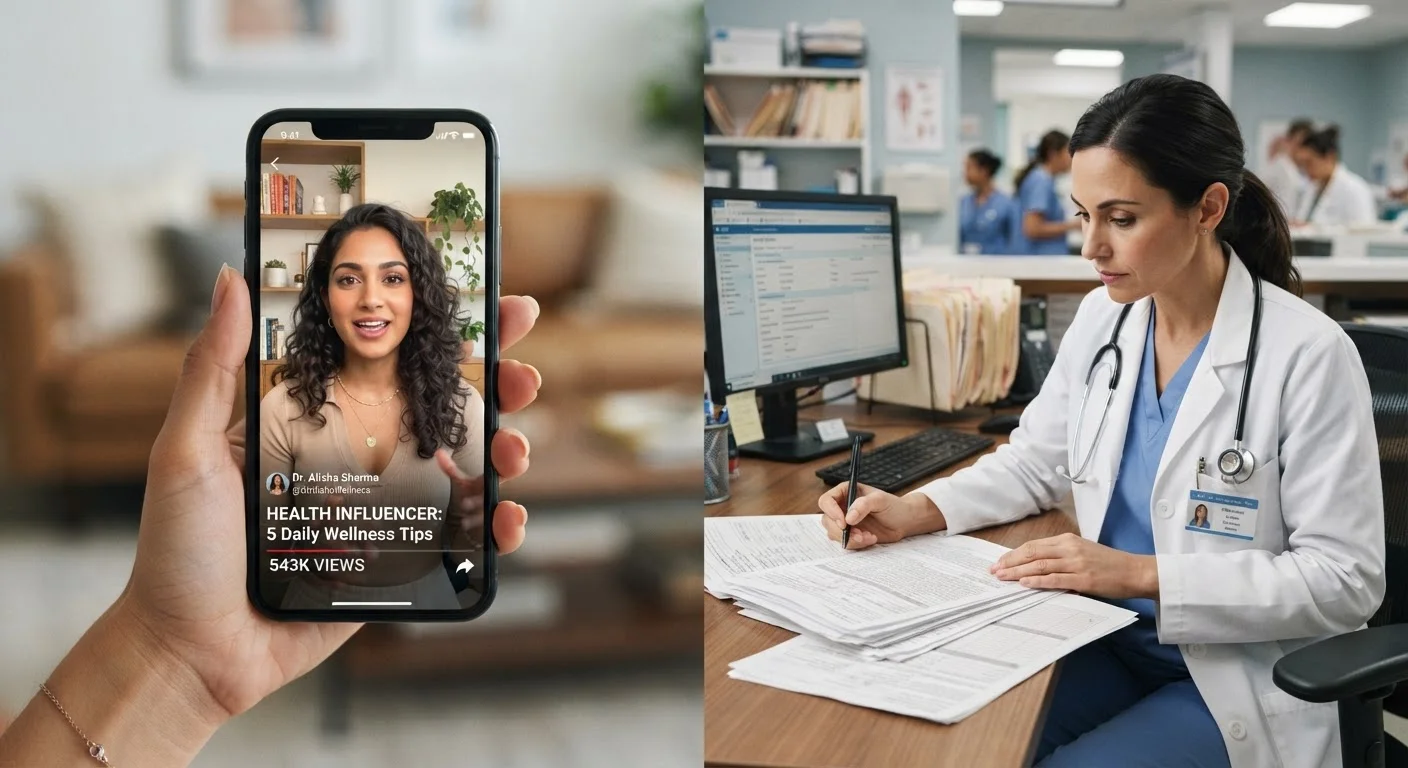
Key Takeaways
- Follower counts and confident delivery are not substitutes for clinical training or licensure.
- Medical professionals are legally accountable for their guidance; influencers generally are not.
- Always verify a creator's credentials before acting on any health recommendation you encounter online.
- Even licensed clinicians on social media cannot replace a personalized consultation with your own provider.
- Critical evaluation skills help you separate evidence-based health content from well-packaged misinformation.
Option A
Health Influencers
The popular, accessible voices shaping digital health culture.
Best for: General wellness inspiration, community support, and discovering topics to discuss with a real clinician.
Option B
Medical Professionals
The credentialed, evidence-trained practitioners accountable to clinical standards.
Best for: Diagnosing conditions, guiding treatment decisions, interpreting test results, and managing ongoing health concerns.
If you need a diagnosis or treatment plan
Medical Professionals
Only licensed clinicians can legally diagnose conditions and recommend treatments tailored to your individual health history and test results.
If you want general wellness inspiration or motivation
Health Influencers
Influencers can be genuinely helpful for lifestyle habits and discovering health topics — as long as you verify claims with a qualified professional before acting on them.
If you are managing a chronic or complex condition
Medical Professionals
Chronic conditions require individualized monitoring, medication management, and specialist input that no social media content can responsibly provide.
If you want to learn how to evaluate online health content
Medical Professionals
Seek out credentialed voices — physicians, registered dietitians, licensed therapists — who cite evidence and disclose their qualifications and any conflicts of interest.
The Credential Gap: Training vs. Influence
Becoming a licensed physician in the United States requires a minimum of eleven years of post-secondary education and supervised clinical training — four years of undergraduate study, four years of medical school, and at least three years of residency. Nurses, registered dietitians, and licensed therapists follow similarly rigorous, regulated pathways. These credentials are not formalities; they reflect the depth of knowledge needed to safely evaluate complex, individual health situations.
Health influencers face no equivalent requirement. A creator with millions of followers may hold advanced degrees, or they may hold none at all. Charisma, production quality, and algorithmic reach are entirely independent of clinical competence. The Federal Trade Commission (FTC) requires influencers to disclose paid partnerships, but there is no federal mandate requiring health content creators to disclose their educational background or professional limitations.
This credential gap matters enormously when the stakes are high. Understanding it is the first step toward safer health media consumption. See our guide to standards reputable health content should meet for a practical checklist.
| Criterion | Health Influencers | Medical Professionals |
|---|---|---|
| Required credentials | None mandated | Licensed degree + supervised training |
| Regulatory accountability | Minimal (FTC disclosure rules only) | State licensing boards, ethics codes |
| Evidence standards | Varies widely; often anecdotal | Peer-reviewed research and clinical guidelines |
| Can legally diagnose or treat | No | Yes, within licensed scope |
| Conflict of interest disclosure | Required only for paid partnerships | Required by professional ethics codes |
| Personalized guidance | Not possible; generic audience content | Yes, based on individual history and tests |
| Accessibility | High — free, immediate, wide reach | Variable — requires appointment and insurance |
Accountability and Evidence: Who Answers for What?
Medical professionals are held to structured accountability systems. Physicians are licensed by state medical boards, bound by ethical codes, and subject to malpractice liability. Registered dietitians are credentialed through the Commission on Dietetic Registration. These frameworks exist to protect patients when guidance causes harm.
Influencers, by contrast, operate largely outside these accountability structures. A health creator who promotes an unproven supplement protocol or advises followers to discontinue medication faces no professional licensing board review — only public opinion, which is an unreliable safeguard.
~70%
Social media users who seek health info online
Surveys by the Pew Research Center have consistently found that a substantial majority of US adults use the internet, including social media, to look up health information.
Low
Proportion of health TikTok claims verified as accurate
A 2022 analysis published in PLOS ONE found that a significant share of health-related TikTok videos contained inaccurate or incomplete information, particularly for nutrition and chronic disease topics.
Evidence standards also differ sharply. Qualified clinicians are trained to interpret peer-reviewed research, assess study quality, and translate findings within the context of individual patient factors. Many health influencers cite studies selectively, misrepresent preliminary findings as established fact, or rely entirely on personal anecdote. Recognizing red flags in online health content — such as miracle-cure language or the absence of source citations — is an essential protective skill.
How to Critically Evaluate Any Health Voice Online
Whether you are watching a short-form video or reading a long-form health article, apply the same evaluative lens to every source. Start by asking three questions: What are this person's verifiable credentials? Do they cite peer-reviewed evidence or reputable institutions such as the CDC or NIH? Do they disclose conflicts of interest, including sponsorships or product affiliations?
Creators who cannot answer these questions transparently warrant extra skepticism. Licensed clinicians who are active online — and many are, providing genuinely valuable public health education — will typically display their credentials clearly and distinguish between general education and individual medical advice.
Even content from credentialed professionals has limits. A cardiologist discussing heart health on a podcast cannot account for your personal risk factors, medication interactions, or family history. That is what an in-person or telehealth consultation is for. Learn more about reading health information online without getting misled and explore guidance on when and how to see a doctor when online content raises questions you cannot resolve on your own.
This article is for general informational and educational purposes only and does not constitute medical advice. Always consult a qualified healthcare professional for guidance specific to your health situation.