

Key Takeaways
- Honey's antibacterial action comes from multiple mechanisms, making it difficult for bacteria to develop resistance.
- Not all honey is equal — medical-grade and Manuka varieties have undergone testing that raw pantry honey has not.
- Clinical evidence supports honey's use for certain wound types, including minor burns and surgical wounds.
- Honey should never replace professional care for deep, infected, or non-healing wounds.
- People with diabetes or compromised immunity should always consult a doctor before using honey on wounds.
- Raw honey from the pantry carries contamination risks not present in sterile medical-grade formulations.
Honey as a Wound Dressing
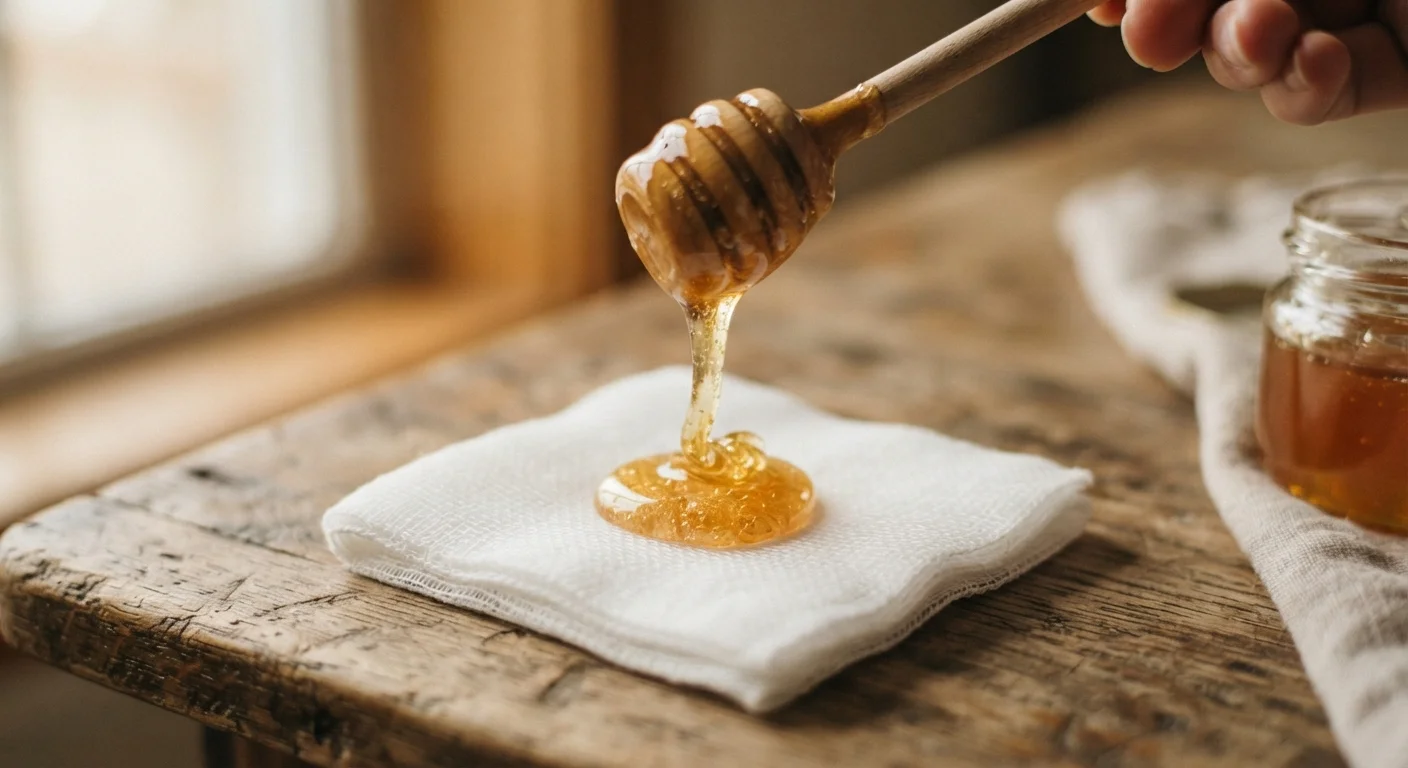
Using honey directly on a wound or skin injury to support healing, reduce infection risk, and manage moisture. This practice draws on honey's natural antimicrobial properties, which come from its high sugar content, low moisture, and the hydrogen peroxide it naturally produces. It has been documented in medical traditions spanning ancient Egypt, Greece, and Ayurvedic medicine.
Medical-grade honey products — most notably Manuka honey from New Zealand — are sterile, standardized for antibacterial activity, and regulated as wound-care devices in several countries including the United States.
Why Honey Was Used on Wounds for Millennia
Long before germ theory, healers across ancient Egypt, Greece, Rome, and South Asia reached for honey when treating cuts, burns, and ulcers. Ancient Egyptian medical papyri describe honey-based wound preparations more than 4,000 years old. Ayurvedic texts similarly catalogued its healing applications. This wasn't coincidence — these traditions were built on direct observation of what worked.
What those healers couldn't explain in molecular terms, they recognized through outcomes: wounds treated with honey tended to stay cleaner, resist putrefaction, and heal with less visible damage than untreated ones. The same properties that preserve honey in a jar — low water content, acidity, and natural antimicrobial compounds — were also working in favor of the wound.
To explore how honey fits into a broader tradition of pantry-based healing, see Kitchen Remedies Across Cultures.
The Science: How Honey Works Against Bacteria
Modern microbiology has identified several overlapping reasons why honey creates an inhospitable environment for bacteria:
- High sugar concentration: Honey draws water out of bacterial cells through osmosis, effectively dehydrating and killing them.
- Low pH: Most honey has an acidic pH between 3.2 and 4.5, which disrupts bacterial growth and may support tissue repair.
- Hydrogen peroxide production: An enzyme called glucose oxidase produces small, sustained amounts of hydrogen peroxide — a known antiseptic — when honey contacts wound fluid.
- Methylglyoxal (MGO): Found in notably high concentrations in Manuka honey, this compound provides antibacterial activity that persists even when hydrogen peroxide is neutralized.
Because honey attacks bacteria through multiple pathways simultaneously, researchers have noted that it is difficult for bacteria to develop resistance to it in the same way they do with single-mechanism antibiotics. This has driven significant scientific interest, particularly as antibiotic resistance becomes a growing global concern.
4,000+
Years of documented honey wound use
Ancient Egyptian medical papyri, among the oldest surviving medical texts, include references to honey as a wound treatment.
3.2–4.5
Typical pH range of honey
This acidic environment inhibits the growth of many common wound pathogens, according to published microbiological analyses.
~80%
Sugar concentration in honey
Honey's high sugar content creates osmotic pressure that draws moisture from bacterial cells, contributing to its antimicrobial effect.
Medical-Grade vs. Pantry Honey: A Critical Distinction
Not all honey performs the same way in wound care. Raw honey from your kitchen shelf is not sterile. It may contain environmental contaminants, pollens, and in rare cases bacterial spores — including Clostridium botulinum, which is why honey is strictly off-limits for infants under 12 months.
Medical-grade honey products are gamma-irradiated to eliminate pathogens while preserving their antibacterial properties. They are standardized to ensure a consistent level of antibacterial activity — something that varies widely between honeys based on floral source, processing, and storage.
Manuka honey, sourced from bees foraging on the Leptospermum scoparium plant in New Zealand and Australia, has become the most extensively studied variety for wound use. It is graded using systems like UMF (Unique Manuka Factor) or MGO concentration to reflect its potency. Manuka-based wound dressings are licensed medical devices in multiple countries.
Choosing Honey for Wound Use
If you're considering honey for minor wound care, look for products specifically labeled as medical-grade or sterile honey dressings rather than reaching for a jar from your kitchen. These formulations are designed to deliver consistent antibacterial activity without contamination risk. Ask a pharmacist or healthcare provider which product may be appropriate for your situation.
What the Evidence Shows — and Where It Falls Short
Clinical trials and systematic reviews have found promising results for honey in specific wound categories. Research has suggested benefits for partial-thickness burns, postoperative wounds, venous leg ulcers, and some chronic skin wounds. A Cochrane review of honey for acute and chronic wounds found it may speed healing in mild to moderate burns compared to conventional dressings in some studies, though the authors noted that overall evidence quality was mixed.
Honey is not a universal solution. Evidence is less consistent for deep wounds, wounds with significant tissue death, or wounds complicated by systemic disease. It also should not be seen as a replacement for antibiotics in cases of established systemic infection.
Honey's broader role in symptom relief extends to other areas, too — see why honey is still one of the most researched sore throat soothers for what science says about that application.
When to Use Caution — and When to Call a Doctor
Honey may be a reasonable addition to minor first aid — think small scrapes or superficial abrasions — but it is not appropriate for all wounds. Always seek professional medical evaluation for wounds that:
- Are deep, wide, or have jagged edges that may need closure
- Won't stop bleeding after sustained direct pressure
- Show signs of infection: increasing redness, warmth, swelling, or pus
- Involve the face, hands, feet, or genitals
- Result from animal bites or puncture wounds
- Have not improved within a few days of basic care
People with diabetes, peripheral artery disease, or conditions affecting immune function carry elevated risks from even minor wounds and should always consult a healthcare professional rather than relying on home remedies.
If you're stocking your home remedy pantry more broadly, keeping a home remedy pantry covers what common ingredients are traditionally used for and when they're appropriate.
This article is for general informational and educational purposes only and is not a substitute for professional medical advice, diagnosis, or treatment. Always consult a qualified healthcare provider with questions about wound care or any medical condition.