

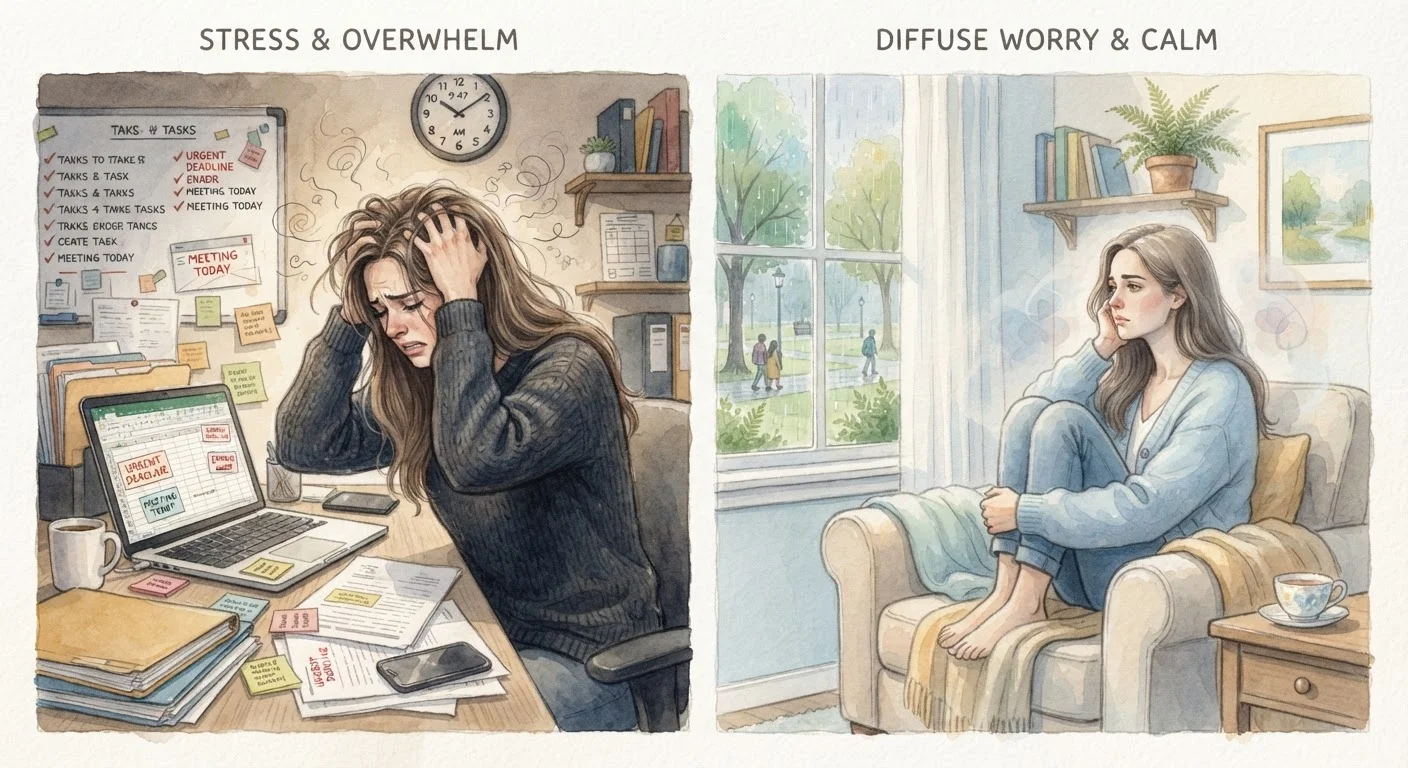
Key Takeaways
- Stress typically has a clear external cause; anxiety often persists without one.
- Both can produce similar physical symptoms, making self-identification genuinely difficult.
- Correctly naming your experience helps you choose the most effective coping strategy.
- Chronic, unmanaged stress can evolve into an anxiety disorder over time.
- Professional support is available and effective for both conditions.
Option A
Stress
The pressure-driven, situation-specific response.
Best for: Understanding a reaction tied to an identifiable external demand or life event.
Option B
Anxiety
The persistent, internally driven state of apprehension.
Best for: Understanding worry that persists even when no clear external threat is present.
If your tension eases once a deadline passes or a problem resolves
Stress
Situation-linked distress that fades with the trigger is the hallmark of stress. Practical problem-solving and rest are your most effective tools.
If worry lingers long after an event is over, or arises with no clear cause
Anxiety
Persistent, free-floating apprehension that doesn't resolve when circumstances improve points toward anxiety, which may benefit from therapeutic approaches.
If symptoms are interfering with sleep, work, or relationships
Anxiety
When distress significantly disrupts daily functioning, consulting a licensed mental health professional is the most important next step, regardless of the label.
If you want to build everyday resilience to pressure
Stress
Learning stress management techniques — such as time structuring and relaxation practices — can prevent acute stress from escalating into longer-term anxiety.
Why the Confusion Is So Common
Stress and anxiety share a lot of real estate in our nervous systems. Both can produce a racing heart, muscle tension, disrupted sleep, and a sense that something is wrong. It's no wonder most people use the words interchangeably — and it's worth knowing that even clinicians acknowledge the boundary can feel blurry in everyday life.
But the distinction matters, because the root cause of each shapes the most useful response. Calling anxiety "just stress" can lead someone to wait for an external situation to change, when the relief they need actually comes from within. Getting the language right isn't about labels for their own sake — it's about pointing yourself toward the help that actually fits.
When Symptoms Overlap: A Quick Note
Because stress and anxiety share physical symptoms — like a racing heart, shallow breathing, and trouble sleeping — it isn't always possible to self-diagnose reliably. If you're experiencing significant or persistent distress, a licensed mental health professional can help you identify what's driving it and what will help most. This article provides general education, not a clinical assessment.
Stress: A Response With a Return Address
Stress is typically reactive. It arises in response to an identifiable external pressure — a looming work deadline, a difficult conversation, a financial setback. The American Psychological Association describes stress as a physical and emotional response to a demand or threat that a person perceives as challenging their resources.
Importantly, stress tends to ease when the stressor is removed or resolved. Once the presentation is over, the tension usually lifts. This doesn't make stress harmless — sustained or chronic stress can have serious health consequences — but its relationship to a cause is usually traceable.
Common stress signals include irritability, fatigue, difficulty concentrating, and physical tension. These are your body's way of marshaling energy to meet a challenge, a mechanism sometimes called the fight-or-flight response.
Anxiety: When Worry Outlives Its Cause
Anxiety is better understood as a state rather than just a response. According to the National Institute of Mental Health (NIMH), anxiety involves excessive worry or fear that is disproportionate to the actual situation — or that persists even when no clear threat is present.
Where stress has a return address, anxiety often doesn't. Someone experiencing anxiety may feel a persistent sense of dread, catastrophic thinking, physical restlessness, or an inability to "switch off" even during calm moments. Over time, this can lead to avoidance behaviors — steering clear of situations that trigger worry, which can gradually shrink a person's world.
Anxiety exists on a spectrum. Occasional anxious feelings are a normal part of human experience. But when anxiety becomes frequent, intense, and disruptive, it may meet the criteria for an anxiety disorder — the most common class of mental health conditions in the United States, according to NIMH. If you're noticing patterns in what triggers your worry, understanding your personal anxiety triggers can be a meaningful first step.
31%
U.S. adults affected by anxiety disorders
According to the National Institute of Mental Health, an estimated 31% of U.S. adults will experience an anxiety disorder at some point in their lives.
77%
Americans reporting physical stress symptoms
The American Psychological Association's Stress in America surveys have consistently found that a large majority of adults report physical or emotional symptoms linked to stress.
~40%
Anxiety disorder cases that go untreated
The Anxiety and Depression Association of America notes that despite anxiety disorders being highly treatable, a large proportion of people do not seek professional care.
Side-by-Side: Key Differences at a Glance
The table below summarizes the core distinctions that clinicians and researchers use to differentiate stress from anxiety. Keep in mind that these are general patterns — individual experiences vary, and a mental health professional can offer the most accurate picture for your specific situation.
| Criterion | Stress | Anxiety |
|---|---|---|
| Primary cause | Identifiable external stressor | Internal worry, often without clear cause |
| Duration | Resolves when stressor passes | Persists beyond triggering situation |
| Thought pattern | Focused on a specific problem | Diffuse, often catastrophic thinking |
| Physical symptoms | Tension, fatigue, irritability | Restlessness, muscle tension, sleep issues |
| Behavioral impact | Temporary disruption to routine | May lead to avoidance behaviors |
| Clinical status | Normal response; can become chronic | Can meet criteria for anxiety disorder |
| Core coping focus | Address or manage the external demand | Regulate internal thought and nervous system |
Coping Strategies: Tailored to the Cause
Once you have a clearer sense of what you're experiencing, you can be more deliberate about how you respond.
For stress, evidence-informed approaches often focus on the external demand itself: breaking large tasks into manageable steps, setting boundaries around time and energy, and building recovery into your routine. Physical activity, adequate sleep, and social connection also play a meaningful role — a connection explored further in our piece on how daily habits shape mental load.
For anxiety, the most well-supported approaches work at the level of thought patterns and nervous system regulation. Cognitive behavioral therapy (CBT) has a strong evidence base for anxiety disorders, helping people examine and reframe distorted thinking. Mindfulness-based practices, breathing techniques, and — in some cases — medication evaluated by a qualified provider are also established options.
If you're unsure which applies to you, speaking with a licensed therapist or your primary care provider is always a reasonable first step. Neither stress nor anxiety is something you have to navigate alone, and early support can prevent either from becoming entrenched.
This article is for general informational and educational purposes only and does not constitute medical advice. Please consult a qualified healthcare professional for concerns about your mental or physical health.