

Key Takeaways
- Hypothyroidism means the thyroid produces too little hormone; hyperthyroidism means it produces too much.
- Despite opposite causes, both conditions can cause fatigue, mood changes, and menstrual irregularities.
- Hypothyroidism is most commonly caused by Hashimoto's disease; Graves' disease is the leading cause of hyperthyroidism.
- Both conditions are diagnosable with a simple TSH blood test and are generally manageable with medical treatment.
- Left untreated, either disorder can lead to serious cardiovascular or metabolic complications.
- A healthcare provider should evaluate any persistent unexplained symptoms — self-diagnosis is not reliable for thyroid conditions.
Our Verdict
Hypothyroidism and hyperthyroidism sit at opposite ends of the thyroid function spectrum, producing contrasting but sometimes overlapping symptom profiles. Both are well-understood, diagnosable conditions with effective treatment options. The right management path depends entirely on which disorder is present, its underlying cause, and the individual's overall health — factors that only a clinician can assess through proper testing.
| Best for | Recommended |
|---|---|
| Those experiencing persistent fatigue, weight gain, and cold intolerance | Evaluation for Hypothyroidism |
| Those noticing unexplained weight loss, rapid heartbeat, and heat sensitivity | Evaluation for Hyperthyroidism |
| Those with a family history of autoimmune thyroid disease | Routine TSH Screening |
What the Thyroid Does — and What Goes Wrong
The thyroid is a small, butterfly-shaped gland at the base of the neck that produces two primary hormones — thyroxine (T4) and triiodothyronine (T3). These hormones regulate metabolism, heart rate, body temperature, and energy use throughout virtually every organ system. Their release is controlled by thyroid-stimulating hormone (TSH) produced by the pituitary gland.
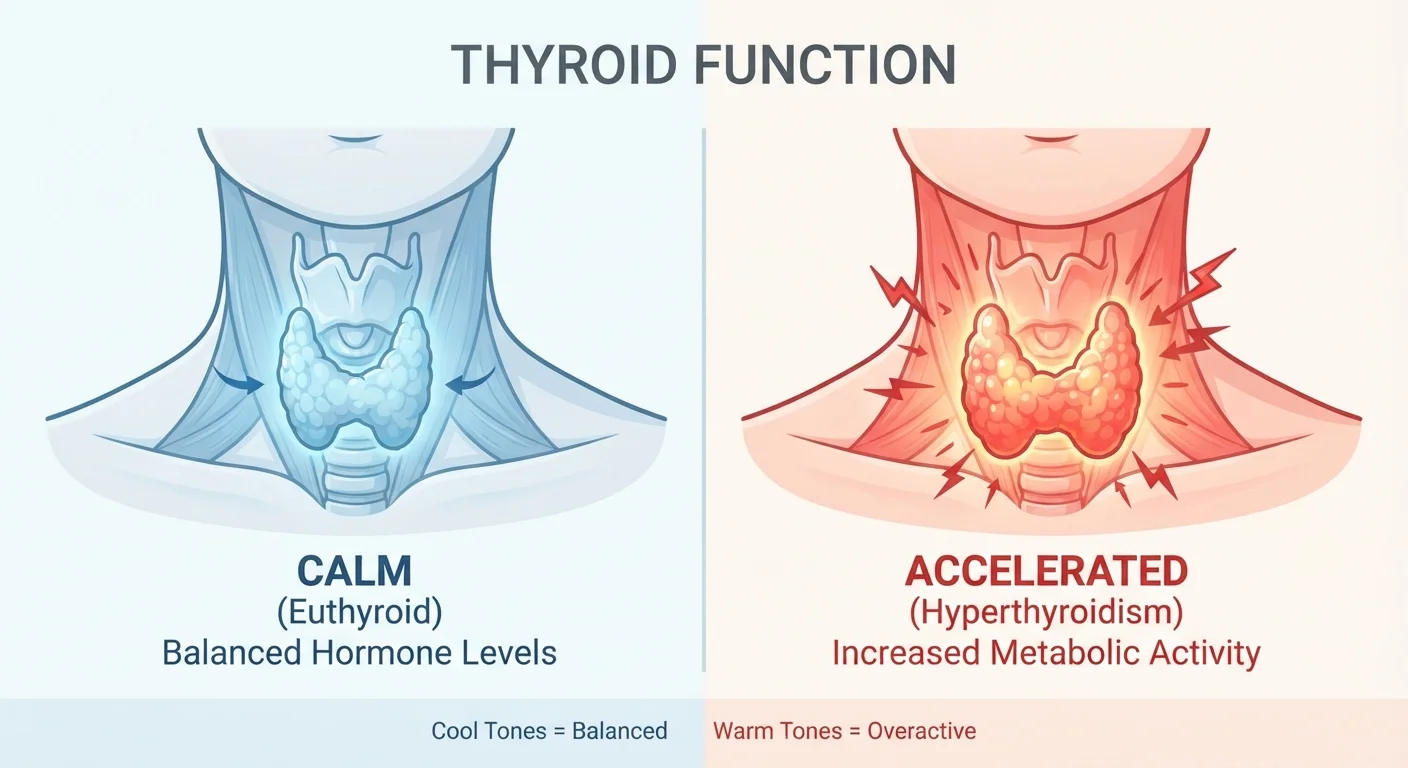
When the thyroid is underactive — a condition called hypothyroidism — it fails to produce enough hormone, slowing bodily processes. When it is overactive — hyperthyroidism — it floods the body with excess hormone, accelerating those same processes. Understanding which direction the gland has shifted is the essential first step toward appropriate care.
Symptoms: Opposite Ends of the Spectrum
Because the two conditions alter body function in opposite ways, their symptom profiles largely mirror each other — though there is some surprising overlap.
| Symptom / Feature | Hypothyroidism (Underactive) | Hyperthyroidism (Overactive) | |
|---|---|---|---|
| Weight changes | Weight gain | Unexplained weight loss | |
| Energy levels | Fatigue, sluggishness | Fatigue (from overactivity), restlessness | |
| Heart rate | Slower than normal | Rapid or irregular heartbeat | |
| Temperature sensitivity | Increased cold sensitivity | Increased heat sensitivity, sweating | |
| Mood and cognition | Depression, brain fog | Anxiety, irritability, tremors | |
| Digestion | Constipation | Frequent bowel movements or diarrhea | |
| Skin and hair | Dry skin, hair thinning | Hair thinning, moist skin | |
| Most common cause | Hashimoto's thyroiditis | Graves' disease |
The overlap is clinically significant. Both disorders can cause fatigue, hair thinning, irregular menstrual cycles, and mood disturbances, which is one reason a blood test rather than symptom review alone is needed for accurate diagnosis.
Don't Rely on Symptoms Alone
The symptom overlap between hypothyroidism and hyperthyroidism — and with other common conditions like anxiety or anemia — makes self-diagnosis unreliable. A TSH blood test is a straightforward, widely available first step that provides objective information. If you suspect a thyroid issue, raise your concerns with a healthcare provider rather than adjusting your approach based on symptoms alone.
Causes and Risk Factors
Hypothyroidism is most commonly caused by Hashimoto's thyroiditis, an autoimmune condition in which the immune system gradually damages thyroid tissue. Other causes include previous thyroid surgery, radioactive iodine therapy, certain medications (such as lithium or amiodarone), and — in parts of the world where iodine intake is insufficient — dietary iodine deficiency.
Hyperthyroidism is most often driven by Graves' disease, another autoimmune disorder in which antibodies stimulate the thyroid to overproduce hormone. Toxic multinodular goiter, a single overactive nodule (toxic adenoma), and thyroiditis (temporary gland inflammation) can also cause elevated hormone output.
Both conditions are significantly more prevalent in women and tend to run in families, suggesting a strong genetic component alongside autoimmune triggers.
~20M
Americans with some form of thyroid disease
The American Thyroid Association estimates roughly 20 million Americans have a thyroid condition, with many cases undiagnosed.
5–8×
Higher thyroid disease prevalence in women
Women are significantly more likely than men to develop thyroid disorders, according to established clinical epidemiology.
Diagnosis and Treatment Approaches
Diagnosis for both conditions begins with a TSH blood test. An elevated TSH typically indicates hypothyroidism (the pituitary is working harder to stimulate a sluggish gland), while a suppressed TSH points toward hyperthyroidism. Follow-up tests measuring free T4 and T3 levels, along with thyroid antibody panels, help identify the underlying cause.
Hypothyroidism is most commonly managed with levothyroxine, a synthetic form of T4 taken daily to restore normal hormone levels. Dosing is individualized and adjusted over time based on follow-up TSH testing.
Hyperthyroidism treatment options include antithyroid medications (such as methimazole or propylthiouracil) that reduce hormone production, radioactive iodine therapy that reduces thyroid tissue activity, or in some cases, surgical removal of part or all of the gland. Beta-blockers may be used short-term to manage symptoms like rapid heart rate while the underlying condition is addressed.
Both conditions require ongoing monitoring by a healthcare provider. Treatment goals, timelines, and approaches vary considerably by individual — there is no one-size-fits-all protocol for either disorder.
This article is for informational purposes only and does not constitute medical advice. If you are experiencing symptoms associated with thyroid dysfunction, consult a qualified healthcare provider for evaluation and appropriate testing.