

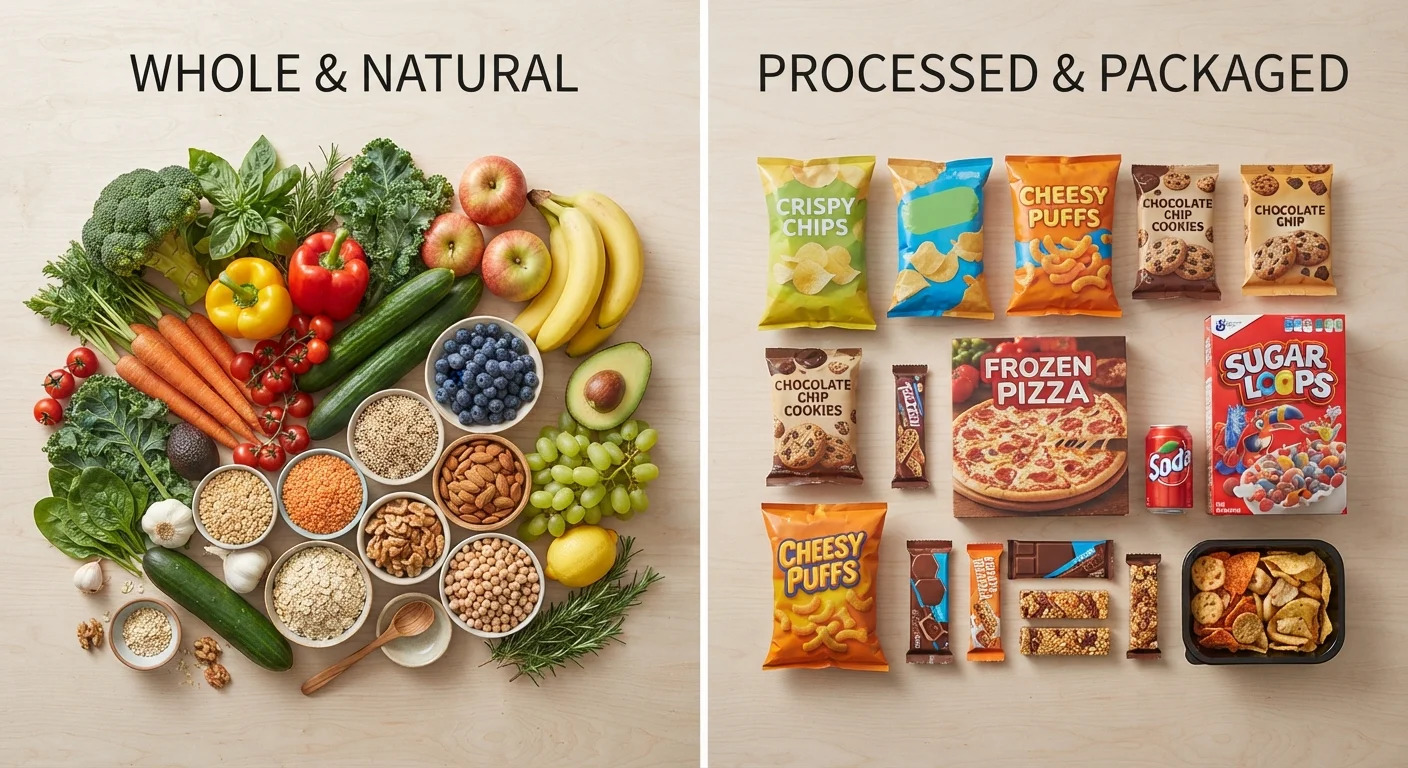
Key Takeaways
- Whole foods retain most of their original nutrients; ultra-processed foods have undergone multiple industrial transformations.
- The NOVA classification system categorizes foods into four groups based on the extent and purpose of processing.
- Observational research consistently links high ultra-processed food intake to increased risk of chronic disease.
- Processing exists on a spectrum — not all processed foods are nutritionally equivalent or harmful.
- Reading ingredient lists is one of the most reliable ways to identify ultra-processed products.
Option A
Whole Foods
The minimally altered, nutrient-dense foundation of healthy eating.
Best for: People seeking maximum nutritional value, fiber, and bioactive compounds from their diet with minimal additives.
Option B
Ultra-Processed Foods
The heavily industrialized products dominating modern food environments.
Best for: Understanding what to limit — and why convenience foods carry greater nutritional trade-offs than most consumers realize.
If you want to maximize nutrient density at every meal
Whole Foods
Whole foods deliver fiber, vitamins, minerals, and phytonutrients in forms the body uses efficiently, without the additives found in industrial formulations.
If you're trying to understand why your current diet may feel unsatisfying
Whole Foods
Ultra-processed foods are engineered for palatability, which can override natural hunger cues. Shifting toward whole foods supports more reliable appetite regulation.
If you need practical, budget-friendly convenience on occasion
Whole Foods
Minimally processed options like canned legumes, frozen vegetables, and plain oats offer convenience without the additives characteristic of ultra-processed products.
If you're trying to reduce chronic disease risk through diet
Whole Foods
A growing body of epidemiological research links diets high in ultra-processed foods to elevated risks of cardiovascular disease, type 2 diabetes, and all-cause mortality.
Defining the Spectrum: What Does 'Processing' Actually Mean?
Food processing isn't binary — it describes a wide continuum of techniques ranging from washing and refrigerating to multi-step industrial manufacturing. The most widely adopted scientific framework for categorizing this spectrum is the NOVA classification system, developed by researchers at the University of São Paulo. NOVA sorts foods into four groups based not on nutrients alone, but on the extent and purpose of processing applied.
Group 1 — Unprocessed or minimally processed foods include fresh fruits, vegetables, plain meats, eggs, milk, and legumes. These retain most of their original structure and nutritional profile. Group 2 covers culinary ingredients — oils, flour, sugar, salt — used to prepare Group 1 foods. Group 3 contains processed foods like canned fish, artisan cheese, or smoked meats, which use preservation techniques but remain recognizable as food. Group 4 — Ultra-processed foods are industrial formulations made largely from refined substances, typically containing additives such as emulsifiers, artificial flavors, and preservatives that have no home-kitchen equivalent.
Understanding where a food falls on this spectrum matters more than any single nutrient. See our plain-language guide to diet terminology for definitions of related concepts like bioavailability and whole-food diets.
| Criterion | Whole Foods | Ultra-Processed Foods |
|---|---|---|
| NOVA Classification | Group 1 (minimally processed) | Group 4 (industrial formulations) |
| Ingredient Complexity | Single ingredient or few natural components | Long list including additives, emulsifiers, colorings |
| Fiber Content | Generally high (whole grains, legumes, produce) | Typically low; fiber often stripped in processing |
| Nutrient Density | High — vitamins, minerals, phytonutrients intact | Lower — nutrients lost; some synthetically re-added |
| Satiety Response | Supports natural hunger regulation | May override satiety signals; linked to overconsumption |
| Chronic Disease Risk (research) | Associated with reduced risk in observational studies | Associated with elevated risk in multiple cohort studies |
| Examples | Apples, lentils, oats, plain yogurt, fresh fish | Packaged snacks, ready meals, flavored cereals, soda |
What the Research Says About Ultra-Processed Foods and Health
The epidemiological evidence linking ultra-processed food (UPF) consumption to poor health outcomes has grown substantially over the past decade. Large prospective cohort studies — including those published in The BMJ and JAMA Internal Medicine — have found associations between high UPF intake and increased risk of cardiovascular disease, type 2 diabetes, obesity, depression, and all-cause mortality. It is important to note that most existing research is observational, meaning it identifies associations rather than proving direct causation.
One particularly notable contribution to this field is a controlled inpatient trial published in Cell Metabolism (Hall et al., 2019), in which participants consuming ultra-processed diets ate significantly more calories and gained weight compared to those consuming minimally processed diets — even when both diets were matched for available nutrients. This suggests that factors beyond macronutrients — including food texture, energy density, and eating rate — may drive excess intake.
57%
Share of calories from UPFs in average US diet
Analysis of U.S. National Health and Nutrition Examination Survey (NHANES) data published in BMJ Open found that ultra-processed foods account for more than half of daily caloric intake for many American adults.
+500 kcal/day
Extra calories consumed on ultra-processed diet
In a controlled inpatient trial by Hall et al. (2019, Cell Metabolism), participants on an ultra-processed diet spontaneously consumed roughly 500 more calories per day versus a minimally processed diet.
12%
Higher all-cause mortality risk per 10% UPF increase
A large prospective cohort study (Schnabel et al., 2019) found that each 10-percentage-point rise in UPF consumption was associated with a 14% higher risk of all-cause mortality.
Multiple mechanisms have been proposed: UPFs tend to be calorie-dense and low in fiber, which disrupts satiety signaling. Certain additives may also affect the gut microbiome, though this area of research remains active and not yet definitive. For context on how food labels can help identify these products, see our guide on reading nutrition labels without confusion.
Practical Strategies for Shifting Toward Whole Foods
Transitioning toward a more whole-food diet does not require dietary perfection or eliminating all processed items. A more sustainable approach focuses on proportional shifts — gradually increasing the share of minimally processed foods across meals without treating occasional convenience foods as failures.
Practical starting points include: building meals around a whole-food protein (eggs, legumes, plain poultry), adding at least one vegetable or fruit to each eating occasion, swapping refined-grain products for whole-grain equivalents, and using the ingredient list — not just the nutrition facts panel — to spot ultra-processed formulations. A long ingredient list featuring unfamiliar chemical-sounding additives is a reliable signal of Group 4 status.
Frozen vegetables, canned legumes with no added salt, plain oats, and unsweetened yogurt represent minimally processed options that retain strong nutritional value at accessible price points. These choices demonstrate that minimally processed does not mean expensive or time-consuming.
For readers interested in dietary frameworks that emphasize whole-food patterns, comparing the Paleo and Mediterranean diets offers a useful evidence-based overview. And if you're weighing food sources against supplements, our coverage of whole foods versus supplements explains the trade-offs clearly.
This article is for general informational and educational purposes only and does not constitute medical or dietary advice. Consult a registered dietitian or qualified healthcare provider for personalized nutrition guidance.