

Key Takeaways
- Portion size and serving size are related but not the same — knowing both matters.
- Visual cues like a fist or palm can help estimate portions without a scale.
- Larger containers and plates are consistently linked to increased food intake.
- Portion awareness supports balanced eating without requiring calorie counting.
- Standard dietary guidelines provide serving size benchmarks by food group.
Portion Size
A portion size is the amount of food you choose to eat at one time — it can be more or less than a standard serving size. Serving sizes are standardized reference amounts set by nutrition guidelines or food labels to help people understand how much of a food provides a certain number of calories and nutrients. Understanding the difference between the two is the first step toward more mindful eating.
The U.S. Food and Drug Administration (FDA) establishes Reference Amounts Customarily Consumed (RACCs) to standardize serving sizes on Nutrition Facts labels, reflecting typical consumption patterns rather than recommended intake.
Why Portion Awareness Matters
Over the past several decades, the average size of meals served in American homes and restaurants has grown substantially. This expansion — sometimes called "portion distortion" — has made it genuinely difficult for many people to recognize what a reasonable amount of food looks like. When larger portions become the norm, the perception of what's "normal" shifts accordingly.
Portion awareness isn't about restriction or anxiety around food. It's a practical literacy skill: understanding how much you're eating relative to nutritional benchmarks so you can make informed decisions. This matters because energy intake and food volume both influence how satisfied we feel after eating, and they don't always track together in intuitive ways.
2–3×
Growth in restaurant portion sizes since the 1970s
According to the National Heart, Lung, and Blood Institute, common restaurant portions have ballooned two to three times larger than they were several decades ago.
92%
Of Americans underestimate calories in restaurant meals
A study published in the British Medical Journal found that most restaurant patrons significantly underestimate calorie content when ordering meals away from home.
~9 inches
Recommended standard dinner plate diameter
Nutrition researchers commonly reference a 9-inch plate as a practical guide for moderating portions, compared to the 12-inch plates now standard in many households.
Serving Size vs. Portion Size: A Key Distinction
The Nutrition Facts label on packaged foods lists a serving size — a standardized reference amount regulated by the FDA. These amounts are intended to reflect how much people typically eat, not necessarily how much they should eat. A bag of chips might list a serving as 15 chips, but most people consume considerably more in a single sitting.
Your portion, by contrast, is whatever you actually put on your plate. The practical implication: when you read a food label for calories, fat, or sodium, multiply those values by how many servings your actual portion represents. If you eat two servings, you're consuming twice the listed amounts — a common source of underestimation.
For whole, unpackaged foods — produce, proteins, grains — the USDA's Dietary Guidelines for Americans provides cup and ounce equivalents by food group, which serve as useful anchors for building balanced meals. Learning what a half-cup of cooked rice or three ounces of chicken actually looks like can recalibrate your sense of scale.
Practical Visual Guides for Everyday Eating
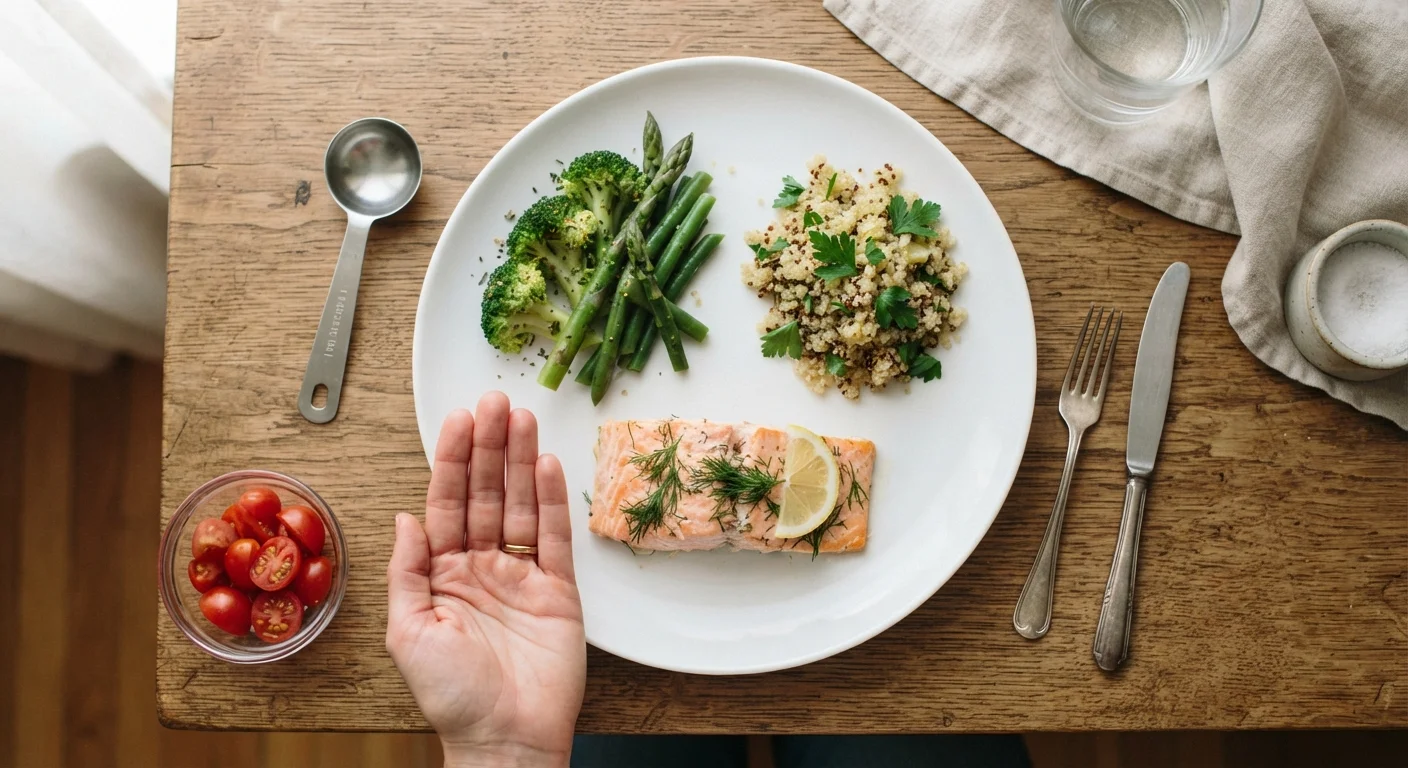
One of the most accessible ways to estimate portions without equipment is to use your own hand as a reference. While hand size varies by person, these approximations provide a consistent personal benchmark:
- A fist approximates about one cup — useful for grains, vegetables, or cereal.
- A cupped palm represents roughly half a cup — helpful for cooked pasta or fruit.
- A flat palm (thickness included) is about three ounces — a common protein reference for meat or fish.
- A thumb approximates one tablespoon — practical for oils, nut butters, or dressings.
These cues aren't perfectly precise, but they offer a repeatable, practical framework. For people looking to move from estimation to a more structured approach, the plate method — dividing a standard plate into sections for vegetables, protein, and grains — is a visually intuitive strategy endorsed by major dietetic organizations. See our guide to what a balanced plate actually looks like for a deeper look at how food groups fit together at every meal.
Try the Plate Method as a Starting Point
Divide a standard 9-inch plate roughly in half for non-starchy vegetables, then split the remaining half between a lean protein and a whole grain or starchy vegetable. This visual approach requires no measuring tools and aligns with major dietary guidance frameworks. It's a flexible framework, not a rigid rule — adjust based on your individual nutritional needs and consult a registered dietitian for personalized recommendations.
Environmental Factors That Shape How Much We Eat
Individual choices around food don't happen in a vacuum. Research in behavioral nutrition has identified several environmental factors that reliably influence how much people eat, often outside their conscious awareness.
Container and plate size are among the most studied. Studies led by behavioral economist Brian Wansink (though subject to subsequent scrutiny and replication by other researchers) popularized the concept that people consistently use larger vessels to serve larger amounts. Independent replication has supported the general direction of this effect, even where specific effect sizes are debated.
Food visibility and accessibility also play a role. Foods placed within easy reach or in plain sight tend to be consumed more frequently and in greater quantities than foods stored out of view. This principle underlies common advice to keep fruit on the counter and store higher-calorie snacks at the back of the pantry.
Eating pace and distraction matter too. Consuming food quickly or while distracted — scrolling a phone, watching television — is associated with reduced awareness of satiety cues, which can lead to eating beyond physical hunger. Slower, more attentive eating gives the body's hunger signals time to register.
This article is for general informational purposes only and does not constitute medical or dietary advice. Speak with a registered dietitian or qualified healthcare provider for personalized nutrition guidance.