

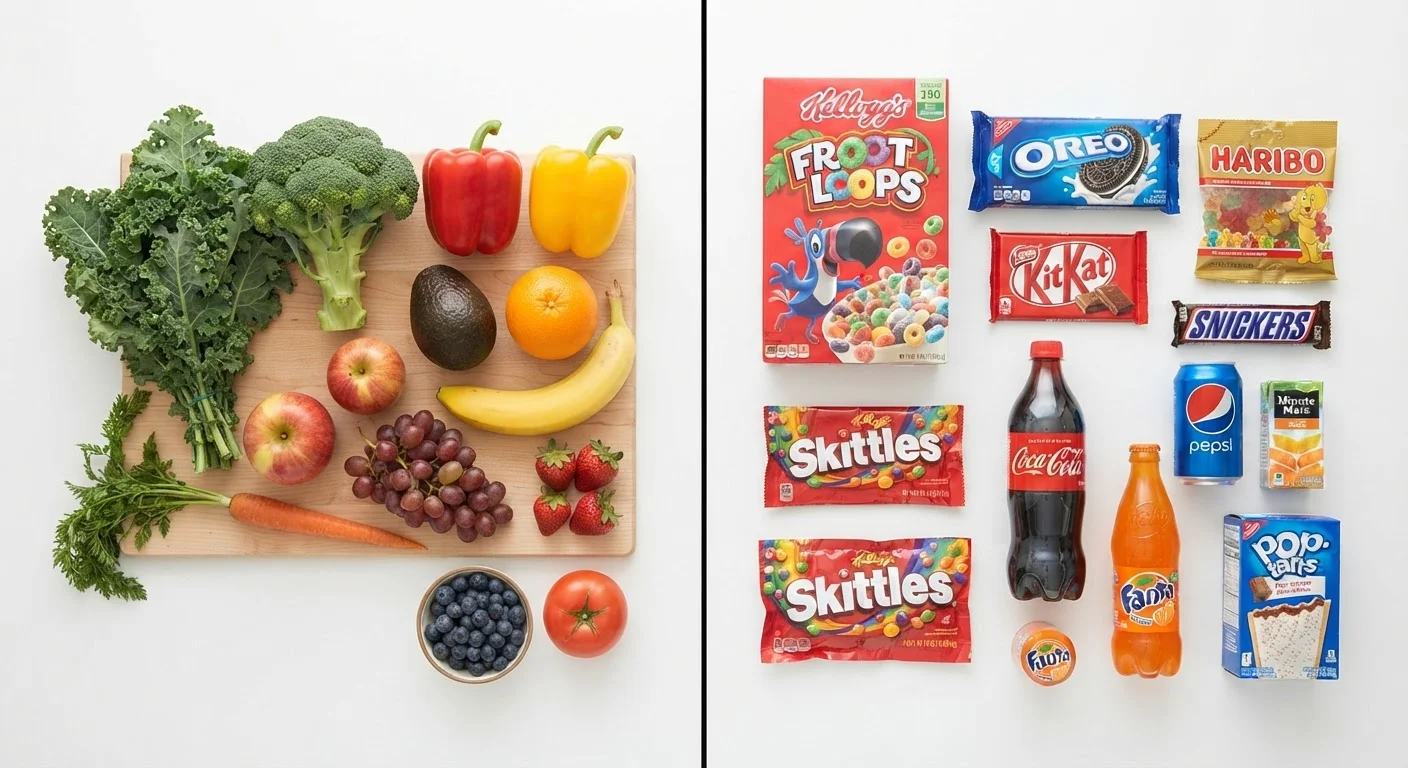
Key Takeaways
- Natural sugars occur in whole foods alongside fiber, vitamins, and minerals that slow absorption.
- Added sugars are incorporated during processing and contribute calories with little nutritional value.
- The Dietary Guidelines for Americans recommend limiting added sugars to less than 10% of daily calories.
- Food labels are now required to list added sugars separately, making identification easier.
- Excess added sugar intake is associated with increased risk of obesity, type 2 diabetes, and cardiovascular disease.
- Whole fruit is nutritionally distinct from fruit juice or foods sweetened with fruit concentrate.
Option A
Natural Sugars
The sugars that arrive packaged with nutrients.
Best for: Everyday energy, fiber intake, and micronutrient delivery through whole foods like fruit, dairy, and vegetables.
Option B
Added Sugars
Sweeteners incorporated during food processing or preparation.
Best for: Understanding food labels, reducing empty-calorie intake, and making informed choices about processed and packaged foods.
If you want to satisfy a sweet craving with nutritional benefit
Natural Sugars
Whole fruits and dairy deliver sweetness alongside fiber, vitamins, and minerals that support overall health, making them a far more nutrient-dense choice.
If you are monitoring your weight or metabolic health
Natural Sugars
Reducing added sugars while keeping whole-food sources of natural sugar is the approach most aligned with mainstream dietary guidelines and research on metabolic risk.
If you are reading food labels for the first time
Added Sugars
Focusing specifically on the 'Added Sugars' line in the Nutrition Facts panel gives you the most actionable number to track and reduce in your diet.
If you are managing blood sugar under medical supervision
Natural Sugars
Whole-food carbohydrate sources with natural sugars generally have lower glycemic impact than added-sugar products, though individual responses vary — always follow your clinician's guidance.
What Makes a Sugar 'Natural' or 'Added'?
The distinction between natural and added sugars is not about the sugar molecule itself — chemically, glucose is glucose. What differs is the food matrix surrounding it. Natural sugars are those found inherently in a whole food: fructose in an apple, lactose in milk, or glucose in a beet. They arrive with fiber, water, protein, fat, and micronutrients that collectively influence how your body processes them.
Added sugars, by contrast, are any caloric sweeteners — cane sugar, high-fructose corn syrup, honey, agave nectar, or fruit juice concentrate — incorporated into a food or beverage during manufacturing or preparation. Stripped of their original food matrix, they deliver sweetness and calories with little else of nutritional value. The U.S. Food and Drug Administration now requires food manufacturers to list added sugars as a separate line on the Nutrition Facts panel, a change that gives consumers a clearer picture than total sugar alone.
For a deeper look at diet-related terminology, see our reference guide to special diet terminology.
| Criterion | Natural Sugars | Added Sugars |
|---|---|---|
| Origin | Inherent in whole foods | Added during processing or cooking |
| Common sources | Fruit, dairy, vegetables | Sodas, sweets, packaged snacks, sauces |
| Nutrient package | Fiber, vitamins, minerals included | Calories only; minimal nutrients |
| Effect on blood sugar | Moderated by food matrix and fiber | Generally faster absorption, sharper spike |
| Satiety impact | Fiber and water promote fullness | Little satiety effect; can promote overconsumption |
| Label identification | Listed under total sugars only | Listed separately on Nutrition Facts panel |
| Dietary guideline status | No specific limit for whole-food sources | Limit to <10% of total daily calories (U.S. DGA) |
Why the Source of Sugar Matters for Health
Research consistently shows that the context in which sugar is consumed affects its metabolic impact. Whole fruit, for example, has a relatively modest effect on blood glucose compared to an equivalent amount of fructose in a sweetened beverage. The fiber in the fruit slows digestion, blunts the glucose spike, and promotes satiety. This does not make fruit sugar meaningless to track — quantity still matters — but it illustrates why lumping all sugars together obscures important nutritional differences.
Diets consistently high in added sugars are associated with elevated triglycerides, increased visceral fat accumulation, and greater risk of developing insulin resistance. Understanding these connections is relevant to a wide range of health concerns — for more on the continuum from normal blood sugar to full diabetes, see our article on type 2 diabetes, prediabetes, and insulin resistance.
17 tsp
Average daily added sugar intake in U.S. adults
According to NHANES data analyzed by the CDC, U.S. adults consume roughly 17 teaspoons of added sugar daily — far above the recommended limit.
<10%
Recommended added sugar limit (of daily calories)
The Dietary Guidelines for Americans advise limiting added sugars to less than 10% of total daily caloric intake for adults and children over age 2.
~40%
Share of added sugar from beverages
Research from the National Cancer Institute estimates that sugary beverages account for roughly 40% of all added sugar consumed by U.S. adults.
Practical Strategies for Reducing Added Sugar Intake
You do not need to eliminate sweetness from your diet to meaningfully reduce added sugars. A few evidence-informed habits make a measurable difference:
- Read the label: Check the Nutrition Facts panel for the dedicated 'Added Sugars' line, not just total sugars. Products marketed as 'natural' or 'fruit-sweetened' can still be high in added sugars if concentrate is used.
- Choose whole over processed: An orange delivers natural sugars with fiber and vitamin C; orange juice removes most of the fiber and concentrates the fructose. Whole foods are generally the better choice.
- Rethink beverages: Sugary drinks are the single largest source of added sugars in the average American diet. Water, unsweetened tea, or sparkling water are straightforward substitutions.
- Scale back gradually: Palate adaptation is real. Gradually reducing the sweetness level of foods — such as using less sugar in coffee or choosing lower-sugar yogurt — allows taste preferences to adjust over time without a jarring shift.
Ultimately, no single food or ingredient defines a healthy diet. Consistently choosing nutrient-dense whole foods while being mindful of packaged and processed products with high added-sugar content is a durable, practical approach grounded in solid nutrition science.
This article is for general informational and educational purposes only and does not constitute medical or dietary advice. Consult a qualified healthcare professional or registered dietitian for guidance tailored to your individual health needs.